
Publication
Georgia’s reaction to Turkish pressure, the Armenian factor, and the prospects for relations with Russia and Israel

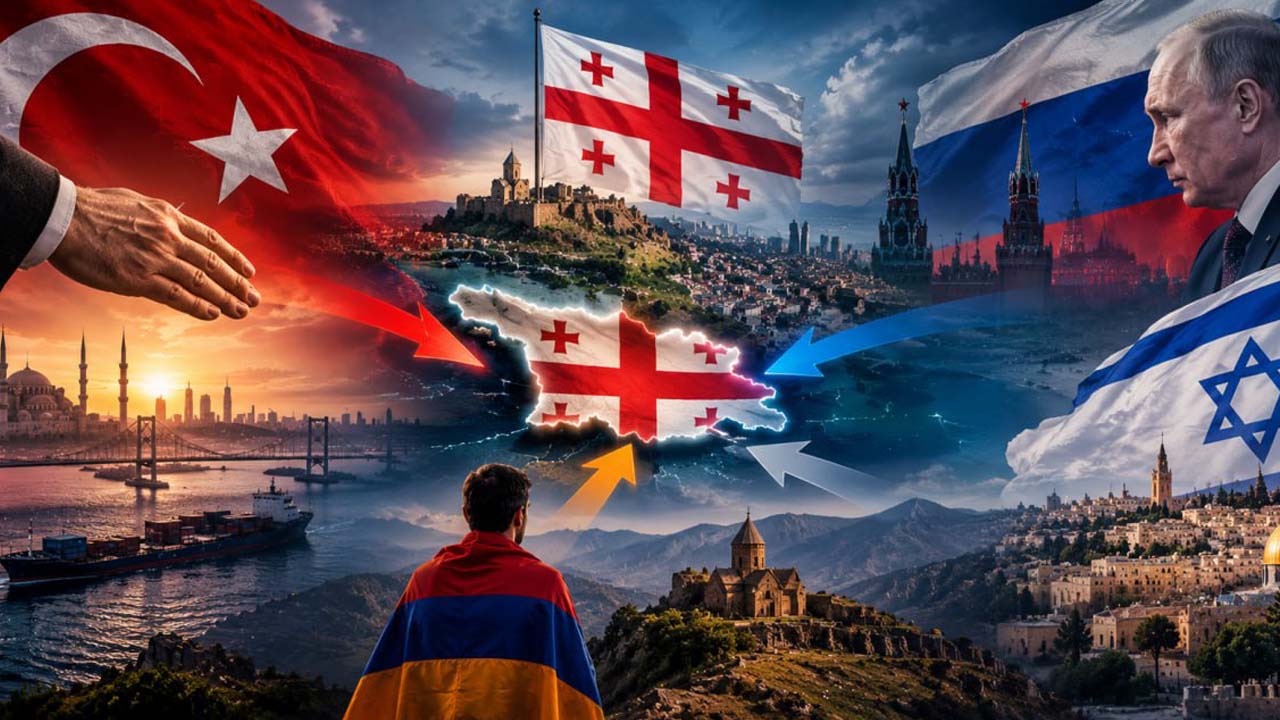
ARVAK Center comment, September 26, 2026 [1]
1. The Tbilisi incident and Turkish expansion in Adjara
Following the diplomatic incident during the Tbilisi meeting between the Interior Ministers of Georgia and Turkey – Sulkhan Tamazashvili and Mustafa Çiftçi – it is logical to expect the Georgian authorities to begin reassessing the nature of bilateral ties with Ankara or, at the very least, to demonstrate to their Turkish partners their readiness to take such a step.
In its comment of September 17, 2026, entitled “The Adjara issue amid changes in the regional security architecture”, the ARVAK Center had already provided a detailed assessment of the talks in Tbilisi, during which the head of the Turkish ministry effectively questioned Georgia’s sovereignty over Adjara. Although the parties attempted at the official level to conceal the demarche that had occurred, media reports about the conflict significantly stirred Tbilisi’s socio-political environment, once again raising acute questions about the Islamization and Turkification of Adjara and intensifying concerns regarding Ankara’s broader expansionist policy in Georgia.
Although the Georgian authorities refrain from making open public statements condemning the actions and rhetoric of Turkey’s top leadership, they are sending Ankara unequivocal, albeit veiled, signals. These messages clearly demonstrate Tbilisi’s deep concern over the development of the situation and the current state of bilateral relations.
2. The “Armenian factor”: An unprecedented signal from Tbilisi to Ankara
An example of such indirect reaction was the television debate of September 14, 2026, during which Georgian Prime Minister Irakli Kobakhidze addressed the issue of the Armenian Genocide. He stressed that the relevance of international recognition of the mass crimes committed in the Ottoman Empire as a crime against humanity remains regardless of the current Armenian leadership’s desire to normalize dialogue with Ankara. In a discussion with Paata Zakareishvili, representing the pro-European Republican Party of Georgia, Kobakhidze specifically stated: “Armenians have not healed the pain of the Genocide, and the process of its recognition does not depend on the position and plans of the current Armenian authorities”.
Since gaining independence, Georgia’s official authorities have displayed extreme caution in assessing the tragic events of a century ago in the Ottoman Empire. In this context, Irakli Kobakhidze’s statement represents an unprecedented step in the country’s political history. Until now, Tbilisi had refrained from state recognition of the Armenian Genocide, strictly limiting commemorative events and public initiatives related to the issue to the framework of the Armenian community. For Georgia, the Armenian Genocide issue has always remained exceptionally sensitive, as it is closely intertwined with relations with both Turkey and Azerbaijan – a state that, no less and at times even more actively than Ankara, promotes a policy of denying the documented facts of this national tragedy of the Armenian people. Historically, the position rejecting recognition of the Armenian Genocide was one of the few consensual areas of Georgia’s foreign policy, uniting the authorities and the systemic opposition despite their sharp disagreements over the country’s political system and foreign-policy orientation. Such agreement underscored that, regardless of geopolitical circumstances and Tbilisi’s orientations toward major global centers of power, maintaining good-neighborly relations with Turkey was consistently regarded by Georgian elites as a key priority and a basic guarantee of security in the unstable South Caucasus and Black Sea basin.
Against this background, the resonant public statements by Prime Minister Irakli Kobakhidze – although without directly mentioning Turkey, but with a clear emphasis on its responsibility for the Armenian Genocide – became a sensation on the country’s domestic political scene. This indicates that Tbilisi is compelled to develop a set of deterrent measures aimed at neutralizing the growing pressure from Ankara and compelling it to adopt a more restrained course. Given the high sensitivity of this issue for the Turkish side, the “Armenian question” is viewed by the Georgian leadership as an effective lever of influence.
Thus, the Georgian leadership is demonstrating a readiness to depart from its longstanding distancing and join international calls for a final and unequivocal qualification of the tragic events of the past, a legal assessment of the crime, and compelling Turkey to fulfill the obligations arising from such a step. At the same time, Georgia has every reason to consider itself an interested party, given that a significant proportion of its Armenian, Yazidi, and Greek communities consists of descendants of refugees who escaped persecution in the Ottoman Empire.
Some Armenian analysts have suggested that, through this unexpected demarche, the prime minister expressed Tbilisi’s desire to “drive a wedge” into the barely recovering Armenian-Turkish dialogue. However, this interpretation of the Georgian side’s motives appears rather superficial – especially in light of Irakli Kobakhidze’s own clarification about the need to distinguish Nikol Pashinyan’s policy from the process of international recognition of the Armenian Genocide. In our view, the key aspect lies elsewhere – namely, in the context of the complicated dynamics of Turkish-Israeli relations. Referring to the ongoing campaign for the international qualification of the Armenian Genocide in the Ottoman Empire, the Georgian prime minister probably had in mind the demarche by the Israeli leadership, which on June 28, 2026 unanimously approved recognition of this large-scale crime and submitted the initiative to the Knesset for legislative force. Since no similar steps have recently been taken by other states, Kobakhidze’s statements were directly addressed to Tel Aviv. Although such a scenario remains highly uncertain, articulating the very possibility of such a geopolitical configuration could provide Tbilisi with additional leverage to counter Turkish pressure. I. Kobakhidze’s signal to Ankara may indicate not so much hypothetical Georgian-Israeli coordination around the Armenian Genocide issue (the relevant bill formally remains on the Knesset agenda, and its further fate will be determined following the autumn parliamentary elections) as Georgia’s readiness to scale up and deepen its partnership with Tel Aviv. In such a configuration, the Armenian issue serves as a catalyst for a process that could hypothetically lead to a shift in Israel’s regional orientation away from reliance on an alliance with Azerbaijan toward more active engagement with Georgia and Armenia.
3. The Israeli vector and the search for regional counterweights
In Tbilisi, there is an awareness that amid the escalation of Turkish-Israeli contradictions, Tel Aviv is interested in finding local allies and forming a regional bloc capable of containing Ankara’s expansion in an area that Israel has traditionally regarded as within its vital interests. Apparently, the Georgian authorities intend to use this counterweight: if the administration of R. T. Erdoğan continues to exert pressure on Georgia’s sovereignty, Tbilisi is prepared to make it clear to Ankara that it reserves the right to support Israel’s foreign-policy initiatives.
4. Reassessing anti-Russian discourse: The Russian Federation as a factor of survival
As another response to Turkey’s actions, the Georgian authorities are intensifying discourse about the need to reassess Russia’s role in the South Caucasus and reevaluate the degree of its responsibility for Tbilisi’s loss of control over Abkhazia and South Ossetia. During a televised debate among representatives of political forces on Rustavi 2 TV channel, Prime Minister Irakli Kobakhidze addressed Georgian-Russian relations. He stressed that it is improper to attribute all of Tbilisi’s problems exclusively to the Russian factor and pointed out that the Russophobia being comprehensively imposed from outside prevents Georgian society from adequately assessing the geopolitical processes surrounding the country.
According to Kobakhidze, the anti-Russian wave being imposed must be “nipped in the bud”, since it carries political and economic risks. Earlier, the head of government had also stated that the artificially provoked growth of anti-Russian sentiment represents a major threat to the country’s independence, behind which stand the opposition and the “deep state”. The prime minister directly linked this “dangerous process” to Tbilisi’s refusal to open a “second front” against Russia after 2022, despite Western incitement.
Obviously, the Georgian leadership is not yet prepared to initiate a full-scale restoration of relations with Russia. This is hindered, on the one hand, by intensified political pressure from the West on Tbilisi and, on the other, by Turkey’s openly expansionist ambitions. The key determinant of Georgia’s foreign-policy course remains the issue of Abkhazia and South Ossetia. I. Kobakhidze confirmed this in his interview of August 11, 2026, stating unequivocally: “Georgia will not restore diplomatic relations with Russia as long as Moscow recognizes the independence of Abkhazia and South Ossetia”.
Under circumstances in which the majority of Georgian politicians and citizens regard these territories as occupied, it is extremely difficult for the government to explain to society the necessity of normalizing dialogue with Moscow – a step dictated by the extremely dangerous geopolitical situation surrounding the republic. Nevertheless, the ruling Georgian Dream–Democratic Georgia Party does not intend to accept this state of affairs. Tbilisi is aware that Western-fueled Russophobia imposes on the state an irrational and total rejection of the Russian Federation – a power which, under current circumstances, is the only one capable of preserving the fragile balance of regional security. The Georgian authorities reasonably believe that over the two decades during which anti-Russian sentiments were cultivated in the country, the external beneficiaries of this process systematically prepared conditions for pursuing their own ambitious designs, including those involving encroachments on the sovereignty and territorial integrity of the republic.
Avoiding alarmist methods of “awakening” the population, the Georgian authorities are acting cautiously while expressing a clear position: the country’s political climate needs to be reformatted, and key risks reassessed. Under the prevailing circumstances, the threat from Russia is no longer perceived by Tbilisi as the principal or existential one. According to the republic’s leadership, eliminating anti-Russian manifestations in the social and political spheres is a primary and unequivocal step toward establishing a new format of dialogue with Moscow.
Despite the baggage of mutual grievances and unresolved disputes, it is Russia, in the view of the Georgian authorities, that remains the only real factor capable of countering the expansion of the Turkish-Azerbaijani duo in the South Caucasus, which enjoys Western support. Thus, normalization of ties with the Russian Federation has transformed for Georgia from a matter of free choice into a condition of survival. This necessity is driven both by external pressure from Ankara and by destabilizing internal processes initiated by ultra-liberal circles, which Irakli Kobakhidze has linked to the activities of the “deep state”.
Almost 20 years after the failed attempt to resolve the South Ossetian conflict by force, Tbilisi once again finds itself facing extremely serious risks of destabilization and threats to its sovereignty. However, the key challenge under current circumstances is no longer forming on the northern border. Georgia is compelled to adapt to a reconfigured geostrategic environment caused by Turkey’s active promotion of its interests in the South Caucasus and Azerbaijan’s assistance in these efforts. Amid Yerevan’s geopolitical turn toward the West and Ankara, the northern vector is becoming Tbilisi’s only fundamental support. This enables the Georgian state not only to balance the regional security architecture and defend national independence, but also to protect its distinctive spiritual and cultural identity, the preservation of which the country’s current leadership has elevated to the rank of a major priority.
5. Conclusion: Georgia’s geopolitical choice amid the new security architecture
Since coming to power in autumn 2012, the Georgian Dream–Democratic Georgia Party has constantly faced accusations of a pro-Russian orientation and a covert desire to normalize relations with Moscow. To refute these accusations, the party was compelled not only to employ tough rhetoric but also to take concrete practical steps demonstrating rejection of the Russian Federation’s “occupation policy” and commitment to the pro-Western course established as early as the “Rose Revolution”.
Nevertheless, accusations of cooperation with Moscow, previously promoted by the West and Georgian ultra-liberals, may acquire quite concrete substance under today’s circumstances. The current Tbilisi leadership is apparently already examining options for geopolitical interaction with Russia, as well as for establishing new ties with Israel. All three sides are similarly uninterested in the expansion of Turkish neo-Ottomanism and at the same time demonstrate a restrained or strained attitude toward the offensive policy of Western liberalism.
[1] The original (in Rus.) was posted on our website on 25.09.2026.