
Publication
The economy of modern warfare: Balancing mass production, cheap weapons, and Armenia’s defense strategy

T. Harutyunyan[1]
Introduction: the macroeconomics of asymmetric attrition
In contemporary military theory, the economic dimension of state-on-state conflict is undergoing a fundamental structural transformation. For nearly a century, the core metric of national defense capability was tied to the procurement of capital-intensive, technologically sophisticated flagship platforms, such as multirole supersonic aircraft, advanced main battle tanks, and centralized long-range air defense networks. These systems required immense national investment, prolonged development cycles, and rigid industrial supply chains.
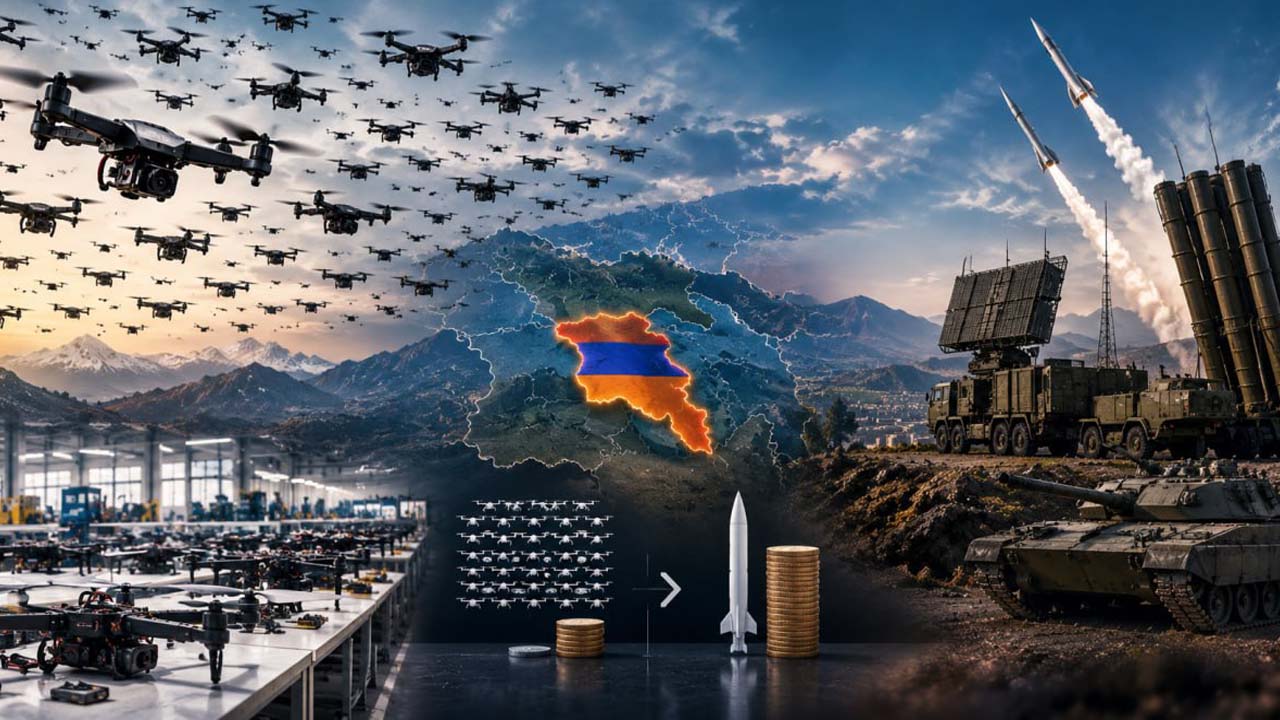
However, the rapid proliferation of low-cost, mass-produced precision effectors, specifically commercial-off-the-shelf (COTS) First-Person View (FPV) strike drones and standardized loitering munitions, has profoundly altered the classic offense-defense balance. Modern interstate conflicts demonstrate that technological complexity no longer guarantees strategic sustainability; instead, the primary metric of military endurance has shifted to the cost-exchange ratio of individual tactical engagements.
This shift introduces a severe fiscal and inventory vulnerability for defending forces, often referred to as the “attrition trap”. When an offensive actor deploys large swarms of dispensable precision strike assets manufactured for a fraction of traditional military costs, the defending military is forced to counter them using established, premium defensive networks.
The mathematical realities of these engagements are economically unsustainable for long-term state survival. For instance, utilizing a modern medium-range surface-to-air missile (SAM) like the Indian-supplied Akash (valued at approximately $500,000 per interceptor) or a short-range point-defense asset such as the French Mistral missile (valued at roughly $550,000 per launch) to neutralize an incoming loitering munition generates a catastrophic cost-exchange asymmetry [1], [2].
This economic imbalance is catalyzed by specific hardware lines designed to exploit premium networks. Offensive forces increasingly deploy specialized uncrewed platforms, ranging from tactical anti-radiation loitering munitions like the Israeli-designed IAI Orbiter-1K and Elbit Skystriker to high-volume, long-range one-way attack assets such as the Iranian-designed Shahed-136 or the Turkish Baykar Sivrisinek. These systems force defenders to exhaust highly complex ammunition reserves faster than global defense supply chains can replenish them, culminating in the strategic phenomenon of “magazine starvation” [3].
Attack/defense comparison
| Attack effector: $20,000 – $100,000 (Orbiter-1K / Shahed-136 / Sivrisinek / FPV Assets) | |
| Military Platforms | Infrastructure nodes |
| Main battle tanks ($6M+) | Dual-purpose power grids |
| Layered air defense radars[2] | Civilian/military logistics hubs |
| Self-propelled artillery | Fuel & supply warehouses |
| Defender defense: $500,000+ per interceptor unit (Akash / Mistral Missile Depletion) |
|
Crucially, the operational scope of these affordable precision weapons has expanded beyond traditional military assets. While they effectively target expensive main battle tanks, air defense radar systems, anti-aircraft batteries, and self-propelled guns, their primary strategic utility lies in the systematic degradation of broader state infrastructure. Affordable unmanned systems are routinely directed against dual-purpose and strict civilian infrastructure, including electrical power grids, fuel storage reservoirs, transport links, communication hubs, automated data centers, and regional logistics nodes. By disrupting the civilian economic foundation, an attacker can induce systemic domestic paralysis at a minimal financial investment.
The paradigm-shifting nature of this asymmetric warfare is anchored in three distinct modern theaters:
- The 2020 Artsakh War: This conflict served as a primary indicator of modern technological asymmetry, where the extensive deployment of loitering munitions (such as the Harop and Orbiter-1K) systematically suppressed conventional Armenian air defense grids and armored columns, demonstrating how unmanned assets can isolate a mountainous theater [4].
- The Russian-Ukrainian War: This theater transitioned the concept of affordable mass into a permanent state of industrial attrition. The widespread utilization of thousand-dollar FPV drones and massed Shahed-136 swarms has targeted not only frontline armored capabilities but also systematically dismantled Ukraine’s national energy grid and grain logistics hubs, forcing the expenditure of multi-million-dollar Western air defense interceptors (such as Patriot or NASAMS units).
- Recent regional conflicts involving Iran (including the 2025 Twelve-Day War and the 2026 Iran War): These operations demonstrated the strategic application of “affordable mass” on a regional scale. During these campaigns, high-volume drone salvos directly targeted critical Western and regional infrastructure across the Persian Gulf and the Levant, including military command installations, commercial airports, port facilities, and vital maritime logistics corridors, proving that cheap uncrewed assets can challenge strategic international choke points [5][3].
For small states navigating strict gross domestic product (GDP) limitations and severe regional security threats, attempting to match peer adversaries in a conventional, platform-centric procurement race is a prescription for economic and operational exhaustion. To maintain airspace and territorial sovereignty, such nations must restructure their defense procurement philosophy and industrial base. This paper examines the systemic economic imbalances of modern precision warfare and outlines a strategic, distributed, and cost-symmetrical defense blueprint tailored specifically for the Armed Forces and the Military-Industrial Complex (MIC) of the Republic of Armenia.
Section II: The platform dilemma: Air defense and armor under asymmetric attrition
The architectural vulnerability of modern defense budgets is most visible in two primary domains of conventional warfare: layered ground-based air defense (GBAD)[4] and heavy armored vehicles. Both domains rely on highly concentrated, capital-intensive, and difficult-to-replace assets. Quantitative assessments of recent conflicts demonstrate that when these premium networks encounter high-volume, low-cost precision effectors, the defender faces an unsustainable cost-exchange deficit that triggers systemic operational failure.
The ground-based air defense attrition loop
Traditional ground-based air defense systems are engineered to counter a finite number of high-value targets, assuming that the cost of an interceptor missile is justified by the preservation of the asset it protects. Massed loitering munition swarms weaponize this economic logic to achieve strategic exhaustion.
During the Russian-Ukrainian War, this asymmetry was codified into an industrial-scale strategy. Offensive forces systematically deployed the Iranian-designed Shahed-136 (and its locally assembled variant, the Geran series), manufactured at an estimated unit cost of $20,000 to $150,000. These platforms were programmed to fly at low altitudes, with vectors close to the terrain, specifically targeting Ukraine’s integrated energy system, in particular by striking 750 kV high-voltage substations and thermal power plants.
To prevent systemic domestic paralysis, defending forces were compelled to engage these low-RCS targets with premium surface-to-air missile (SAM) networks [6].
- The cost-exchange asymmetry: Utilizing a NASAMS[5] / AMRAAM[6] interceptor (approx. $1,000,000 to $2,000,000 per missile) or an Iris-T SL[7] missile (approx. $270,000 to $600,000 per launch) to down a single $35,000 drone yields a catastrophic cost-exchange deficit.
- Quantitative attrition: Academic econometric modeling of these engagements establishes a profound ~200:1 cost-exchange ratio disadvantaging the defender when premium strategic systems like the Patriot are exhausted against massed drone salvos.
This dynamic was mirrored on a strategic level during recent regional conflicts involving Iran. In the retaliatory saturation campaigns, the Islamic Revolutionary Guard Corps Aerospace Force (IRGC-ASF) deployed hundreds of Shahed-136 and jet-powered Shahed-238[8] platforms to overwhelm layered theater air defenses. The high volume of affordable threats exploited a fundamental structural vulnerability: the financial and temporal cost of specialized missile manufacturing is exponentially higher than the assembly of composite uncrewed airframes. When defenders are forced to expend multi-million-dollar interceptors to protect naval logistics nodes or energy infrastructure, they fall into the “attrition trap”, rapidly inducing “magazine starvation” and leaving the airspace open to heavier tactical ballistic strikes.
The economic obsolescence of concentrated armor
A parallel economic crisis has emerged in the ground domain, where the main battle tank (MBT) and heavy infantry fighting vehicles (IFVs) have lost their monopoly on tactical maneuver. The widespread deployment of First-Person View (FPV) kamikaze drones, costing between $400 and $1,000 per unit, has inverted the economics of armored warfare.
In the 2020 Artsakh War, the preliminary phase of this transformation was executed via high-tier loitering munitions. The Azerbaijani military deployed the Israeli-manufactured IAI Harop anti-radiation drone (unit cost approx. $700,000) alongside Orbiter-1K (unit cost approx. $115,000), and SkyStriker (unit cost approx. $110,000) assets. These platforms were utilized to execute a systematic suppression of Armenian air defenses campaign, hunting down Osa-AK, S-300PS, and Tor-M2KM radar arrays before shifting to the destruction of stationary Armenian T-72 tanks and armored columns. The cost-to-kill ratio in this theater was estimated at 1:20 to 1:50, completely invalidating conventional armored density in mountain defiles.
By 2025–2026, the industrialization of the Russian-Ukrainian War lowered these costs even further through the deployment of thousands of tactical FPV quadcopters daily. Armed with modified RPG-7 shaped-charge or tandem warheads, these ultra-low-cost assets utilize real-time video transmission to strike the most vulnerable structural zones of armored vehicles, specifically the thin top-armor plating, rear engine grates, and turret rings [7].
Tactical cost-exchange matrix (2020–2026)
| Conflict theater | Offensive effector (cost) | Target platform (value) | Cost-to-kill ratio |
| 2020 Artsakh War | Orbiter 1K / IAI Harop ($115, ooo to $700,000) | T-72B ($1,500,000) / Tor-M2KM ($25,000,000) | 1:10 to 1:250 |
| Ukraine War | Shahed-136 / Geran-series ($20,000 to $150,000), Standard FPV quadcopter ($400 to $1000) | NASAMS / Patriot / Iris-T intercept ($270,000 to $2,000,000),
T-64/T-72 ($1,000,000 to $1,500,000) |
1:13 to 1:2000 |
| 2025 Twelve-Day War / 2026 Iran War | Shahed-136 / Shahed-238 ($20,000 to $300,000) | NASAMS / Patriot intercept, Regional port & power infrastructure, / AN/TPY-2 Radar ($1,000,000 to $500,000,000) | 1:50 to 1:16,000 |
The resulting Return-on-Investment (ROI)[9] calculations are unprecedented in modern military history:
- The Return-on-Investment Ratio: Verified battlefield data confirms that a successful strike by a $400 Ukrainian FPV drone against a modern Russian T-90M main battle tank (valued at $4.5 million) generates a dynamic cost-exchange ratio of approximately 1:11,250.
- Systemic attrition: Aggregate statistical modeling across multiple combat sectors places the broader return-on-investment ratios for FPV deployment between 2,000:1 and 250,000:1, depending on the target configuration (ranging from logistical soft-skinned supply trucks to state-of-the-art self-propelled artillery systems and $30 million early-warning radar installations).
The tactical consequences of this shift are profound. Armored formations can no longer mass for offensive maneuvers without being detected by omnipresent reconnaissance UAVs and systematically disassembled by waves of low-cost kamikaze drones. Defensive additions, such as heavy steel anti-drone cages, degrade the vehicle’s power-to-weight ratio and limit mobility while failing to protect against synchronized, multi-angle drone strikes or newer autonomous fiber-optic-guided variants that are invulnerable to most electronic warfare suppression means.
For small states with restricted defense budgets, this asymmetry represents a structural vulnerability. Investing a large percentage of national capital into a small number of heavy, concentrated platforms creates fragile defense architecture. A single massed drone attack can instantly wipe out a nation’s conventional combat power, making a transition toward a distributed, low-cost, and highly scalable force structure an operational and fiscal necessity [8], [9].
Section III: Armenia’s strategic procurement and budgetary challenges
For the Republic of Armenia, the structural change in modern military economics is not a theoretical debate, but an urgent challenge in defense procurement. Operating within a severely constrained gross domestic product (GDP) and facing partner states with significant defense budgets, Yerevan cannot win the traditional, platform-centric arms race. Trying to match the competitor’s resources by purchasing complex, indispensable high-end weapons systems risks financial and operational exhaustion.
The financial realities of the Defense budget and post-2018 trajectory
Armenia’s military expenditures must be evaluated against the strict macroeconomics of its national budget. Since 2018, the country’s defense spending has expanded unprecedentedly, rising from 245 billion drams (approximately $640 million) in 2018 to a peak of 667 billion drams (approximately $1.74 billion) in 2025. Reports indicate that capital expenditures explicitly dedicated to procuring new armaments and infrastructure rose 5.4 times during 2022–2025 compared with the preceding two decades, shifting a large share of the national budget toward direct hardware acquisitions [10].
During this post-2018 modernization drive, Armenia diversified its defense supply chain away from its historical reliance on a single supplier toward partnerships with up to seven countries, notably India and France. Major hardware allocations since 2018 have included:
- Air Defense and Sensors: Indian Akash-1 surface-to-air missile systems (including contracts for up to 400 missiles), French Thales Ground Master 200 (GM200) mobile radar networks, and Mistral SHORAD.
- Artillery Systems: French CAESAR 155mm self-propelled howitzers (36 units contracted in 2024) and Indian MArG 155mm self-propelled howitzers, Pinaka 214mm MBRL’s.
- Tactical Mobility and Armor: French Bastion armored vehicles and Indian Konkurs-M anti-tank guided missiles (ATGMs).
Despite the temporary 15% fiscal contraction scheduled for the 2026 defense budget (dropping to 563 billion drams or $1.47 billion due to the early repayment of strategic defense obligations), the absolute volume of capital dedicated to arms contracts remains elevated. The core structural risk, however, is that an overly centralized reliance on these premium systems exposes the state to severe fiscal shocks if these non-replaceable assets are neutralized by cheap, disposable threat lines.
The risk of status-symbol procurement
The deployment history of certain legacy systems highlights the mismatch between conventional prestige platforms and the realities of modern attrition warfare. The acquisition of heavy multirole fighter jets, like the Sukhoi Su-30SM, represents a significant capital investment that yields limited tactical returns in a highly contested, low-altitude drone environment. In the confined airspace of the South Caucasus, these high-value aircraft are restricted by dense, overlapping ground-based SAM networks operated from deep within neighboring territories. Consequently, they are often too valuable and vulnerable to risk in localized tactical engagements, transforming an expensive asset into an operational liability that requires protection rather than projecting power.
Similarly, relying solely on heavy, centralized rocket artillery systems, such as the BM-30 Smerch, introduces severe logistical vulnerabilities. These large, slow-moving launch vehicles feature massive thermal and radar signatures, making them easily detectable by modern high-altitude long-endurance (HALE) reconnaissance UAVs. Once tracked, these non-attritable platforms can be neutralized by low-cost kamikaze drone swarms long before they can execute their firing missions or displace to safety.
Refining the procurement matrix: Expanding asymmetric sovereignty
Crucially, addressing these vulnerabilities does not imply a radical rejection of current procurement logic. High-tier conventional acquisitions cannot be completely abandoned, especially in the case of heavy tube artillery, long-range rocket artillery, and layered ground-based air defense (GBAD), as their tactical role continues to remain highly important and irreplaceable for counter-battery fire, structural area denial, and suppressing high-altitude threats. Rather than overturning this foundation, the proposed framework argues for a strategic adjustment and expansion of the procurement matrix by shifting a calculated volume of capital toward the domestic military-industrial complex to build mass-production capacities for affordable, sovereign weapons:
- Establishing domestic mass-production capacities (the affordable volume expansion): Using the 171 billion drams (approximately $450 million) invested in the domestic military-industrial complex in 2023-2025 and the 150 billion drams (approximately $400 million) planned for 2026-2028, the state has already begun to transition from low-volume engineering production to high-speed industrial production [11]. Open sources lack information on the range and volume of domestic production, but unofficial information presented in the press and at various exhibitions suggests that it is still too early to talk about high-speed industrial production. The goal of the policy and budget reassessment is to rapidly expand the volume and range of domestically produced cost-effective consumables. This includes the creation of automated assembly lines for standardized modular unmanned aerial vehicles, such as HRESH homing munitions and DDS-10K hunting devices, gyro-stabilized optical-electronic stations (OES) with edge artificial intelligence target recognition, and low-cost guided munitions, such as Dev-50/GSA-155 glide bombs and aerial mortar mines. Furthermore, using the existing small arms repair and assembly infrastructure, MIC has the fundamental capabilities to create new production lines for lightweight 12.7 mm aircraft cannon shells to arm secondary levels locally.
- Strategic complementary foreign procurement (the aerial second echelon): To insulate expensive heavy artillery and SAM batteries from low-altitude attrition, the state should expand its foreign procurement to include a dedicated second echelon of air defense. As proposed previously, this entails the acquisition of light turboprop airframes (such as the Embraer A-29 Super Tucano or KAI KT-1C) and modified Yak-52 to act as mobile, low-cost airborne interceptors and sensors [12], [13], [14]. These assets would work alongside imported heavy CAESAR howitzers and Thales GM200 radar arrays, neutralizing low-tier drone threats before they can exhaust the main defense systems.
Under this refined concept, the fiscal costs to the military budget will be highly optimized. Instead of funding additional non-replaceable prestige systems, capital is routed into high-volume domestic manufacturing lines, establishing an internal economic multiplier. By scaling up the production of local drone components and ammunition, and integrating them with affordable light aviation platforms operating at under $1,000 per hour, Armenia can dramatically lower its overall battlefield cost-per-intercept while preserving its vital conventional artillery and air defense capabilities.
Section IV: Structural recommendations for the armed forces and MIC of Armenia
To address the financial and material imbalances noted in the previous sections, the Republic of Armenia must implement a coordinated, two-way structural shift between its military commands and its domestic production base. This reorganization aims to shift from a centralized, vulnerable defensive posture to a resilient, distributed system that can impose symmetrical financial attrition on an attacking force.
-
Tactical and operational realignment of the Armed Forces
The Armenian Armed Forces must decouple their tactical doctrine from legacy, high-signature systems and transition toward low-visibility, network-centric operations.
- Asymmetric airpower balancing strategy: The Republic of Armenia possesses a critically limited conventional air force, while its potential state adversaries are aggressively expanding their fleets of advanced multirole fighter jets and long-range, multifunctional reconnaissance and strike UAVs. Armenia cannot realistically bridge this gap through symmetrical procurement. Instead, the tactical role assigned to Armenian aviation must be redefined: manned and uncrewed aviation must function strictly as an integrated, low-altitude mobile element of the domestic air defense grid. By combining a secondary air defense echelon of rugged, low-cost turboprops or upgraded trainers acting as drone hunters with massed swarms of localized FPV interceptors and decentralized mobile SAM networks, Armenia can achieve defensive parity. This network-centric aviation model aims not to win traditional air superiority, but to deny the adversary the ability to safely exploit the lower airspace, effectively neutralizing their multi-billion-dollar aerial investment [15].
- Distributed mortar artillery and FPV teams: Rather than relying heavily on centralized rocket artillery like the BM-30 Smerch, which is easily tracked by high-altitude reconnaissance UAVs, the military should field hundreds of mobile, cross-trained tactical cells. Equipping light, highly mobile infantry units with standard 82mm or 120mm mortars alongside short-range FPV strike drones creates a highly survivable, low-signature artillery alternative. These units can operate independently, executing precise hit-and-run strikes on enemy forward positions while presenting a negligible thermal and radar cross-section.
- Low-signature camouflage and deception frameworks: Survival on the transparent battlefield requires absolute visual and infrared discipline. The Armed Forces must implement mandatory, widespread deployment of multi-spectral camouflage nets designed to mask the thermal and electromagnetic signatures of stationary assets. Concurrently, the military should invest heavily in high-fidelity, low-cost inflatable and wooden decoys that mimic high-value targets (such as radar dishes or artillery pieces), forcing the adversary to expend their expensive loitering munitions on valueless targets.
The issue of individual protection and invisibility of military personnel should also be in the spotlight. Local manufacturers can produce thermal signature-masking uniforms and other means.
-
Strategic roadmap for the Armenian MIC
The state must aggressively fund and steer the domestic MIC to prioritize scalability, technological sovereignty, and automated battlefield synchronization.
- Beyond visual line of sight (BVLOS) algorithmic identification: The contemporary battlefield exhibits an intense proliferation of tactical UAVs deployed against massed formations and individual military personnel in rapidly changing combat situations. When operating weapon systems beyond visual line of sight (BVLOS), the risk of fratricide and target misidentification rises exponentially. To mitigate this, the Armenian MIC must prioritize the development of automated, edge-AI target scanning and Identification Friend or Foe (IFF) algorithmic nodes [16]. By embedding light, neural-network-driven computer vision models directly into the software loop of local optical payloads, the system can automatically classify targets (e.g., personnel silhouettes, distinct camouflage patterns, or specific equipment profiles) and cross-reference them with encrypted geolocation tracking data of friendly forces. This allows automated fire-control networks to safely execute strikes at machine-speed far beyond the operator’s direct line of sight.
- Expansion of ground robotic assets (UGVs): Beyond aerial platforms, achieving true logistical and tactical resilience requires the immediate expansion of the range, volume, and mass production of ground robotic assets (Unmanned Ground Vehicles – UGVs). The domestic MIC must establish production lines for specialized multi-mission robotic ground platforms tailored for alpine topography, focusing on[10]:
- Logistical cargo carriers and medical transporters: Automated mule-type UGVs to transport ammunition and supplies to high-altitude mountain posts and safely evacuate wounded personnel without exposing soft-skinned transport vehicles to FPV strikes.
- Autonomous minelayers: Remote-controlled ground units capable of rapidly deploying defensive minefields across exposed border paths during dynamic tactical breakthroughs.
- Mobile combat and fire-control: Low-profile tracked or wheeled units armed with remote-controlled machine guns or anti-tank guided missiles (ATGMs) to hold defensive choke points without risking infantry lives.
- Communication repeaters and electronic warfare nodes: Mobile UGV platforms equipped with EW stations[11] and localized signal repeaters, extending the command mesh deep into mountain canyons while actively spoofing enemy drone guidance frequencies. In modern warfare, electromagnetic or HPM weapons are also effective[12], and UGVs armed with them can close shadow zones for hostile low-flying drones in mountainous terrain.
- Hyper-scalable, standardized drone assembly lines: The Armenian government must transition the domestic drone sector from low-volume, boutique engineering into standardized, high-throughput mass production. The MIC should focus on producing one or two modular, open-architecture drones that can be rapidly configured for reconnaissance, FPV kinetic strike, or signal-transmission missions. Production must utilize non-restricted, commercially available off-the-shelf components wherever possible to ensure that international sanctions or supply-chain bottlenecks cannot halt assembly lines [17].
Section V: Conclusion
The macroeconomics of contemporary state-on-state conflict have permanently devalued conventional, prestige-heavy military architectures. In high-intensity wars of attrition, a nation’s security is no longer determined by the raw speed of its supersonic fighter jets or the concentrated armor thickness of its heavy vehicles, but by the financial, logistical, and structural scalability of its industrial defense base. Attempting to maintain an archaic, platform-heavy force structure under tight GDP constraints creates extreme strategic fragility, one that can be systematically exploited by mass-produced, low-cost precision effectors.
For the Republic of Armenia, adapting to the economics of asymmetric defense is an existential imperative, yet it does not require a reckless abandonment of premium conventional procurement logic. The critical tactical roles of heavy tube artillery, long-range rocket systems, and layered ground-based air defense remain highly important and irreplaceable for counter-battery fire and structural area denial. Rather than attempting a total doctrinal overhaul, Armenia’s strategic blueprint must focus on smart, calculated adjustments: expanding the volume and assortment of affordable, locally produced weapons, and aggressively establishing domestic production capacities for their high-throughput mass production.
Ultimately, long-term state survival in the modern era belongs to the side that can achieve the lowest cost-per-intercept and maintain a resilient, highly distributed industrial ledger. By integrating edge-AI automated target identification to secure operations beyond visual line of sight, expanding the range of ground robotic platforms to preserve infantry capital, and deploying an aerial second echelon of light turboprops, Yerevan can effectively neutralize the material and financial advantages of its peer adversaries. Airspace and territorial sovereignty are no longer bought with prestige platforms, they are sustained through mass, cost-symmetrical efficiency, and structural endurance.
[1] PhD, worked at the “Noravank” Foundation as a Deputy Director; at the Public Administration Academy of Armenia as a Head of the Center for the Regional Studies; researcher at the Institute for Armenian Studies (Yerevan State University), and at the “Enterprise Incubator Foundation” as a Program Coordinator. Specialized in science and higher education management and regional security issues.
[2] Air and missile defense radar unit costs vary drastically by layer, ranging from roughly $180 million to over $500 million for strategic upper tiers, down to tens of thousands of dollars for tactical counter-drone systems. The unit cost of a Thales GM200 air defense radar ranges from roughly $16 million to $33 million. AN/TPY-2 Radar (THAAD System): Costs between $220 million and $500 million per standalone radar unit (with total battery packages running up to $1 billion).
[3] Because the active phase of operations concluded recently, comprehensive international audits are still ongoing. However, according to preliminary assessments from regional governments, defense think tanks, and maritime insurance syndicates (including Lloyd’s), the total direct and indirect damage to civilian and dual-use infrastructure across the Persian Gulf and the Levant is estimated to be between $120 billion and $160 billion.
[4] A layered ground-based air defense (GBAD) system uses a network of overlapping, complementary weapon ranges and sensors from the Earth’s surface to protect an area from diverse aerial threats.
[5] NASAMS (National/Norwegian Advanced Surface-to-Air Missile System) is a highly adaptable, distributed medium-to-short-range ground-based air defense system that serves as a core building block for layered defense networks worldwide.
[6] AMRAAM (Advanced Medium-Range Air-to-Air Missile), designated as the AIM-120, is a radar-guided tactical missile originally built for fighter jets, but now widely adapted as a premier interceptor for ground-based air defense systems like NASAMS.
[7] IRIS-T SL (Infrared Imaging System Tail/Thrust Vector Controlled Surface Launched) is a modular family of ground-based short- to medium-range air defense systems designed by Germany’s Diehl Defence. Developed from the highly agile IRIS-T air-to-air missile, the surface-launched variant serves as a critical component in layered defense networks.
[8] The Shahed-238 is an Iranian jet-powered loitering munition (kamikaze drone) designed as a deep modernization of the propeller-driven Shahed-136. Its most significant upgrade is the integration of a micro-turbojet engine, which drastically alters its flight speed, radar signature, and tactical employment compared to older models.
[9] Return on Investment (ROI) is a fundamental financial metric used to evaluate the efficiency or profitability of an investment. It measures the amount of return on an investment relative to its initial cost.
[10] For example, DAVARO Defence Systems (DAVARO LLC) is an Armenian defense technology company specializing in the design, development, and production of unmanned systems, including both unmanned aerial vehicles (UAVs) and unmanned ground vehicles (UGVs). Specifically, this encompasses logistics platforms, medical transport vehicles, robotic demining systems, and remotely controlled combat modules.
[11] A mobile EW (Electronic Warfare) station is a highly agile, vehicle-mounted, or portable system that detects, analyzes, and disrupts enemy electronic signals. Unlike fixed installations, these units can rapidly deploy, move with tactical forces, and adapt to changing battlefield conditions.
[12] Mobile Electromagnetic Interference (EMI) weapons, more formally known as High-Power Microwave (HPM) systems, Radio Frequency (RF) weapons, or Intentional Electromagnetic Interference (IEMI) devices, are a class of directed-energy weapons (DEWs).
Unlike traditional EW systems that temporarily jam or confuse radio signals, EMI weapons emit intense, highly concentrated pulses of electromagnetic energy designed to physically overload, fry, or permanently destroy electronic components like microprocessors and memory chips.
References
- S. Tiwari, Indian Missiles, Chinese UAVs & Iranian SHORAD: Armenia Showcases Diversified Arsenal Post-Nagorno Karabakh Setback.
The Eurasian Times, 31.05.2026,
https://www.eurasiantimes.com/armenia-showcases-diversified-arsenal/ - France to sell Thales GM 200 radars and Mistral air defense systems to Armenia.
Armenpress, 24.20.2023,
https://armenpress.am/en/article/1122654 - Sh. Shaikh, W. Rumbaugh, The Air and Missile War in Nagorno-Karabakh: Lessons for the Future of Strike and Defense.
Center for Strategic and International Studies, 08.12.2020,
https://www.csis.org/analysis/air-and-missile-war-nagorno-karabakh-lessons-future-strike-and-defense - G. Gressel, Military lessons from Nagorno-Karabakh: Reason for Europe to worry.
European Council on Foreign Relations, 24.11.2020,
https://ecfr.eu/article/military-lessons-from-nagorno-karabakh-reason-for-europe-to-worry/ - A. Burilkov, G.B. Wolff, The costs and failures of air defence in the Iran conflict and what they mean for Europe.
Bruegel, 30.03.2026,
https://www.bruegel.org/first-glance/costs-and-failures-air-defence-iran-conflict-and-what-they-mean-europe - The State of Integrated Air and Missile Defence: How NATO and Its Allies Are Building Full‑Spectrum Air Defence for 2030.
Unmanned Airspace, 20.03.2026,
https://www.unmannedairspace.info/commentary/the-state-of-integrated-air-and-missile-defence-how-nato-and-its-allies-are-building-full-spectrum-air-defence-for-2030/ - The new economics of warfare: Cost asymmetry and structural strain on Western arsenals, EPC Analysis.
European Policy Centre, 09.03.2026,
https://www.epc.eu/publication/the-new-economics-of-warfare/ - Cody, M. A. The End of the Exposed Warfighter–Cost Asymmetry and Attrition Economics in Modern Combat. Preprints 2026, 2026010190.
https://doi.org/10.20944/preprints202601.0190.v1 - The Military Balance 2024.
International Institute for Strategic Studies (IISS), 2024.
https://www.iiss.org/publications/the-military-balance/2024/the-military-balance-2024/ - Armenia’s military spending in 2022-2025 exceeded the previous 20-year figures by 5.4 times: Papikyan.
ARKA News Agency, 25.03.2026,
https://arka.am/en/news/economy/armenia-s-military-spending-in-2022-2025-exceeded-the-previous-20-year-figures-by-5-4-times-papikyan/ - State orders for Armenia’s military-industrial complex reach 170 billion drams.
ARKA News Agency, 16.04.2026,
https://arka.am/en/news/economy/state-orders-for-armenia-s-military-industrial-complex-reach-170-billion-drams-pashinyan/ - Harutyunyan T., Asymmetric skies: Light turboprop aviation as Armenia’s second-line counter-UAS shield.
ARVAK, 14.08.2026,
https://arvak.am/en/asymmetric-skies-light-turboprop-aviation-as-armenias-second-line-counter-uas -shield/ - Embraer to expand A-29 Super Tucano capabilities to counter Unmanned Aerial Systems.
Embraer, 11.11.2025,
https://www.embraer.com/media-center/en/?mediatype=NEWS&detail=23308-Embraer-to-expand-A-29-Super-Tucano-capabilities-to-counter-Unmanned-Aerial-Systems - Newdick, This Is How Ukrainian Yak-52 Crews Hunt Russian Drones.
TWZ, 30.08.2025,
https://www.twz.com/air/this-is-how-ukrainian-yak-52-crews-hunt-russian-drones - Global spending on C-UAS systems reaches more than USD 53 billion in the first eight months of 2026.
Unmanned Airspace, 02.09.2026,
https://www.unmannedairspace.info/counter-uas-systems-and-policies/global-spending-on-c-uas-systems-reaches-more-than-usd53-billion-in-the-first-eight-months-of-2026/ - Harutyunyan T., AI technologies in recent wars and armed conflicts (2010–2026).
, 25.05.2026,
https://arvak.am/en/ai-technologies-in-recent-wars-and-armed-conflicts-2010-2026/ - RISE Powered by Silicon Mountains 2026 showcases Armenia’s defense and tech innovations.
Armenpress, 03.06.2026,
https://armenpress.am/en/article/1251863