
Publication
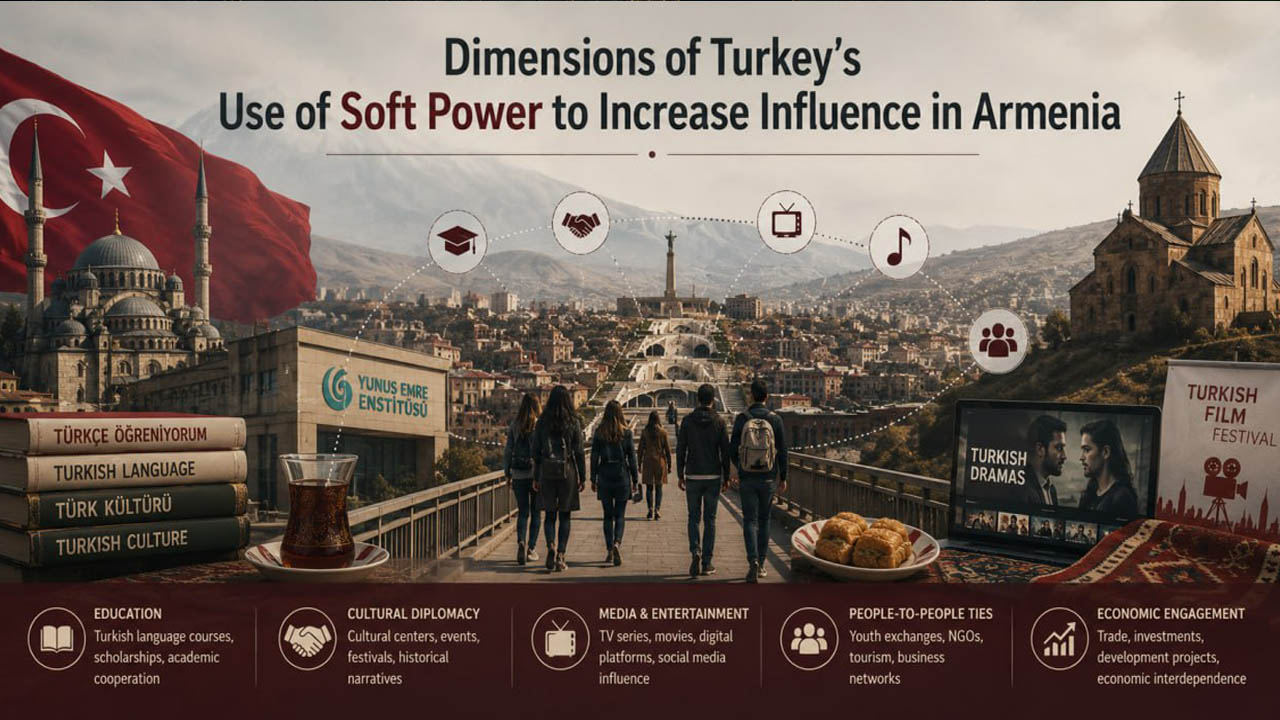
Dimensions of Turkey’s use of soft power to increase influence in Armenia

Dr. Ehsan Movahedian[1]
1. Introduction
Although diplomatic relations between Armenia and Turkey were not established after the collapse of the Soviet Union due to Turkey’s support for Azerbaijan’’s positions and the Turkish government’s objection to Armenian control over Artsakh, various geopolitical and regional developments, the emergence of new realities, problems, and political, security, social, environmental, cultural, and many other challenges directly concerning both countries, and the necessity to overcome them, have created conditions that make contact between the parties inevitable, even without formal relations. In the current geopolitical context and considering Turkey’s expansionist trend in the Caucasus and Central Asia, Turkish authorities have accelerated their efforts to increase influence in Armenia.
Since Armenia’s independence from the Soviet Union in 1991, Armenian and Turkish parties have had various forms of communication and contact at different times. Moreover, it is noteworthy that these contacts have addressed various issues, even at the highest official levels. Armenian Prime Minister Nikol Pashinyan and Turkish President Recep Tayyip Erdoğan have met 4 times in the last 4 years. However, the lack of diplomatic relations has reduced the feasibility and effectiveness of these mutual communications, but it has also created specific opportunities. It seems that in the absence of interstate relations between Armenia and Turkey, the use of public diplomacy and soft power tools has facilitated contact between the parties.
It is worth noting that in the absence of diplomatic relations, the instruments of public diplomacy and soft power between Armenia and Turkey have sometimes been used on Turkey’s initiative, sometimes on Armenia’s initiative, and sometimes on the initiative of a third party interested in normalizing relations between the two countries. It should be explained that in the absence of diplomatic relations, alternative or informal communication channels are necessary to advance public diplomacy. Public diplomacy tools enable a government or any other entity to pursue specific issues and, if possible, resolve them without the need for direct contacts (Gorenc, 2019, p. 912). This is particularly meaningful for the Armenian government, which seeks to establish contacts with Erdoğan’s government without creating excessive sensitivity in society and with minimal tension with opposition political forces opposed to any contact with Turkey.
Among public diplomacy tools, the influence of cultural and informational propaganda is particularly important, as it can be effective not only in the absence of diplomatic relations but also regarding countries and societies that have a clear negative attitude towards each other (Szostek, 2020, pp. 2728–2748). During the First Artsakh War in the 1990s and especially after its end, separate efforts were made to organize contacts between Turkey and Armenia. Given that the two countries had inherited deep historical, identity, and civilizational conflicts and differences, and new challenges arising from the First Artsakh War had been added to these, organizing Armenian-Turkish contacts within the framework of public diplomacy was easier than normalizing relations between the two countries through mediation or initiatives by interested third parties. However, there have also been direct, unmediated initiatives, implemented either through formal initiatives or through the efforts of public organizations and individuals in both countries.
2. Theoretical framework
The aforementioned initiatives can be framed within the theoretical framework of soft power, formulated by Joseph Nye in the 1990s after the collapse of the Soviet Union and first proposed as a scientific theory. According to Nye, soft power is the ability of a power-wielder to achieve its objectives through attraction rather than coercion or financial reward. Nye argues that while there are various ways to achieve a country’s national interests, including the threat of force or power and inducement, promoting global and regional cooperation and striving to increase the attractiveness of American culture, politics, values, and institutions is a suitable way for the U.S. to exercise power in the transitioning era. This is because military power alone cannot maintain cultural and political hegemony for the U.S. (Nye, 2004, p. 7).
In subsequent years, the concept of “smart power” emerged, meaning the simultaneous exploitation of hard military power resources and soft economic, cultural, and political power resources. This aims to use smart power against the target country instead of political-military aggression, which lacks legitimacy and acceptance. Smart power involves influence and impact accompanied by political, economic, and cultural legitimacy. Some of the most important methods of creating smart power include establishing economic and trade agreements and deepening shared interests with opponents and allies, restoring the country’s image in the target country, strengthening or creating regional and international agreements, increasing authority, and using diplomacy and reorganizing economic relations (Crocker, 2007, pp. 11-14).
Experts and scholars of soft power consider the most important objectives of exercising soft power to be: changing the dominant ideology of the target country, reducing people’s political participation and inducing the ineffectiveness of the target country’s government, changing citizens’ religious and national identity by destroying their historical background, manipulating public opinion in line with the power’s demands and against the ruling system, altering political cohesion and weakening national unity, changing societal values and creating cultural transformation, establishing a new culture and changing the dominant political model, and intensifying and strengthening ethnicism (Elyasi, 2010, p. 50).
Soft power experts state that the country implementing these plans and measures must possess high hard and soft power authority in various economic, cultural, political, and military fields. It should be able to advance its goals relying on non-physical methods, through propaganda, influence in media, parties, various non-governmental and professional organizations, and through indoctrination and persuasion (Rafie & Qorbi, 2010, pp. 124-126).
The following will examine how Turkey exercises soft power towards Armenia. It will be observed that Turkey, given the history of animosity among Armenians towards Turkey due to repeated historical wars, the genocide of 1.5 million Armenians at the beginning of the 20th century by the Ottoman Empire, and Turkey’s support for the Republic of Azerbaijan in various wars between Baku and Yerevan over the past three decades, has been unable to advance its desired objectives in Armenia through formal diplomacy. Consequently, it has resorted to public diplomacy and soft power towards this country.
3. Turkey’s efforts to strengthen economic soft power in Armenia
Turkey’s efforts to promote economic relations with Armenia can be divided into two periods: before and after the 2020 Artsakh War. We will examine the developments in both periods below.
3.1. Strengthening Turkey’s economic soft power in Armenia before the 2020 War
In the absence of diplomatic relations between Turkey and Armenia, one of the first instances of institutional contact between the two countries to advance Turkey’s intended public diplomacy in Armenia was the establishment of the “Turkish-Armenian Business Development Council” (TABDC), jointly in both countries. The TABDC was simultaneously founded on May 3, 1997, in Istanbul and Yerevan. From the outset, it aimed to develop cooperation between the economic circles of the two countries, facilitate communication between Turkish and Armenian companies, and establish direct trade links. Its establishment was therefore the result of a private sector and non-governmental initiative. The idea for the council was raised at the Black Sea Economic Cooperation Organization meeting in Istanbul in 1997, aiming to create new trade links. Also, due to the lack of diplomatic relations, the council could not be registered as an official economic council in Turkey, thus having an informal structure. Although there was no direct trade relationship between Armenia and Turkey at the time, the TABDC included businessmen who directly and without mediation discussed several issues related to economic relations between the two countries and proposed initiatives. In subsequent years, several cultural events were also held on the initiative of the TABDC (Çuhadar, 2014).
This action can be described as advancing “Track two diplomacy”, first proposed in 1981 in an article by psychologist William Davidson and former U.S. State Department official Joseph Montville. According to the authors, “Track two diplomacy” contrasts with traditional forms of diplomacy and is conducted through informal and unstructured contacts (Davidson and Montville, 1981–1982, p. 155).
Noyan Soyak, who has been the Vice President of the TABDC since 2000, mentioned in an interview: “When we were taking the first steps to establish this council, finding a name was difficult. It was 1997, and putting the words ‘Turkish’ and ‘Armenian’ together was difficult. We thought a lot about what we were going to do, discussed many names. Finally, we decided to choose the name with the word ‘business’. But there was no business between Turks and Armenians. That’s why we decided to call it the Business Development Council. Of course, there were also problems. Since there were no diplomatic relations between the two countries, there was no formal structure we could refer to. Depending on the increase or decrease in tension between politicians and the political atmosphere, the frequency of our work would increase or decrease. Currently, the Business Development Council works normally and carries out its activities” (aliqmedia, 2022).
He pointed out the difficulties of this work for Turkey. In an interview aimed at impressing the Armenian side, persuading them, and creating a sense of need for a relationship with Turkey, he stated: “Economically, countries must communicate with each other. Armenia has been isolated in the region for about 30 years. To overcome this isolation, regional integration is necessary, and we must reach a state where we can live together. Our projects are really important in this regard” (duvarenglish, 2023).
Responding to opponents of Turkish economic influence in Armenia who warned that Turkey seeks to control Armenia’s small economy, make the country dependent on Turkey, economically exploit it, and then exercise comprehensive influence in Armenia, Soyak stated: “I hear many questions in Armenia: ‘As soon as the border opens, the Turkish economy will come and suffocate Armenia’. In 1996, when Turkey joined the EU Customs Union, we also had this fear. But Turkey learned to compete. Before that, Turkey only imported products from Europe, then it learned to produce and developed production. Turkey’s number one export product became automotive equipment; before that, textiles were always in first place. I think this change will also happen in Armenia. By activating its production, Armenia will be able to participate in competition. To compete, developing industry will be essential. As a result of all this, a great transformation will occur. These are things that progress with time. I see it that way. I hope it will be that way” (duvarenglish, 2023).
These statements are disproportionate to the economic, political, and geographical conditions and capacities of Armenia, as well as Turkey’s intentions, objectives, and capacity in the region and future geopolitical developments in the South Caucasus. Mourad Papazian, co-chair of the Coordination Council of Armenian Organizations of France (CCAF) and a member of the Dashnaktsutyun party, believes: “In the event of establishing trade relations with Turkey, Armenia’s economy will be threatened by Turkish development. Because after normalizing relations with Yerevan, Ankara would only need to invest $2.5 billion in Armenia’s economy to completely control it. In the first stage, the Armenian market will be flooded with cheap Turkish goods, inevitably harming Armenian producers. The next step will be buying local companies and firms at low prices. Turkish investors will start developing key areas like hospitality and tourism, and then take over the banking sector. These actions endanger Armenia’s independence. Such a change will lead to an increase in Armenia’s economic dependence on Turkey and may cause mass emigration of Armenian economic actors. Therefore, likely up to 500,000 people will leave this country of less than 3 million. Therefore, seeking ways to normalize relations with Turkey is necessary, but these decisions must consider the interests of the Armenian people and ensure their security” (ARKA News Agency, 2024).
Many Armenian experts, including Gagik Makaryan, head of the Union of Employers of Armenia, have warned that opening the borders between Armenia and Turkey and Ankara’s economic presence in the country would create economic, security, and political problems for Armenia. Sectors like building materials production, agriculture, and real estate-related businesses would be completely vulnerable because Turkish traders and companies would saturate these markets, and Armenian economic actors would be unable to compete with them (CivilNet, 2025).
In any case, the “Track two diplomacy” implemented through the efforts of the TABDC also led to formal contacts between Armenia and Turkey. Armenia provided humanitarian aid to Turkey to help overcome the consequences of the earthquake that occurred in Turkey in 1999. The aforementioned council was significantly involved in this process (Gültekin Punsmann, 2014, p. 17).
Furthermore, in subsequent years, the Armenian government sent humanitarian aid to Turkey several times regarding disasters in Turkey. However, this did not change the relationship between the two countries. Turkey consistently conditioned the improvement of relations with Armenia on the resolution of disputes between the Republic of Armenia and the Republic of Azerbaijan. In recent years, Turkey has also linked full normalization of relations with Armenia closely to the resolution of the conflict and the achievement of a peace agreement between Armenia and Azerbaijan. Hakan Fidan explicitly stated on November 19, 2025, that Turkey would be ready to normalize relations with Armenia after the signing of a final peace agreement between Baku and Yerevan (Anadolu Agency, 2025).
3.2. Strengthening Turkey’s economic soft power in Armenia after the 2020 War
Following the 2020 Artsakh War and Armenia’s defeat, Turkey, under a calculated strategy coordinated with the Republic of Azerbaijan and with Washington’s green light, initiated an unprecedented economic activity process for soft economic influence in Armenia. These efforts, presented under the guise of “normalization of relations” and “regional integration”, while appearing commercial and economic, provide the groundwork for implementing the so-called “Zangezur Corridor”. Consequently, they seriously threaten Armenia’s territorial integrity, national security, and strategic independence. The following outlines Turkey’s latest economic steps towards Armenia, links them to the American-Turkish plan for the so-called “Zangezur Corridor”, and explains its security implications.
Appointment of Special Representatives and the Roadmap for border opening: Turkey and Armenia, in December 2021, after several years of political disconnection, initiated a new process to normalize relations. In January 2022, Serdar Kılıç, Turkey’s former ambassador to the United States, and Ruben Rubinyan, then Vice Speaker of the Armenian Parliament, were appointed as special representatives of the two countries. This process reached one of its most important practical agreements in July 2022. The two sides agreed to open their common land border in the first phase to third-country nationals and diplomatic passport holders and to resume direct cargo flights between the two countries. However, this agreement was not fully implemented at that time, and the land border remained closed. During this period, direct passenger flights between Istanbul and Yerevan resumed from February 2022, and on January 1, 2023, direct air cargo trade between the two countries was also made possible (Reuters, 2024; Al Jazeera, 2022).
Subsequently, the normalization process, though with interruptions, did not stop. On July 30, 2024, the 5th meeting of the special representatives of Turkey and Armenia was held at the Alican–Margara border crossing. During this meeting, the parties discussed the possibility of reopening the Akyaka–Akhurik border crossing for rail transport, simplifying visa procedures for holders of diplomatic and official passports, and continuing the normalization process without preconditions. Despite these developments, no specific date was set for reopening the border, and the linkage between the normalization of Turkey–Armenia relations and developments in Armenia–Azerbaijan relations remained one of the important variables in Ankara’s calculations (Reuters, 2024).
A more significant sign of progress came in 2025. The 6th meeting of the special representatives was held on September 12, 2025, in Yerevan. During this meeting, Serdar Kılıç and Ruben Rubinyan emphasized continuing confidence-building measures and advancing the normalization process. Simultaneously, at the end of 2025, the two countries took another step in facilitating travel and agreed that from January 1, 2026, holders of diplomatic, special, and service passports could receive free electronic visas. This action was taken within the framework of the unconditional normalization process, aiming to increase official and human contacts between the two countries (Republic of Türkiye Ministry of Foreign Affairs, 2025; AP, 2025).
However, the most significant economic development occurred in 2026. Turkey’s Ministry of Foreign Affairs announced on May 13, 2026, that the necessary technical and bureaucratic preparations for the start of direct trade between Turkey and Armenia had been completed by May 11. According to the new mechanism, goods transiting through a third country from Turkey or Armenia can register Turkey or Armenia as their final origin or destination. This removed the limitation that practically forced the two countries’ trade to use third countries. The Turkish Ministry of Foreign Affairs described this action as part of confidence-building measures within the normalization process, while Armenia’s Ministry of Foreign Affairs also assessed it as an important step towards establishing full, normal relations and a logical precursor to opening the land border (Ministry of Foreign Affairs of the Republic of Türkiye, 2026; Reuters, 2026).
The importance of this development is that the normalization process has moved closer to creating actual economic mechanisms from the stage of political dialogue and potential agreements. In other words, while the land border remains closed, restrictions on direct trade have been reduced, and the possibility of forming more formal trade relations between economic actors of the two countries has increased. Thus, the current situation can be described as a form of “gradual normalization without full border opening” – a process in which trade, air transport, visas, and railway infrastructure proceed incrementally, while the full opening of the land border is still postponed to the future (Reuters, 2026).
Simultaneously, developments in rail transport indicate that cooperation between Turkey and Armenia is entering a phase beyond commodity trade. On April 28, 2026, the meeting of the Joint Working Group between Turkey and Armenia for the rehabilitation and operationalization of the Kars–Gyumri railway line was held in Kars. Turkey’s Ministry of Foreign Affairs announced that the parties emphasized the importance of launching this line as soon as possible to strengthen regional transport connections. The Kars–Gyumri railway, if operationalized, could be the first direct rail link between the two countries’ transport networks after decades of suspension. Its significance is therefore not merely bilateral but connects to the broader architecture of transport in the South Caucasus (Republic of Türkiye Ministry of Foreign Affairs, 2026).
This development has special geopolitical importance because the Kars–Gyumri railway, if the border is opened and the necessary infrastructure is established, could directly connect Turkey to Armenia’s transport network. Consequently, Turkey’s communication routes with the Caucasus and Central Asia would no longer be limited to routes through Georgia and Iran. On the other hand, the revival of this line could also be linked to Armenia’s “Crossroads of Peace” initiative, which emphasizes unblocking regional transport routes based on the principle of sovereignty and jurisdiction of the states along the route. Armenia’s Foreign Minister had previously stated that reviving the Kars–Gyumri railway could create significant economic opportunities for Armenia, Turkey, and the wider region (Ministry of Foreign Affairs of Armenia, 2025).
From this perspective, the normalization process between Turkey and Armenia in 2025 and 2026 should be seen as part of a broader transformation of the connectivity architecture in the South Caucasus. Turkey, on the one hand, seeks to expand direct economic relations with Armenia and, on the other hand, pursues the development of the “Middle Corridor” and connection to Central Asia. Hakan Fidan, Turkey’s Foreign Minister, in January 2026, while explaining the importance of relations with Armenia, also linked this issue to Turkey’s trade and transit plans, including the Middle Corridor and the so-called “Zangezur route” (Ministry of Foreign Affairs of the Republic of Türkiye, 2026).
In conclusion, recent developments show that the Turkey–Armenia process is no longer merely a political project to resolve historical disputes and establish diplomatic relations but is gradually transforming into an economic, transit, and infrastructure project. The commencement of direct trade in May 2026 and the advancement of studies and actions concerning the Kars–Gyumri railway are two important indicators of this shift. However, one must avoid exaggerating the progress of this process: as of August 2026, the Turkey–Armenia land border has still not been fully opened, and formal diplomatic relations have not been established. Therefore, the current situation can be considered an intermediate phase in which economic and connectivity obstacles are gradually diminishing, but the main political-security barrier has not yet been fully removed.
For Iran, the importance of this development lies in the fact that the normalization of Turkey–Armenia relations could gradually create a new connectivity option north of Iran, extending from Turkey to Armenia and then to Azerbaijan and the Caspian Sea basin. If the border opens and rail and road networks become operational, part of the trade flows currently passing through Iran or Georgia might, in the long term, find alternative options. Hence, developments related to direct Turkey–Armenia trade, the Kars–Gyumri railway, and negotiations on border opening should be monitored in Iran not as separate events but as components of a broader restructuring process of connectivity and transit networks in the South Caucasus.
Resumption of flights, cargo, and tourist exchange: Turkey lifted the air embargo on Armenia, and from January 2022, cargo flights and subsequently tourist charter flights were established. Turkish construction companies also gradually entered infrastructure tenders in Armenia. However, Turkey closed its airspace to Armenian flights again in May 2023 in protest against the unveiling of the Nemesis Monument in Yerevan (Public Radio of Armenia, 2023).
The latest developments in 2026 also indicate a gradual movement of the two countries’ economic relations towards normalization. Turkey’s Ministry of Foreign Affairs announced on May 13, 2026, that the necessary administrative preparations for the commencement of direct trade between Turkey and Armenia had been completed; although negotiations and technical actions regarding the opening of the land border continued. According to the new regulations, goods transported between Turkey and Armenia via a third country can register Turkey or Armenia as their final origin or destination. This development indicates that even before the complete opening of the border, legal and commercial mechanisms for increasing direct engagement are being established (Ministry of Foreign Affairs of the Republic of Türkiye, 2026).
Increased air connectivity can also be analyzed within this framework. The TABDC has announced that Turkish Airlines flights between Istanbul and Yerevan began in March 2026, and the number of weekly flights on this route increased between March and June 2026. Such developments, even with continued border restrictions, increase the capacity for contact among economic actors, tourists, and business communities of the two countries and can strengthen the social and economic groundwork for normalizing relations (TABDC, 2026).
Expansion of unofficial Economic Representation Office activities and Chamber of Commerce meetings: In recent years, the activities of the TABDC have gone beyond merely establishing communication between economic actors of the two countries. Through conferences, exhibitions, and business meetings, the TABDC has helped identify cooperation opportunities, find business partners, and facilitate the entry of Turkish companies and brands into the Armenian market. These activities occur while the land border remains officially closed, but Turkey’s economic influence steadily progresses through third parties, tourism, and air cargo (Soyak, 2024).
The importance of this council in the current context should be examined in light of the evolving nature of Turkey–Armenia relations. The council is no longer focused solely on establishing bilateral trade relations. In its recent materials, it has also addressed the future of regional connectivity within the framework of the so-called “Trump Route for International Peace and Prosperity” (TRIPP). TABDC has recently spoken of forming a “digital connection” between Azerbaijan, Armenia, and Turkey, presenting this connectivity as part of a high-capacity, secure terrestrial fiber optic network. In the council’s narrative, such a network could serve as the “digital backbone” of a broader architecture for connecting Central Asia, the South Caucasus, and Europe (TABDC, 2026).
This development is geopolitically significant because it shows that the concept of “connectivity” in Turkey–Armenia relations is moving beyond traditional trade and the movement of goods and people into broader infrastructure areas, including railways, transport, energy, and digital communications. In other words, what was previously primarily presented as a private sector effort to establish trade between the two countries can now be redefined within a multi-layered network of trade, transit, energy, and digital infrastructure.
The importance of this development becomes even clearer when considering the position of Armenia’s Syunik province in the new regional connectivity architecture. The TRIPP plan, linked to the so-called “Zangezur Corridor”, passes through southern Armenia and Syunik province. Its aim is to connect the mainland of the Republic of Azerbaijan to Nakhchivan by crossing the border line between Iran and Armenia. This route could then connect to Turkey and contribute to the formation of a Turkic world, supported by NATO, in opposition to Iran, Russia, and China. This route is part of Turkey’s broader strategy to develop the “Middle Corridor”, and TRIPP could link Turkey via Nakhchivan to regional transport networks and Central Asia (İnan, Sak & Yücel, 2026).
From this perspective, Syunik is no longer just a border region in southern Armenia but has become one of the crucial nodes in the competition between the West and Iran, China, and Russia over the future architecture of transport and connectivity in the South Caucasus. TRIPP, if fully implemented, could also include energy transmission lines, gas pipelines, and fiber optic infrastructure. Therefore, its importance extends beyond creating a simple transit route and could lead to the establishment of a multi-purpose economic and infrastructure network in the southern Caucasus (de Waal, Kochinyan & Shiriyev, 2026).
The strategic importance of this project does not necessarily depend on its short-term profitability. Creating alternative routes for transport, energy, and digital communications could, in the long run, reduce the dependence of regional actors on traditional routes. Thus, even if TRIPP faces economic limitations in the short term, the development of its infrastructure could be influential in reshaping the geopolitical balance of the region.
Turkey’s support for creating the so-called “Zangezur Corridor”, or the Trump Route, in Armenia’s Syunik province near the border with Iran, is presented within the new discourse of “regional connectivity”, obscuring its security and geopolitical objectives. TRIPP is presented as a platform for creating digital and economic links among the three countries. However, the implementation of this plan threatens to maintain Armenia’s border with Iran and the current Armenian identity of Syunik province. Conversely, Turkey attempts, through public diplomacy campaigns, to imply that creating such a corridor is in the interest of the Armenian people. To this end, Turkey appeals to the few Armenians residing in Turkey who support such an idea.
For example, one can cite the statements of Garo Paylan, a former Armenian-origin deputy in the Turkish parliament, who claimed: “Armenia and Turkey will benefit from this corridor. If Trump offers investment for this road, not only Armenians, but everyone will benefit. Because goods will pass, and this will be a guarantee of security for all of us, because this way borders will open, our economy will grow, and both sides will benefit. We cannot win the arms race; we are 2.5 million people, but with peace, we can achieve security” (Tert, 2025).
In sum, Turkey’s economic maneuvers towards Armenia – from appointing special representatives and resuming flights to the activities of the Turkey–Armenia Business Council – are not signs of genuine convergence and mutual respect but are part of a calculated strategy for Turkey’s soft influence and economic exploitation of Armenia. Turkey, under the cover of “normalization of relations” and ”regional integration”, effectively unilaterally opens Armenia’s market, infrastructure, and communication routes to its own interests while simultaneously preparing the ground for implementing the so-called “Zangezur Corridor”. This corridor severely threatens Armenia’s territorial integrity, its border with Iran, and Yerevan’s strategic independence. The use of Armenian figures residing in Turkey to legitimize this project and present it as an opportunity for peace and economic growth is part of Turkey’s public diplomacy to place Armenia in a position of gradually accepting the economic and security dominance of the Ankara–Baku bloc. Thus, what is called “normalization of relations” is, in reality, a tool to contain and make Armenia dependent, sever its strategic link with Iran, and transform it into a geo-economic and security periphery of Turkey in the South Caucasus.
4. Turkey’s efforts to strengthen political and cultural soft power in Armenia
In addition to economic soft influence, Turkey also seeks to strengthen its political and cultural soft power in Armenia. These efforts have also intensified after the 2020 Artsakh War. Below, we review these efforts before and after the 2020 Artsakh War.
4.1. Strengthening Turkey’s political and cultural soft power in Armenia before the 2020 Artsakh War
An important example of “Track two diplomacy” and the attempt to advance public diplomacy and Turkey’s soft power towards Armenia before the 2020 Artsakh War was the formation of the “Turkish-Armenian Reconciliation Commission” (TARC). This was a mediatory initiative, formed on July 9, 2001, in Geneva through the efforts of the U.S. government. It consisted of 6 Turkish and 4 Armenian members. The commission included former government officials from Armenia and Turkey, diplomats, academics, and civil society representatives. Although soft power and public diplomacy are easier and more effective in areas less connected to political issues, the activities of the TARC were centered on the most sensitive issue in Armenia’s relations with Turkey: the Armenian Genocide (Yapıcı, 2013, pp. 157-159).
Given the weak connection of the members to their respective governments (especially on the Armenian side), the skepticism of Armenians towards this commission (which they viewed as a U.S. tool to resolve the Karabakh conflict and then ensure energy security and oil interests, including advancing the Baku–Tbilisi–Ceyhan pipeline project), the lack of public support for this initiative, the distrust stemming from Turkey’s support for Azerbaijan, and most importantly, the Turkish government’s non-recognition of the Armenian Genocide, the commission’s work did not lead to any tangible results at the level of formal relations between the two countries. However, Turkish academic circles promoted the view that if the TARC had not been influenced by the Armenian diaspora, it could have achieved much more tangible results, thereby absolving themselves of responsibility (Mandacı, 2014, pp. 235-257).
Ultimately, in the final stage of its activities before its final dissolution in December 2011, the commission raised a request to examine whether the 1948 UN Convention on the Prevention and Punishment of the Crime of Genocide was applicable to the events of 1915. It referred the matter to the “International Center for Transitional Justice” (ICTJ). Consequently, the relevant report by the ICTJ was published. Its concluding section stated: “… that at least some of the organizers of those events (the Armenian Genocide) knew that the consequence of their actions would be the complete or partial destruction of the Armenians of Eastern Anatolia or acted persistently with such a purpose, and therefore, their intent was genocidal” (International Center for Transitional Justice, 2002, p. 17).
The rise to power of the Justice and Development Party (AKP) in Turkey in 2002 also influenced the formation of a new type of civil society in Turkey and, to some extent, facilitated the activities of individuals involved in various issues concerning Armenians. However, this open space lasted only a few years and was later restricted (Şahin, 2019, pp. 405-427). Several non-governmental organizations were established, and non-governmental organizations operating in various fields were strengthened. These developments also contributed to the increase in Armenian-Turkish contacts at the informal level (Ter-Matevosyan, 2016, pp. 3-6).
In the absence of diplomatic relations, initiatives were also implemented by some state institutions, the execution of which again created skepticism on the Armenian side. For example, in 2007, the Ministry of Culture of the Republic of Turkey initiated a symbolic ceremony for the restoration and opening of the Surb Khach Church on Akhtamar Island in Van. The Turkish side also invited the Armenian side to participate in these processes. In response to this initiative, the Armenian side decided to send a delegation headed by the Deputy Minister of Culture of the Republic of Armenia, including historians and representatives of the cultural community, to Turkey (mfa.am, 2007).
Surb Khach Church was once the scientific, religious, and cultural center of Armenians. Following the Armenian Genocide of 1915, Ottoman forces, besides massacring the clergy and inhabitants of the island and looting property, threw all the church’s manuscripts and historical documents into the lake, committing not only genocide but also culturicide. After the establishment of the Republic of Turkey and following the policy of Armenization by Turkish rulers, in 1960 the Turkish army brought explosives to the island to destroy this church. However, this was thwarted when the news was reflected abroad and caused protests from the local population and some intellectuals, including Yaşar Kemal. Yaşar Kemal, a thinker and intellectual of Kurdish origin from Turkey, helped to take steps to preserve the church through his friends and connections. In that same decade, the island became a military base. During this period, Surb Khach Church was repeatedly targeted by soldiers stationed on the island, and its carvings suffered severe damage (Qazaryan, 2019).
Armenian experts stated that opening this church as a museum, and not as a functioning church, was an attempt by the Turkish government to separate the building from its roots and the original identity of the Armenian religious site. Thus, converting the building into a museum meant isolating it from the Armenian community. Even when the church restoration was completed, Turkey did not allow a cross to be placed on its dome, and the museum or rather church opening ceremony took place without a raised cross. For three years after the opening, Armenians were not allowed to hold religious ceremonies there. Following pressure from the international community and the world’s Armenians, 95 years after the Genocide and looting of the church, a religious ceremony was finally held in 2010, and a cross was erected on its dome (Qazaryan, 2019, Ibid).
These types of actions are classified within the realm of public diplomacy because they have a greater impact not on the governments of Turkey and Armenia but on various social and cultural circles and strata of those countries. Furthermore, news of such initiatives is quickly disseminated in the media of both countries and sometimes even becomes a subject of public and political debate. Thus, both Armenia’s aid in overcoming natural disasters and the initiative to restore cultural monuments can be considered manifestations of efforts to exercise soft power, directly exchanged between the two countries.
However, examining Turkey’s efforts to strengthen political and cultural soft power in Armenia before the 2020 Artsakh War reveals that these actions were not motivated by goodwill for genuine reconciliation but were utilized as a tool to exploit Armenian cultural heritage and sentiments while simultaneously obstructing the path to recognizing historical realities. The experience of the TARC clearly demonstrates this approach: instead of accepting responsibility for the 1915 Genocide, Turkey effectively blocked any possibility of honest dialogue by absolving itself of responsibility and attacking the Armenian diaspora.
A similar pattern is evident in the cultural sphere. The restoration and opening of Surb Khach Church on Akhtamar Island as a “museum”, without a cross and with Turkey preventing religious ceremonies for several years, is a clear example of the attempt to appropriate Armenian heritage, separate it from its living Armenian identity, and turn it into a propaganda display. Through these actions, Turkey claimed cultural convergence but in practice continued the policy of de-Armenization and denial of the religious and historical identity of Armenians, only retreating slightly under international pressure. This dual behavior – claiming reconciliation while continuing to deny realities, obstruct, and instrumentally use cultural symbols – demonstrates the purposeful misuse of soft power and the deliberate obstruction of the path to genuine normalization of relations. Thus, what Turkey calls “cultural diplomacy” is, in fact, a tool to legitimize denialist policies, weaken and distort Armenian identity, and contain Armenia’s historical demands, rather than a sincere step towards sustainable reconciliation.
4.2. Strengthening Turkey’s political and cultural soft power in Armenia after the 2020 War
After the Artsakh War of 2020 and the fundamental shift in the balance of power in the South Caucasus, Turkey significantly activated its soft influence strategy in Armenia through non-state channels, particularly in cultural, educational, and artistic fields. These actions pursue several strategic objectives: rewriting the historical memory of Armenians, especially regarding the Genocide, and constructing a false narrative of shared suffering and the possibility of peaceful coexistence; manipulating identity and creating a cultural and civilizational discourse favoring the Ankara–Baku axis within Armenian society; and preparing the cultural-psychological groundwork for accepting the so-called “Zangezur Corridor”. The most important actions are detailed below with concrete examples and precise sources.
4.2.1. Cultural actions: restoration of symbols, festivals, and fabrication of history
Restoration of the historic Ani Bridge: One of the most symbolic cultural actions in the normalization process of Turkey–Armenia relations is the joint restoration of the historic Ani Bridge on the Akhurian River, which marks the border between the two countries. This bridge is a historical artifact associated with medieval trade routes and the Silk Road. In February 2023, during a meeting of the foreign ministers of the two countries, the joint restoration of the Ani Bridge was proposed and agreed upon as a cooperation project between the two sides (Ministry of Foreign Affairs of Armenia, 2023). In September 2025, the special representatives of the two countries, Serdar Kılıç and Ruben Rubinyan, also agreed to take necessary actions for the joint restoration of the bridge (Ministry of Foreign Affairs of Türkiye, 2025).
This process entered an important implementation phase in May 2026 when a protocol for the joint restoration operation of the Ani Bridge was signed between the special representatives of the two countries. Turkish officials described this project as an example of practical cooperation and confidence-building between the two countries (Prime Minister of the Republic of Armenia, 2026; Anadolu Agency, 2026).
According to Turkey’s constructed narrative, this action will ultimately cause the narrative of historical coexistence to prevail over the narrative of ethnic rivalry between Turkey and Armenia. This, of course, does not align with historical realities and the repeated attacks by the Ottoman Empire and the subsequent nascent Turkish Republic against Armenia, including the massacre of millions of Armenians and the seizure of their lands in the early decades of the 20th century. In reality, by restoring a historical heritage, Turkey seeks to construct a distorted narrative of coexistence between Turkey and Armenia. Turkey’s emphasis on historical periods of trade and coexistence, while simultaneously ignoring the historical conflicts and violence of the Ottomans against Armenians, can lead to the formation of a selective narrative of the region’s past. By forgetting part of the history, this narrative helps advance Turkey’s influence in the South Caucasus.
Launching joint cultural festivals and exhibitions: After the Artsakh War of 2020 and the start of the normalization process between Turkey and Armenia, cultural and artistic cooperation between the two countries gradually increased. A significant part of these activities took place through projects supported by Turkish and European non-governmental institutions, including the Hrant Dink Foundation, Anadolu Kültür, the Eurasia Foundation, and independent cultural networks. These programs included art exhibitions, film festivals, workshops, artist residencies, music performances, and joint meetings between artists, journalists, and researchers from both countries. The organizers of these projects stated their main objectives as increasing mutual trust, countering historical stereotypes, developing cultural dialogue, and establishing direct contact between civil societies in Turkey and Armenia (anadolukultur, 2022).
In the field of culture and art, examples of direct cooperation between Turkish and Armenian artists continued after 2020. However, in some cases, the Turkish government, through strict measures and even the arrest of some individuals active in these projects, restricted the presence of Armenian artists in Turkey, especially in the eastern part of the country where Armenian heritage exists. In the field of music, the “Music Action Lab Women” project, which had begun in February 2020 with musicians from Armenia and Turkey but was halted due to the COVID-19 pandemic and the 2020 War, resumed in 2023 with artist residencies and joint productions. Also, in November 2024, the Hrant Dink Foundation organized the “Turkey–Armenia Music Dialogue” program, during which musicians and music professionals from the two countries participated in joint workshops and rehearsals and performed in a concert titled “Melodies Beyond Borders” (yerkir, 2024).
In cinema, cooperation between Anadolu Kültür and the Golden Apricot Yerevan International Film Festival has been facilitated through the “Armenia–Turkey Cinema Platform” since 2008, enabling workshops, filmmaker exchanges, and co-productions (anadolukultur, Ibid). In the field of visual arts and historical memory, the Hrant Dink Foundation organized the exhibition “Hrant Dink: Here and Now” in Yerevan in 2022, addressing topics such as memory, justice, minority rights, dialogue, and coexistence. Side events were held on the connection between art and confronting the past (hrantdink, 2022).
From the perspective of international relations theories, these programs can be considered examples of “Track two diplomacy” and soft power. Unlike formal governmental negotiations, through these projects, an attempt was made via interactions among artists, academics, media figures, and civil society activists to create a more favorable social atmosphere for reducing historical tensions between Turkey and Armenia, pursuing the normalization process, increasing mutual understanding, and strengthening cultural cooperation. From this perspective, art and culture have been used as tools to create human connections and reduce the mental distances between these two societies, aiming to change Armenians’ mental image of Turkey as an aggressive and invasive country. The publication of books and the organization of exhibitions by Turkey to promote the idea of coexistence between Armenians and Ottoman Turks can be seen in this same vein.
For instance, in 2020 and 2021, the exhibition “Coulisse: Hagop Ayvaz, A Chronicler of Theater” was held in Istanbul, highlighting the history of Armenian theater in Istanbul and the role of Armenians in the cultural life of the Ottoman Empire and Turkey. In its official introduction, the exhibition was presented as an opportunity to recognize the “culture of living together on both sides” (ykykultur, 2021). During the same period, the Turkish Historical Society, through narrative-building favorable to the Ottomans, published a series titled “Birlikte Yaşama Kültürü” (“Culture of Coexistence”), which examined topics such as “Examples of Coexistence with Armenians in the Seljuk and Ottoman Periods” and “Culture of Coexistence with Armenians in Ottoman Society”. This is done with the aim of marginalizing historical facts concerning the Armenian Genocide (ttk.gov.tr, 2021).
Fabrication of history: One of the important elements in Turkey’s cultural diplomacy and historical narrative regarding relations with Armenia is the emphasis on concepts such as “shared history”, “shared suffering”, “shared memory”, and “culture of coexistence”. For example, Turkey’s Presidency’s Directorate of Communications, at a conference in 2022 concerning the 1915 events, framed these events within the context of “shared suffering” of the peoples of the Ottoman lands and emphasized the “shared past”, “shared memory”, and “shared future” of Turks and Armenians. This discursive framework can be seen as part of Turkey’s effort to distort the reality of the 1915 genocide and redefine it within the concepts of reconciliation, coexistence, and a shared future (Republic of Türkiye Directorate of Communications, 2022).
Conversely, this process has faced different reactions within Armenia. Proponents of these programs believe that expanding cultural interactions can help reduce historical distrust, break down mental and physical barriers between the two countries, and lay the groundwork for future cooperation. However, many parties, researchers, and critical currents in Armenia have warned that such projects may gradually distort historical and identity narratives and reduce Armenian society’s sensitivity towards certain historical and political issues, such as the Armenian Genocide. The primary concern is not necessarily opposition to cultural exchange between the two countries but the possibility that an emphasis on concepts like “shared heritage”, “historical coexistence”, and “shared memory”, if detached from discussions of historical responsibility and the genocide, could lead to the gradual framing of Armenian historical memory in a distorted form. This could result in the repetition of previous tragedies in a modern guise through cultural, economic, and political exploitation (Salomoni, 2024, p. 190).
4.2.2. Educational actions: Scholarships and academic diplomacy
Allocation of Turkish scholarships (Türkiye Bursları) to Armenian students: In recent years, higher education and scholarship provision have been used as tools to increase human and educational contacts between Turkey and Armenia. The current Türkiye Bursları program has its roots in the “Great Student Project” initiated in 1992 to attract students from various countries to Turkish higher education institutions. This system was restructured in 2012 and brought under the centralized authority of the Presidency for Turks Abroad and Related Communities (YTB) under the name “Türkiye Bursları” (ytb.gov.tr, 2026).
Citizens of Armenia were explicitly made eligible for one of its official programs, the “Black Sea Undergraduate Scholarship Program”, from the initial stage of this system’s restructuring in 2012. The official guide for the 2012 program listed Armenia among eligible countries, alongside Russia, Romania, Belarus, Estonia, Georgia, Ukraine, Poland, and the Czech Republic. This program enabled citizens of these countries to apply for undergraduate studies in Turkey (adu.edu.tr, 2012).
This process continued in subsequent years. The 2013 report on Türkiye Bursları indicated that for the first time, applicants from Armenia were specifically included in the application process. According to a report published in the newspaper Hürriyet and republished by Habertürk in November 2013, among over 140,000 applicants from 150 countries, two students from Armenia applied to study at Turkish universities at the undergraduate, master’s, and doctoral levels. The report also stated that scholarships were awarded to applicants from Armenia, Israel, and the USA, though the exact number for each country was not disclosed (demokrathaber, 2013).
Furthermore, within the framework of the normalization process between the two countries, mutual scholarships were awarded to 5 university students from each country (anadoluajansi.gov.tr, 2026). Turkey implements similar schemes for students from other neighboring, Arab, and Central Asian and South Caucasus countries with similar objectives.
It should be noted that Turkey’s scholarship provision aims to create long-term relationships and shape a global network of alumni and “future leaders” (YTB, 2026a). From this perspective, this program can be analyzed beyond being a simple financial aid mechanism as a tool for elite socialization and transnational networking in favor of Turkey in other parts of the world.
The political significance of this policy lies in the combination of academic education, language learning, cultural exposure, and the creation of sustainable post-graduation networks. Students from the South Caucasus and Central Asia studying in Turkey become acquainted with Turkish institutions, the Turkish language, academic networks, and Turkey’s perceptions of regional history and politics. YTB’s emphasis on teaching Turkish is significant because language is not merely a means of communication but can also carry identity, cultural, and historical elements favored by the Turkish state (YTB, 2026b). Academic studies on Turkish foreign policy also show that education, cultural programs, development aid, and public diplomacy are increasingly used as instruments of Turkey’s soft power, especially in the Caucasus and Central Asia, to advance its economic, cultural, political, and security objectives (Aras & Fidan, 2015; Mamedov, 2023).
This policy is also relevant in the production and dissemination of historical narratives. The Turkish government presents a different official narrative regarding the events of 1915 from the Armenian narrative and rejects the application of the term “genocide”. Consequently, Turkish educational, academic, and cultural institutions operate within a broader identity and historical policy framework, where the history of the Ottoman Empire, the Caucasus, Turkish identity, and the Armenian issue are interpreted differently from the dominant Armenian narrative (Souleimanov, Ehrmann, & Kopeček, 2013). Methodologically, one cannot conclude that every foreign graduate from Turkey necessarily adopts the Turkish government’s viewpoints. Rather, the more precise argument is that prolonged presence in Turkey’s academic and cultural environment creates more opportunities for Ankara to influence the intellectual and analytical frameworks of future elites in regional countries, including Armenia.
In a broader analysis, the systematic promotion of the Turkish language and culture, the establishment of transnational academic networks, and the strengthening of institutional ties between the Caucasus region, Turkic-speaking Central Asian countries, and Turkey can contribute to the formation of a shared Turkic identity to advance Turkey’s policies. Especially among the youth and elites of the Caucasus and Central Asian countries, these mechanisms can create a greater acceptance of Ankara’s ideas about the “Turkic world” and its political, economic, and cultural linkages, so that the new generation of Armenians does not resist joining this process (Aras & Fidan, 2015).
The geopolitical importance of this issue increases when members of identity and elite networks educated in Turkey assume responsibilities in the South Caucasus and Central Asian countries and become involved in implementing regional connectivity and infrastructure projects envisioned by Turkey. Turkey’s support for developing connections between Turkey, Armenia, Azerbaijan, and Central Asia should be analyzed within Ankara’s broader Eurasian strategy. From this perspective, advancing the implementation of the so-called “Zangezur Corridor” is linked to increasing Armenian youth’s uptake of Turkish scholarship programs.
In a broader geopolitical environment where education, culture, economy, transport, and elite networks fall under Turkish influence, countering this corridor becomes a serious challenge. Therefore, these networks can gradually, through Ankara’s expanding influence among the next generation of regional elites, facilitate greater acceptance of Turkish perspectives and create the necessary social and intellectual infrastructure regarding the region’s history, asserted Turkic identity, economic integration, and Turkey’s geopolitical priorities (Aras & Fidan, 2015; Mamedov, 2023; Nazarenko-Ignatenko, 2026).
Holding academic conferences proposing the “Historical Reconciliation” narrative: Since 2020, and especially after the 44-Day Artsakh War, coinciding with the new normalization process between Ankara and Yerevan, Turkish universities, research centers, and scientific institutions have also become arenas for redefining the relationship between the two countries. In this context, a portion of Turkish academic literature has focused on concepts like “reconciliation”, “conflict resolution”, “shared history”, “coexistence”, and the necessity of moving beyond historical disputes to achieve future cooperation. For example, Marmara University held an academic meeting in April 2021 titled “What happened on April 24, 1915?” where the Armenian-Turkish dispute and the 1915 events were examined from the perspective of Turkish researchers (Marmara University, 2021). Also, the Center for Eurasian Studies (AVİM) has organized a continuous series of scientific conferences since 2020 on Turkey–Armenia relations and the 1915 dispute, publishing the articles and speeches of these meetings as research collections (AVİM, 2022).
At a conceptual level, these activities can be considered part of Turkey’s attempt to shift the dispute from the framework of “genocide and Turkey’s historical responsibility to acknowledge and apologize” to the framework of “reconciliation, conflict management, and a shared future”. Ebru Çoban Öztürk’s article in the journal Ermeni Araştırmaları in 2023 is a clear example of this approach. The author describes Turkey–Armenia relations as a “passive conflict” and examines the possibility of transforming frozen relations into positive ones through conflict resolution and reconciliation approaches (Çoban Öztürk, 2023, pp. 53-70). Within this same framework, Könül Şahin, in an article on the normalization process between Turkey and Armenia, emphasizes the centuries-long history of Turks and Armenians living together in a single geography and examines the normalization of relations in the context of ongoing efforts by Ankara and Yerevan. She also stresses the need to look to the future in bilateral relations and links the normalization process between Turkey and Armenia to the peace process between Armenia and Azerbaijan (Şahin, 2023).
These academic activities support a unified plan by the Turkish government to alter the narrative regarding Armenians and indicate the formation of a discursive space where some Turkish scientific and research institutions, alongside formal diplomacy and civil society, emphasize “reconciliation”, “shared history”, and a “shared future”. On the other hand, some academic research in Armenia indicates that the 2020 War and Turkey’s support for Azerbaijan have complicated the Armenian society’s perception of Turkey. Despite efforts by currents favoring normalization with Turkey, historical concerns and negative perceptions have intensified. Therefore, the attempt to introduce concepts like reconciliation, normalization, and shared history in Turkey’s academic and research spaces has not necessarily changed Armenian society’s attitude towards Turkey. After the 2020 War, this effort has even encountered powerful social obstacles (Papazian, 2023, pp. 317-338).
The aim of these actions is to create new, fabricated history and identity in the minds of Armenian elites and youth, to build a positive image of Turkey and the Ottomans, reduce cultural and identity resistance within Armenian society towards Turkey’s policies, and facilitate Turkey’s economic, political, and security presence in Armenian society in the coming years. This facilitates civilizational manipulation and the transformation of values in Armenian society. The ultimate goal will be cultural transformation in Armenia, establishing a new culture and changing the dominant political model, and the economic and cultural exploitation of the country.
4.2.3. Media actions: News reports and documentary films
After the 2020 Artsakh War, Turkey, utilizing soft power instruments, including international media like TRT World and TRT Avaz, produced television projects and documentaries, attempting to present a positive image of cross-border cooperation, regional connectivity, and normalization of relations with Armenia. This aligns with Turkey’s other cultural activities towards Armenia. Some analysts consider these actions part of the social groundwork in Armenia to increase acceptance of regional transit projects, including the so-called “Zangezur Corridor” through Syunik province. However, Turkey officially describes these activities as having cultural and economic goals within the framework of developing connections and regional cooperation, developing trade, reducing transport barriers, and promoting peace and economic welfare (Parim & Çetin, 2021).
TRT network productions on Transport corridors: In the last 6 years, TRT World and TRT Avaz have produced dozens of reports, short documentaries, and analytical programs on topics such as the Middle Corridor, the Baku–Tbilisi–Kars railway, the necessity of connecting Nakhchivan to the Republic of Azerbaijan through Armenian territory, the geopolitical significance of Syunik, and Turkey’s role in connecting Europe and Asia. These programs typically emphasize concepts like the importance of seamless connectivity between Baku and Ankara, regional trade development, peace through economic reliance, and the revival of the Silk Road centered on Turkey and Turkic countries.
TRT Avaz has also played a role in representing the Silk Road as a platform for connecting communities and Turkic-speaking countries through the production and broadcast of the documentary series “Modern İpek Yolu” and participation in the “Modern Silk Road Joint Tourism Package” project. This project, initiated in 2018 in coordination with the Secretariat of the Cooperation Council of Turkic Speaking States and TRT Avaz, emphasized connecting member states through shared tourism routes and promoting their common historical and cultural heritage. From this perspective, the “Modern Silk Road” was not just a transport and trade project but was also represented at the cultural and identity level as a tool to strengthen the connection and convergence of the Turkic world. The documentary discusses the importance of reviving the Silk Road in the South Caucasus and Central Asia, strengthening the Turkic world, and facilitating transport, trade, and tourism in the region by reducing border, political, and cultural barriers (TRT Avaz, 2026; Türk Konseyi, 2018).
This portrayal is also evident in the direct coverage of the so-called “Zangezur Corridor”. For example, TRT World, in June 2022, reported Turkey’s support for the “immediate opening” of the so-called “Zangezur Corridor”, presenting it as a route connecting the western regions of the Republic of Azerbaijan to Nakhchivan. The report also introduced this corridor as a tool for connecting regional countries, having a positive impact on regional development (TRT World, 2022).
In October 2023, this network also published a special report titled “The Zangezur Corridor: Linking Türkiye and Azerbaijan through Armenia”, presenting it as part of a network of roads and railways connecting Azerbaijan and Turkey through Armenian territory. This report explicitly stated that Syunik province was historically part of the Republic of Azerbaijan’s territory, gifted to Armenia by the former Soviet Union in 1920. Citing former U.S. Ambassador to Azerbaijan Matthew Bryza on the economic importance of the corridor, it asserted that establishing this corridor would allow Turkey to access the Caspian Sea, the region’s natural resources, and the Turks of Central Asia without needing to pass through Iran. It also noted that Armenia, which currently only trades with Iran, could also trade with Turkey and Baku. The report implicitly criticized Armenia for insisting on exercising customs and border control within its territory along this route!
Another report in January 2024 placed this route within the context of the Middle Corridor, trade between China and Europe, and the development of Eurasian transport networks, claiming it would have a positive impact on regional countries. None of these reports mentioned the geopolitical and geo-economic risks of the so-called “Zangezur Corridor” for Armenia’s independence, territorial integrity, and sovereignty. Turkish media places the “Zangezur Corridor” within a broader narrative of “Eurasian connectivity” and “revival of the Silk Road” – a narrative where transport infrastructure is not merely a technical project but part of a new economic and geopolitical order for Eurasia (TRT World, 2023, 2024).
In fact, watching these series of news reports and documentary films creates the impression for the audience that all these regions, including Armenia and especially Syunik province, are “detached pieces of a single civilization”. Thus, the creation of the so-called “Zangezur Corridor”, the geographical disconnection between different parts of Armenia in case of identity manipulation and occupation of Syunik, and the destruction of this country’s border and identity link with Iran are interpreted in the viewer’s mind as a “return to the natural historical state”. These documentaries and news reports transform the prosperity and development resulting from Turkey’s economic influence into a lever to silence security concerns in Armenia, so that Armenians accept in their minds the creation of a passage without Armenian border and customs control. In this way, the so-called “Zangezur Corridor” is not represented as an imposed political phenomenon but as a civilizational and logistical necessity.
Therefore, the main goal is to normalize the idea of unimpeded transit through southern Armenia in the minds of Armenian elites and public opinion. Through this, an attempt is made to replace the security-military mindset with an economic-historical one, weakening resistance to establishing an extraterritorial passage between Turkey and Azerbaijan through Armenian territory. This completes the puzzle of encircling Iran and is part of a larger Washington–Ankara campaign to legitimize the corridor that severs the strategic link between Iran and Armenia.
5. Turkey’s counteraction against the Armenian Diaspora through soft power
One of Turkey’s motivations for using soft power tools and public diplomacy in Armenia–Turkey relations is the presence of a powerful and active Armenian diaspora in various countries. Turkish officials believe that since the establishment of the Third Republic of Armenia after the Soviet collapse, the primary obstacle to normalizing Armenia–Turkey relations has been the views and influence of the Armenian diaspora, which vigorously pursues the international recognition of the Armenian Genocide (Kesgin, 2017, pp. 185-188). Scholars of Turkish foreign policy have consistently believed that the Armenian diaspora and its insistence on recognizing the Armenian Genocide have not only influenced Armenia–Turkey relations but also affected Turkey’s overall foreign policy and its relations with some European countries that support Armenia, especially France (Laçiner & Ermeni, 2008, p. 654).
Some Turkish political thinkers consider the primary beneficiary of Armenian Genocide recognition to be not the Republic of Armenia but the Armenian diaspora and its affiliated structures, which, according to the Turkish side, are the initiators, promoters, and followers of this process. From Turkey’s perspective, the Republic of Armenia sometimes directs these processes but is not seriously involved. It is no coincidence that in 2023, the main event dedicated to denying the reality of the Armenian Genocide, organized under the auspices of the Turkish government, was held outside Turkey, in the United States, which is home to nearly 1.5 million Armenians (United Nations in Armenia, 2021).
On April 21 of that same year, the Directorate of Communications of the Turkish Presidency organized a panel at Turkish House in New York titled “A Call for Truth: The Historical Reality of the Events of 1915”. The session was moderated by Professor Şay Nihat Açıkalin from Hacı Bayram Veli University in Ankara. Participants included Sedat Önal, Turkey’s Permanent Representative to the UN; Çağatay Özdemir, Deputy Head of the Directorate of Communications; members of the Presidency’s Security and Foreign Policy Council, Professors Nurşin Ateşoğlu Güney and Çağrı Erhan; Edward Erickson, representative of the Center for Eurasian Studies; and independent journalist Raul Lowery Contreras. The panel claimed that the Armenian community lived peacefully in the Ottoman Empire for centuries and that the events of 1915 were non-violent movements (iletisim, 2023).
Therefore, the Turkish government has consistently held a clearly negative position towards the traditional Armenian diaspora, which considers the Genocide a deliberate crime of the “Young Turks” and organizes ceremonies and protest marches worldwide on the anniversary of this event in April each year. This mutual tension has intensified in recent years with some positions adopted by official authorities of the Armenian government, aiming to downplay the role of the Armenian Genocide as a deterrent factor in reviving Armenia’s relations with Turkey. Over the past two years, Nikol Pashinyan, the Prime Minister, and Ararat Mirzoyan, the Minister of Foreign Affairs of Armenia, have made statements that have raised concerns among a significant portion of Armenian society. They explicitly stated that pursuing the “international recognition of the Armenian Genocide” is no longer among the country’s main foreign policy priorities; the current priority is ensuring peace and stability on the borders of the Republic of Armenia (primeminister.am, 2025).
Hakob Badalyan, an Armenian political commentator, responded by stating that the Yerevan government’s positions on the Genocide issue indicate that preconditions, albeit unofficially, are being dictated by Ankara for reviving relations. He suggested that Turkey probably does not consider it appropriate to present preconditions directly to Yerevan and therefore uses Baku as an intermediary or proxy. Baku’s demand for changing Armenia’s constitution (which refers to the Declaration of Independence and the clause on Genocide recognition) is the first example of these proxy demands. According to him, the issue of genocide recognition, despite the power imbalance, gives Armenia a certain agency and standing vis-à-vis Turkey. Perhaps after the elimination of the Karabakh issue through military aggression, this is Armenia’s last point of leverage that should not be abandoned (JAMnews, 2025).
From the Armenian opposition’s perspective, more concerning than the constitutional change discussion were Pashinyan’s statements in the spring of the previous year during a meeting with Armenians in Switzerland. He called for “returning to the history of the genocide” and “understanding why it happened” and how the discourse around it was formed, implicitly raising the role of the Soviet Union in highlighting the issue. These statements drew sharp reactions from former foreign ministers, the opposition, analysts, and international bodies. Critics, including Vartan Oskanian, former Armenian Foreign Minister, and Ara Ayvazian, former Foreign Minister, accused Pashinyan of “beginning the denial of the Armenian Genocide”, “serving Turkey’s agenda”, “beginning the denial of our national tragedy”, and questioning historical certainties (Stepanian, 2025).
The Lemkin Institute for Genocide Prevention, described these remarks as “dangerous” and aligned with “implicitly legitimizing Turkish denialism” and “emboldening” Armenia’s neighbors. It stated this could shift blame from the actual perpetrators of the genocide (the Ottoman “Young Turks”) to the victims (Armenians) for their “misreading of the political situation” (Lemkin Institute for Genocide Prevention and Human Security, 2025).
The protests were such that Pashinyan later attempted to moderate his remarks. He stated he did not intend to question the “fact” of the Genocide and explained that his comments on examining the Genocide issue were for “self-knowledge”, not denial. He also reiterated that denying or rejecting the reality of the Genocide is a criminal offense in the Republic of Armenia (Pashinyan, 2025).
Reacting to these conditions, Turkey, through combating the Armenian diaspora by all possible means, also attempts to soften or make positive the attitude of Armenians residing in various countries towards the Republic of Turkey and Turks. In recent years, in addition to the Turkish government, the Turkish diaspora and some affiliated organizations have also actively fought against Armenian diaspora structures. Their activities are gradually becoming institutionalized through various cultural and artistic measures (Karapoghosyan, 2016, pp. 140-141).
Given that the issue of recognizing the Armenian Genocide is considered an important topic in Turkey’s diaspora policy, the government has attempted to react to the activities of Armenian lobbies and resolutions concerning 1915 by organizing and mobilizing Turkish communities and affiliated organizations in countries where Armenians reside (Bezirgan-Tanış, 2022). For example, in France, after the French Senate passed a law criminalizing the denial of genocide in 2012, about 35,000 members of the Turkish diaspora demonstrated in Paris. Organizers stated this action was linked to the Turkish government’s efforts to counter the influence of Armenian lobbies in France (Bezirgan-Tanış, 2022). Also, in Germany, after the President used the term “genocide” for the 1915 events in 2015, major Turkish diaspora organizations, including the Turkish-Islamic Union for Religious Affairs (DİTİB), the Federation of Turkish Communities in Berlin, and the Union of European Turkish Democrats, called their members to participate in protest rallies (Bezirgan-Tanış, 2022). These examples show that Turkey’s diaspora policy is not solely focused on maintaining cultural ties with Turkish citizens and immigrants. In controversial foreign policy issues, the capacity of these networks is also used to influence public opinion, the political space of host countries, and counter rival narratives.
This approach is linked to the broader transformation of Turkey’s diaspora policy since the early 2000s. Academic research indicates that the Turkish government has gradually identified and institutionalized the Turkish diaspora as a tool for advancing public diplomacy and exercising soft power. It has utilized immigrant organizations and networks to improve Turkey’s image, defend foreign policy interests, and influence the political environment of host countries (Akçapar & Aksel, 2017). Regarding the Armenian issue, this policy has taken a more distinct character because the Armenian diaspora’s efforts to recognize 1915 directly conflict with the official Turkish narrative. Alongside its formal denial of the genocide concept, the Turkish government has mobilized the Turkish diaspora in protest activities and lobbying against resolutions recognizing this human tragedy (Bezirgan-Tanış, 2022).
On the other hand, in recent years, efforts to counter the Armenian diaspora narrative have not been limited to political activities. Media content production, historical conferences, publication of research works, cultural activities, and the introduction of the narrative of “shared history” and “coexistence of Turks and Armenians” have also become part of this narrative competition. For example, the think tank AVİM has published a series of conferences and research works on Turkish-Armenian relations and the 1915 events in various parts of the world. In some of these activities, attempts have been made to present the official Turkish narrative about 1915 and the concept of “shared history” against the Armenian Genocide narrative, interpreting the legal and historical aspects of the event in favor of Turkey (AVİM, 2015; AVİM, 2022; AVİM, 2026).
From the perspective of soft power and public diplomacy, the significance of these actions is that Turkey is not merely trying to react to the Armenian lobby at the government level but also attempts to influence the social and communicative environment that produces narratives about Turkey and Armenians. This policy has taken different forms at various times: from mobilizing the Turkish diaspora against parliamentary resolutions and Armenian lobby activities to using international media, cultural networks, universities, research institutions, and even cultural symbols in Turkey and abroad. For instance, Recep Tayyip Erdoğan’s message on the eve of April 24, 2014, which expressed condolences to the descendants of Ottoman Armenians and emphasized “shared suffering”, was analyzed by the USC Center on Public Diplomacy as a significant public diplomacy act. This was because the message directly targeted Armenian audiences, the international community, and Turkish public opinion, attempting to create a new framework for Turkey’s engagement with the 1915 issue (USC Center on Public Diplomacy, 2014). Therefore, Turkey’s policy towards the Armenian diaspora can be viewed not merely as a “confrontational” policy but as a multi-layered competition over historical memory, the legitimacy of narratives, Turkey’s international image, and shaping public opinion.
The declaration of the Second World Turkic Forum in Istanbul, published on the eve of the 100th anniversary of the 1915 Genocide, explicitly spoke of the necessity to abandon the defensive approach and adopt active policies to counter “Armenian genocide claims and the activities of Armenian lobbies in the world”. This document proposed that, in addition to hard tools, the “collective elements of the soft power of the Turkic world” should be activated and that Turkish foreign ministries, universities, and research institutions should be coordinated within the framework of public diplomacy. It also emphasized the role of the Turkish diaspora and Turkish intellectuals in this process (TASAM, 2013).
Consequently, for analyzing Turkey’s engagement with various groups of the Armenian diaspora, soft power can be considered one of the main instruments of Turkish policy. However, those who implement Turkish foreign policy sometimes deviate not only from set objectives but also, through their behavior, disrupt Turkey’s efforts to advance public diplomacy and soft power. They demonstrate that Turkey’s nature and its interest in imposing its policies on Armenia have not changed. For example, Mevlüt Çavuşoğlu, Turkey’s former Foreign Minister, during a visit to Uruguay, showed the “Grey Wolves” sign to representatives of the local Armenian community, causing anger and astonishment and undermining Turkey’s public diplomacy (voaturkce, 2023).
Also, Turkey’s insistence on normalizing relations with Armenia only if peace is established between Yerevan and Baku has prevented its public diplomacy from being sufficiently effective in this country. Ömer Çelik, the spokesperson for the ruling AKP, last winter, while emphasizing the importance of Yerevan fulfilling Baku’s demands “in order to create a new impetus for the normalization of Armenia–Turkey relations”, stated: “Armenia must change some laws or constitutional provisions that are against Azerbaijan. It is time for the OSCE Minsk Group to be dissolved; they have nothing else to do, they have not helped solve the problem. When these happen, the normalization process between Turkey and Armenia will gain new momentum” (azatutyun, 2025).
Another factor that can negatively affect the Armenian public’s perception of Turkey’s role and, consequently, the effectiveness of Turkey’s public diplomacy, is the commentary of some Turkish media and political figures on Armenia’s internal and security issues. This issue became particularly apparent during the widespread protests in Armenia in the spring of 2024. The protests began following Prime Minister Nikol Pashinyan’s agreement to delimit and demarcate the border with Azerbaijan, ceding 4 border villages in Tavush province, and escalated into massive anti-government demonstrations and calls for Pashinyan’s resignation in May and June (RFE/RL, 2024).
In this context, Nevzat Çiçek, editor-in-chief of the independent website Türkçe, commented on the security of Nikol Pashinyan during a television program on Sözcü TV. Referring to an incident involving the Armenian Prime Minister’s helicopter and Pashinyan’s positions on accepting Armenia’s current borders, he stated that although his words might anger many, he believed Pashinyan’s security should be provided by Turkish special forces (NEWS.am, 2024). This commentary, in Armenia’s sensitive political atmosphere, was interpreted from the perspective of political communication and public perception as a sign of Turkey’s disrespect for Armenia’s sovereignty and independence. The suggestion, even by a journalist and not the Turkish government, that the special forces of a foreign country should protect another country’s prime minister, was perceived as an indication of Turkey’s territorial and security ambitions towards Armenia.
Given all the factors mentioned, Turkey still faces a high level of distrust in Armenian public opinion. One of the clearest pieces of evidence for this situation is the results of a survey by the International Republican Institute (IRI) in September 2024. Based on this survey, conducted with 1503 Armenian citizens over 18 and displaced Armenians from Karabakh, 87% of respondents identified Azerbaijan and 79% identified Turkey as the most significant security threats to Armenia; Russia followed at a considerable distance with 41%. Therefore, in the minds of a large part of Armenian society, Turkey is still perceived not merely as a neighbor but as one of the primary sources of security threat (International Republican Institute, 2024; CivilNet, 2024).
This negative attitude is also reflected in the issue of opening the Turkey–Armenia border. In the same survey, 56% of respondents opposed opening the border with Turkey, while 42% supported it. This finding is significant because in recent years the Armenian and Turkish governments have pursued the normalization process with the slogan “without preconditions”, and in July 2022, the special representatives of the two countries agreed to open the border for third-country nationals and diplomatic passport holders. However, this agreement had not been implemented as of 2024 (CivilNet, 2024).
More recent data indicate that the attitude of Armenians towards Turkey has changed slightly but remains predominantly negative. In a more recent survey published in 2026, Turkey, along with Azerbaijan, is still cited as one of the main political threats to Armenia. However, the proportion of respondents identifying Turkey as the main threat decreased from 79% in the previous survey to 69%. Simultaneously, the proportion identifying Azerbaijan as the greatest threat also decreased from 87% to 80%. This change could indicate a relative decrease in the intensity of threat perception regarding the two countries, but by no means signifies a fundamental change in Armenian society’s attitude towards Turkey (CivilNet, 2026).
Data from another, even more recent survey show that although the level of threat perception from Turkey and Azerbaijan has decreased, both countries remain at the top of Armenian society’s political concerns. In that survey, 73% named Azerbaijan and 58% named Turkey as the greatest political threat to Armenia, while these figures were 93% and 89% respectively in March 2023. Thus, one could speak of a gradual decrease, but not an end, to security distrust towards Turkey (CivilNet, 2026).
In sum, despite the expansion of Turkey’s public diplomacy tools – from media and cultural and academic activities to efforts to normalize economic and border relations – these actions have not yet fundamentally changed Turkey’s image in Armenian public opinion. Turkey’s ranking as the second security threat to Armenia at 79% in 2024 and the 56% opposition to border opening indicate that the social and historical capital necessary for the success of Turkey’s soft power remains limited. However, the decrease in these figures in subsequent surveys suggests that the continuation of the normalization process, the reduction of regional tensions, and the development of economic ties may gradually moderate this attitude.
Conclusion
Given the profound disputes with Armenia over issues such as the Armenian Genocide, Ankara’s extensive cooperation with Baku to weaken Yerevan’s power, and its assistance to Baku in seizing Karabakh, Turkey has attempted to resort to public diplomacy and soft power to influence Armenian society. Turkey’s objectives in exercising soft power towards Armenia include: changing Armenia’s policies, changing citizens’ national identity by destroying their historical background, manipulating public opinion to advance its own demands in Armenia, altering political cohesion and weakening the country’s national unity, changing societal values and creating cultural transformation in Armenia, establishing a new culture and changing the dominant political model, and economically exploiting the country. Various examples of these objectives were referenced in the text of this article. However, given the depth of disputes between the two countries, concerns about the consequences of Turkish economic and political influence, some tactless behavior and remarks by Turkish officials and political elites, and the serious resistance of the Armenian diaspora and a significant part of Armenian society against any attempt to bring the two sides closer, Turkey’s public diplomacy towards Armenia has not been successful so far.
Nevertheless, the most important objectives Turkey continues to pursue using soft power tools towards Armenia are as follows:
Structural dependency and loss of national sovereignty: Turkey’s economy is tens of times larger than Armenia’s. The gradual opening of borders and the influx of Turkish capital would transfer many vital infrastructures (roads, rail, energy) to Turkish companies or investors aligned with the Ankara–Baku axis. Such dependency would strip Yerevan of its political independence and make it vulnerable to future extortion, including the surrender of authority over the so-called “Zangezur Corridor”. The result of this development, especially considering the potential implementation method of the Trump Route in Armenia (through a 99-year land lease with economic and security management by the U.S. through approved private companies with a 74% American stake), would be the geographical disconnection of Armenia. If Turkish and Azerbaijani trains and trucks pass through Syunik without Armenian sovereignty, the country’s territorial integrity would collapse.
Geopolitical isolation and severing the vital communication artery with Iran: The so-called “Zangezur Corridor”, and its continuation as the Trump Route, would block the common border between Iran and Armenia and cut Iran’s access route to Eurasia and Europe. For Armenia, the loss of the border with Iran means losing its only secure land route capable of escaping the Turkish-Azerbaijani encirclement. By cutting this lifeline, Armenia would fall entirely into the hands of Turkey and Azerbaijan, losing its sovereignty and strategic independence completely.
Psychological and social groundwork in favor of the so-called “Zangezur Corridor”: Cultural, artistic, educational, and media narrative-building transforms southern Armenia from a “national border” into a “common civilizational passageway with the Turkic world” in public opinion. When the idea of unimpeded transit of goods and people through Syunik is accepted in the Armenian mindset as a “return to a historical reality”, political resistance to implementing the so-called “Zangezur Corridor” would crumble.
Advancing the American-Turkish project to encircle Iran: The corridor envisioned by Baku and Turkey, which would run precisely along the Iran-Armenia border, explicitly aims to separate Iran from Armenia. Turkey’s cultural influence is the software component of this project, providing the necessary social backbone for the physical connection of Nakhchivan to Baku through Syunik and the severing of the Iran-Armenia border.
Manipulating the historical memory of Armenians and normalizing Turkey’s presence in Armenia: All of Turkey’s actions aim to transform the image of the “usurping Turk” in the minds of the younger Armenian generation into that of a “cultural neighbor and trade and political partner”. The gradual elimination of the term “genocide” from the official discourse of Armenian elites is a prerequisite for the political and economic acceptance of Turkey in Armenian society.
Cultivating a generation of pro-Ankara elites in Armenia: Scholarships and academic programs create a network of Armenian technocrats, managers, and artists whose interests are tied to the continuation of ties with Turkey. This network acts as an internal lobby, increasing pressure for the full opening of borders and concessions in negotiations regarding the so-called “Zangezur Corridor” and the Trump Route.
An indirect but important consequence of this process is the reduction of Russian and Iranian influence. Previously, Armenia’s economic and military ties with Russia and its deep cultural and partly trade and security ties with Iran kept Yerevan in the orbit of resistance against the Turkey–Azerbaijan axis. Turkey’s soft influence, by providing a direct cultural, educational, and subsequently economic and security alternative, undermines Yerevan’s ties with Moscow and Tehran.
Therefore, Turkey’s soft influence in Armenia, which intensified after the 2020 War, is not a scattered action but the soft layer of a comprehensive geopolitical strategy aimed at weakening cultural sovereignty, forging a false identity, and facilitating dominance over Armenia’s Syunik province to create the so-called “Zangezur Corridor”. With Washington’s green light and full coordination with Baku, this program threatens Armenia’s independence and territorial integrity and targets the vital connection link between Iran and the Caucasus.
[1] Dr. Ehsan Movahedian is a well-known Iranian international relations scholar and lecturer at Allameh Tabataba’i University (ATU) in Tehran, where he specializes in international affairs and South Caucasus geopolitics. A PhD graduate in international relations from Allameh Tabataba’i University, he has been extensively cited and interviewed by various international media outlets for his in-depth analyses of regional dynamics, particularly concerning Armenia, Azerbaijan, and Iran. He advocates peace, sovereignty, and balanced cooperation in the region. He criticizes Azerbaijan’s use of ultimatums in peace talks, warning that external interference risks turning the South Caucasus into a “geopolitical playground”. Movahedian also opposes projects like the “Zangezur Corridor”, viewing them as threats to Iranian security and regional sovereignty.
References
Sources in Farsi:
- Elyasi, Mohammad Hossein (2010). An Introduction to the Nature, Dimensions, and Foundations of Soft Power. In Hojjatollah Moradi (Ed.), The Book of Power and Soft War. Tehran: Sagi Publications.
- Rafie, Hossein & Qorbi, Seyed Mohammad Javad (2010). Dissecting Soft Power and Its Practical Tools. Basij Studies Quarterly, Year 13, No. 47, pp. 124-126.
- Public Radio of Armenia. Turkey explained the reason for closing its airspace to Armenian flights, May 4, 2023.
<https://fa.armradio.am/2023/05/04/%D8%AA%D8%B1%DA%A9%DB%8C%D9%87-%D8%AF%D9%84%DB%8C%D9%84-%D8%A8%D8%B3%D8%AA%D9%86-%D8%AD%D8%B1%DB%8C%D9%85-%D9%87%D9%88%D8%A7%DB%8C%DB%8C-%D8%A8%D9%87-%D8%B1%D9%88%DB%8C-%D9%BE%D8%B1%D9%88%D8%A7%D8%B2/> - Turkish and Azerbaijani Pressure; Reason for Armenia’s Change of Stance on Genocide?
Tasnim News Agency, adapted from
<https://www.tasnimnews.ir/fa/news/1404/02/05/3298871> - Anadolu Agency. “Turkey and Armenia held a technical meeting to restore the historic bridge,” July 1, 2022.
- Qazaryan, Grigor. Restoration of Surb Khach Church, a Balm on the Mysterious and Sorrowful Past of Armenians (Interview with Zakaryam Yıldırmışoğlu, Armenian-origin Architect of Turkey).
Payman Cultural Quarterly, Spring 2019, No. 87, adapted from:
<https://paymanonline.ir/%D8%A8%D8%A7%D8%B2%D8%B3%D8%A7%D8%B2%DB%8C-%DA%A9%D9%84%DB%8C%D8%B3%D8%A7%DB%8C-%D8%B3%D9%88%D8%B1%D9%BE-%D8%AE%D8%A7%DA%86%D8%8C-%D9%85%D8%B1%D9%87%D9%85%DB%8C-%D8%A8%D8%B1%D8%B3%D8%B1-%DA%AF/>
Other Sources:
- 30 տարի է՝ Հայաստանը միայնության մեջ է․ Նոյան Սոյաք. (2022, June 29). Aliq Media. <https://www.aliqmedia.am/2022/06/29/70560>
- Akçapar, Ş. K., & Aksel, D. B. (2017). Public diplomacy through diaspora engagement: The case of Turkey. Perceptions: Journal of International Affairs, 22 (4), 135–160.
- (2022, July 1). Turkey, Armenia agree to open land border for third-country nationals.
- Altun, T., Efesoy, C., & Celiker, G. (2026). Turkish vice president’s Armenia visit marks turning point: Envoy. Anadolu Agency.
- Anadolu Agency. (2024, September 12). Turkish, Armenian businesspeople hold landmark 1st meeting in Yerevan.
- Anadolu Agency. (2025, November 19). Turkish foreign minister reiterates Türkiye’s determination to normalize relations with Armenia.
- Anadolu Agency. (2026, May 4). Türkiye, Armenia signs deal to restore historic Ani Bridge amid thaw in ties.
- Anadolu Kültür. (2022, December 27). Support to the Armenia-Turkey normalisation process III and IV.
- ARKA News Agency. (2024, December 14). Turkey only needs to invest $2.5 billion in Armenia’s economy to take control of it, says CCAF head.
- Associated Press (AP). (2025, December 29). Turkey, Armenia agree to simplify visa procedures to normalize ties.
- AVİM (Center for Eurasian Studies). (2015). Prospects for Turkish-Armenian Relations: AVİM Conference Book No. 15. Ankara: Center for Eurasian Studies.
- AVİM (Center for Eurasian Studies). (2022). International Scholars on the Events of 1915. Ankara: Center for Eurasian Studies.
- AVİM (Center for Eurasian Studies). (2026). The Ömer Engin Lütem Conferences / Reports and Conference Books. Ankara: Center for Eurasian Studies.
- Avrasya İncelemeleri Merkezi (AVİM). (2022). Türk-Ermeni ilişkileri üzerine Ömer Engin Lütem konferansları 2021. AVİM.
- (2025, March 18). Անկարայից Բաքվի պահանջների իրագործումն են կարևորում՝ «հայ-թուրքական կարգավորմանը նոր թափ հաղորդելու համար».
- Bezirgan-Tanış, B. (2022). The AKP government in Turkey and diaspora-making: Lobbying, public diplomacy and the erasure of difference. In Routledge Handbook on Middle Eastern Diasporas (pp. 39-51). Chapter 3.
- Black Sea Undergraduate Scholarship. (2012). Black Sea undergraduate scholarship.
- Crocker, C. A. (2007). Leashing the dogs of war: Conflict management in a divided world. United States Institute of Peace Press.
- Çavuşoğlu’nun Bozkurt İşaretinin Yankıları Sürüyor. (2024, April 25). VOA Türkçe.
- Çuhadar, E. (2014). Bridging the divide: Turkey-Armenia.
- (2024, October 18). Հայաստանցիների 56 տոկոսը դեմ է Թուրքիայի հետ սահմանի բացմանը.
- (2025, February 27). Հայ-թուրքական սահմանի բացումը՝ ռի՞սկ է, թե՞ հնարավորություն. Քննարկում.
- (2026). Poll shows Armenians leaning West but favoring balanced foreign policy.
- (2026). 3 in 4 Armenians support joining the EU, survey says.
- Çoban Öztürk, E. (2023). Türkiye ve Ermenistan İlişkilerinde Çatışma Çözümü ve Uzlaşma Yaklaşımları, Yeni Öncelikler ve Çatışmanın Yönetilmesi. Ermeni Araştırmaları, (73), 53-70.
- Davidson, W. D., & Montville, J. V. (1981-1982). Foreign policy according to Freud. Foreign Policy, (45).
- de Waal, T., Kochinyan, A., & Shiriyev, Z. (2026, April 1). Rewiring the South Caucasus: TRIPP and the New Geopolitics of Connectivity. Carnegie Endowment for International Peace.
- Directorate of Communications. (2023). Directorate of Communications holds a panel on “The Events of 1915” in New York.
- Duvar English. (2023). Armenia can become the Switzerland of the region; business association deputy head says.
- Ermenistan ve İsrailli öğrenciler Türkiye’ye geliyor. (2013). Demokrat Haber.
- Gorenc, N. (2019). Public diplomacy as an instrument of US foreign and security policy. Teorija in Praksa, 56(3).
- Gültekin Punsmann, B. (2014). Bridging the Divide: Turkey–Armenia. Manfred Wörner Fellowship, NATO.
- Hrant Dink Foundation. (2022). “Hrant Dink: Here and Now” exhibition in Yerevan.
- İnan, F., Sak, G., & Yücel, B. (2026, February 23). How Turkey Can Help the Economies of the South Caucasus to Diversify. Carnegie Endowment for International Peace.
- International Center for Transitional Justice. (2002). The applicability of the United Nations Convention on the Prevention and Punishment of the Crime of Genocide to events which occurred during the early twentieth century.
- International Republican Institute (IRI). (2024). Center for Insights in Survey Research: Public Opinion Survey of Armenia, September 13-25, 2024. Washington, DC: International Republican Institute.
- (2025, April 24). 110th anniversary of the Armenian Genocide: “International recognition is not among government’s priorities”.
- Karapoghosyan, S. (2016). Թուրքիայի Հանրապետության և թուրքական սփյուռքի համագործակցության հակահայկական ուղղվածությունը. Yerevan: YSU Publishing House.
- Kesgin, S. (2017). Türkiye–Ermenistan ilişkilerinin realist dış politika bağlamında incelenmesi. İktisadi ve İdari Bilimler Dergisi, 3(6), 185-188.
- Laçiner, S. (2008). Ermeni sorunu, diaspora ve Türk dış politikası. Ankara: International Strategic Research Organization.
- Lemkin Institute for Genocide Prevention and Human Security. (2025, January 30). Statement on the Continued Denialist Rhetoric of Armenian Prime Minister Nikol Pashinyan.
- Mandacı, N. (2014). Reconciliation under the shadow of diaspora politics: Some lessons from the Turkish-Armenian Reconciliation Commission (TARC). Dokuz Eylül Üniversitesi Sosyal Bilimler Enstitüsü Dergisi, 16(2), 235-257.
- Marmara University. (2021, April 26). A panel titled “What happened on April 24, 1915?” was held.
- Ministry of Foreign Affairs of Armenia. (2007, March 28). Ministry spokesperson comments on the reopening of Akhtamar Church.
- Ministry of Foreign Affairs of Armenia. (2023, February 15). Armenia, Turkey agree to restore Ani Bridge, take care of infrastructures ahead of full opening of border.
- Ministry of Foreign Affairs of the Republic of Armenia. (2025, January 8). Introductory remarks by Foreign Minister of Armenia at the annual press conference.
- Prime Minister of the Republic of Armenia. (2026, May 4). Armenia, Türkiye sign protocol on restoration of historic Ani Bridge.
- Ministry of Foreign Affairs of Türkiye. (2025, September 12). Regarding the Sixth Meeting of the Special Representatives for the Normalization Process between Türkiye and Armenia.
- Ministry of Foreign Affairs of the Republic of Türkiye. (2026, May 13). Statement of the Spokesperson Öncü Keçeli in Response to a Question Regarding the Commencement of Direct Trade Between Türkiye and Armenia.
- Modern İpek Yolu. (2019, April). Modern İpek Yolu: 1. bölüm [Video]. YouTube.
- am. (2024, May 30). Turkey special forces should ensure Armenia PM Pashinyan’s safety, Turkish figure says.
- Nye, J. S. (2004). Soft power: The means to success in world politics. PublicAffairs.
- Papazian, H. (2023). Turkey and ‘Turks’ in postwar Armenia: Anxieties, meanings, and politics after the 2020 Artsakh War. Ethnopolitics, 23(3), 317-338.
- Parim, A., & Çetin, C. (2021). Bir kamu diplomasisi aracı olarak TRT Avaz ve milliyetçilik. İletişim ve Diplomasi, (5), 25-55.
- Pashinyan, N. (2025, January 31). The fact of Armenian Genocide indisputable and undeniable – PM Pashinyan. Public Radio of Armenia.
- Republic of Türkiye Directorate of Communications. (2022, April 20). Director of Communications Altun speaks at the conference on the events of 1915 from international law and history perspective: Türkiye will always vigorously defend what is right.
- Republic of Türkiye Ministry of Foreign Affairs. (2025, September 12). Sixth Meeting of the Special Representatives for the Normalization Process between Türkiye and Armenia.
- Republic of Türkiye Ministry of Foreign Affairs. (2026, January 15). Press Conference by Foreign Minister H.E. Hakan Fidan with representatives of national and international media organizations.
- Republic of Türkiye Ministry of Foreign Affairs. (2026, April 28). Regarding the Meeting of the Joint Working Group Between Türkiye and Armenia for the Rehabilitation and Operationalization of the Kars-Gyumri Railway. No. 78.
- Republic of Türkiye Ministry of Foreign Affairs. (2026, May 13). Statement of the Spokesperson Öncü Keçeli Regarding the Commencement of Direct Trade Between Türkiye and Armenia.
- (2024, July 30). Turkey and Armenia make progress in normalisation talks.
- (2026, May 13). Turkey and Armenia move closer to direct trade links in sign of warming ties.
- RFE/RL. (2024, May 27). As land in northern Armenia ceded to Azerbaijan, protests spread in Yerevan. Radio Free Europe/Radio Liberty.
- Salomoni, G. (2024). Difficult past, cultural trauma and national identity: The commemorations of the Armenian Genocide in Istanbul. *Studies in Ethnicity and Nationalism, 24*(2), 186-202.
- Şahin, O., & Akboğa, S. (2019). Türkiye’de devlet-sivil toplum kuruluşları ilişkisi ve sivil toplum kuruluşlarına katılım. *Uluslararası Siyaset Bilimi ve Kentsel Araştırmalar Dergisi, 7*(2), 405-427.
- Şahin, K. (2023). Armenia-Türkiye Relations: Attempts at Normalization. ‘Baku Dialogues, 6’(3). ADA University.
- Soyak, N. (2024, June 21). Sınırın açılması sadece Ermenistan ve Türkiye’nin kararlarına bağlı değil [Opening the border does not depend only on the decisions of Armenia and Turkey]. Ermenihaber.
- Stepanian, R. (2025, January 28). Pashinian allies deny questioning of Armenian Genocide. Radio Free Europe/Radio Liberty, Armenian Service.
- Szostek, J. (2020). What happens to public diplomacy during information war? Critical reflections on the conceptual framing of international communication. International Journal of Communication, 14.
- (2013). 2nd World Turkic Forum Istanbul Declaration. Turkish Asian Center for Strategic Studies.
- Ter-Matevosyan, V. (2016). Track two diplomacy between Armenia and Turkey: Achievements and limitations. Caucasus Analytical Digest, (86), 3-6.
- The Prime Minister gives interview to Turkish media representatives. (2025, March 13). Prime Minister of the Republic of Armenia.
- TRT Avaz. (2026). Modern İpek Yolu. TRT Avaz.
- TRT World. (2022, June 27). Türkiye supports “immediate” opening of strategic Zangezur corridor.
- TRT World. (2023, October 6). The Zangezur Corridor: Linking Türkiye and Azerbaijan through Armenia.
- TRT World. (2024, January 9). Azerbaijan approaches completion in Zangezur Corridor construction.
- Turkish-Armenian Business Development Council (TABDC). (2026). Azerbaijan–Armenia–Türkiye Digital Connectivity Initiative / TRIPP. LinkedIn.
- Turkish-Armenian Business Development Council (TABDC). (2026). Turkish Airlines to Launch Flights to Armenia. LinkedIn.
- Türk Konseyi. (2018, June 7). Türk Konseyi Turizm Çalışma Grubu 12. Toplantısı. Türk Devletleri Teşkilatı.
- Türkiye Scholarships. (2026). Türkiye Scholarships achieves record with nearly 200,000 applications in 2026.
- Türk Tarih Kurumu. (2021). Türk-Ermeni külliyatı, III. cilt: Birlikte yaşama kültürü.
- United Nations in Armenia. (2021). Enhancing development through diaspora engagement in Armenia. United Nations Armenia.
- USC Center on Public Diplomacy. (2014). Turkey’s Armenian initiative: Rhetoric or confidence building? University of Southern California.
- Yapıcı, U. (2013). Track-two diplomacy in Turkish foreign policy: The Turkish-Armenian Reconciliation Commission example. The Turkish Yearbook of International Relations, (44).
- (2014). Les mélodies intimes d’Anatolie.
- YKY Kültür Sanat. (2021). Coulisse: Hagop Ayvaz, a chronicler of theater.
- Կարո Փայլան. (2025, January 31). Միջանցքից բոլորս ենք օգտվելու, մենք պետք է խաղաղության կողմից լինենք, որ անվտանգությունը շահենք. Tert.am.