
Publication
The Mecca Pact dilemma: Turkey and Pakistan’s position in the Yemen crisis

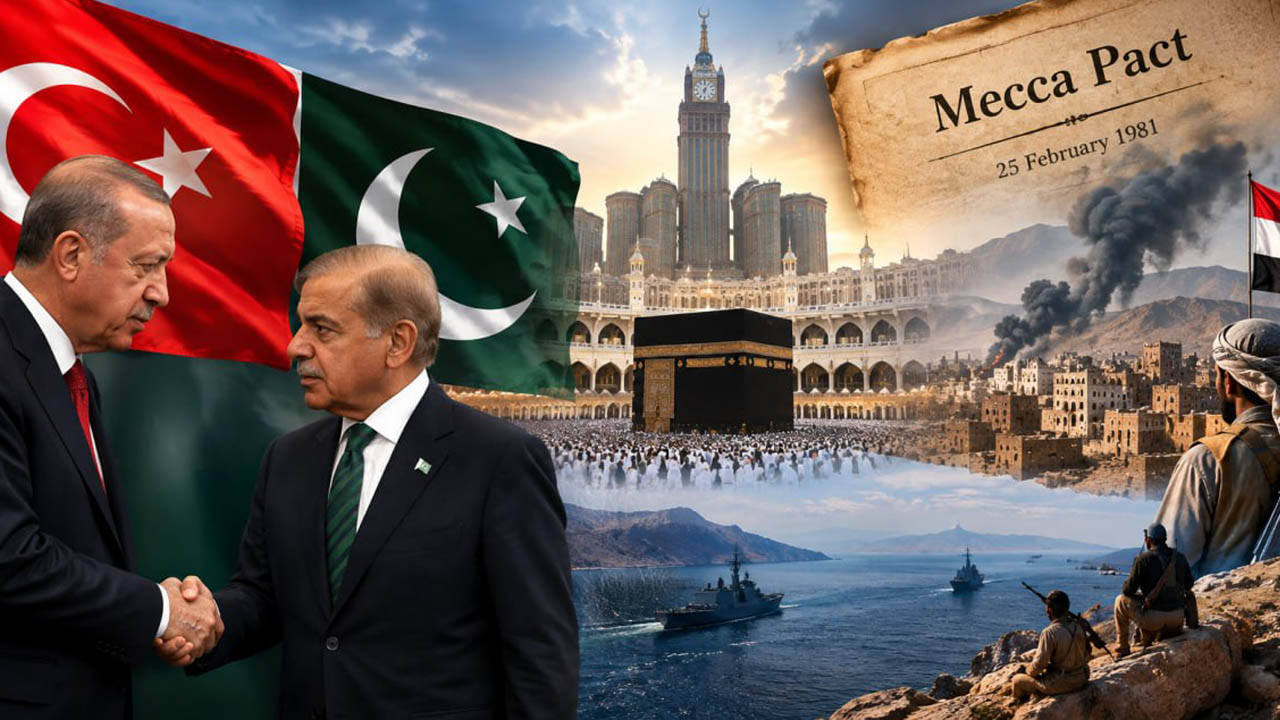
ARVAK Center Comment, October 15, 2026 [1]
1. Activation of the Mecca Treaty and Allies’ responses
At an emergency meeting of the Strategic Political and Defence Committee of the Mecca Alliance countries, held in Riyadh on October 5, 2026, Turkey and Pakistan announced a joint decision to “provide military assistance to Saudi Arabia and rapidly deploy their contingents on the territory of the Kingdom”. This decision marked the de facto launch of the mechanism for implementing the agreement of August 7, 2026, under which an act of aggression against any party to the treaty is considered an attack on the entire alliance.
Representatives of Turkey and Pakistan stressed that their support would involve the transfer to Saudi Arabia of “coordinated military forces and resources”. Ankara stated that it was ready to provide short- and medium-range air-defence systems, UAV technologies, and electronic-warfare systems. The Turkish side stipulated, however, that the direct deployment of troops would be possible only after the agreement had been ratified by parliament, to which the document was expected to be submitted shortly. In addition, participants at the Riyadh meeting approved the appointment of the first Secretary-General of the Mecca Defence Union for a 3-year term. The post went to retired Pakistani Lieutenant General Nauman Mahmood, who was tasked with coordinating allied military efforts to counter Yemen’s Houthis.
Turkey and Pakistan thus responded to the Saudi authorities’ official call for military support under the provisions of the Mecca Treaty. In its analytical paper of September 28, 2026, ARVAK examined in detail the highly restrained positions taken by Islamabad and Ankara as they sought to distance themselves from the crisis surrounding Yemen and avoid being drawn into hostilities on the Arabian Peninsula alongside Riyadh. The Turkish leadership justified its restraint by pointing to the underdeveloped institutions of the Mecca Pact and the absence of established practical mechanisms for cooperation. Pakistan, for its part, contributed to escalating tensions along its border with Afghanistan, seeking to justify its reluctance to intervene by citing the overriding need to defend its own frontiers. Both countries also emphasized that Saudi Arabia had not formally requested activation of the pact’s defence provisions. Under these circumstances, Riyadh’s partners indicated that they were prepared to provide only limited assistance, relying on previously concluded bilateral cooperation agreements rather than the multilateral Mecca Pact.
According to ARVAK Center, Riyadh’s partners were additionally restrained by the unfavorable geopolitical environment surrounding Islamabad and Ankara, as well as direct warnings from Ansar Allah that it was prepared to wage an uncompromising war against Pakistan and Turkey.
The Mecca Treaty was concluded on August 7, 2026, amid rising tensions surrounding the Yemen crisis. The escalation followed a July missile strike on a Houthi delegation returning from Tehran, prompting Ansar Allah’s leadership to formally declare war on Riyadh. Nevertheless, when the trilateral alliance of Sunni states was formed, the situation on the Arabian Peninsula had not yet reached its peak. The rebels’ actions were limited to targeted attacks on pro-Saudi government forces and maintaining a constant threat along the Kingdom’s southwestern borders, without developing into a large-scale military campaign. Ankara and Islamabad apparently expected to have time to establish the alliance’s institutional structure and work out practical collective-security mechanisms. However, in the first half of September 2026, Ansar Allah units unexpectedly launched a rapid offensive along the Red Sea coast, in the Gulf of Aden area, and in the mountainous regions approaching Aden, where the country’s internationally recognized authorities were based. At the same time, the Houthis reinforced their ground operations with massive ballistic-missile and UAV strikes against key Saudi military facilities and critical infrastructure. This caught the parties to the trilateral pact off guard, exposing their lack of readiness to respond rapidly to military developments and repel the emerging threats.
It appears clear that Saudi Arabia’s partners – Islamabad and Ankara – lacked the necessary capabilities and operational-technical capacity to provide timely assistance to the Kingdom. The allies also feared escalation on the Arabian Peninsula, viewing it as a potential “geopolitical trap”: refusing to take military action could undermine the Sunni bloc’s authority, while direct intervention could draw them into an exhausting confrontation with uncertain prospects.
These concerns in Ankara and Islamabad intensified when Washington, the Kingdom of Saudi Arabia’s key external patron, also refrained from direct military involvement on the side of the Kingdom and the Aden-based administration, explaining that its resources had to be focused as a priority on Iran. The United States limited itself to assurances of intelligence assistance and selective air support for Saudi units in exceptional circumstances. This situation caused serious concern in Turkey and Pakistan, which had good reason to fear being left alone to confront Ansar Allah forces. Since 2015, those forces have repeatedly demonstrated their ability to repel interventions by multinational Arab and Western coalitions effectively. Another significant factor was the Houthi leadership’s direct warnings that, if Ankara and Islamabad fully joined the Arabian campaign, military operations would be extended to Turkish and Pakistani territory and to areas of their key regional interests. An overall assessment of these factors compelled Riyadh’s partners in the Mecca Pact to avoid abrupt moves and seek to distance themselves from the escalation while “saving face”. According to some analysts, it was the Turkish and Pakistani sides that initiated an appeal to Crown Prince Mohammed bin Salman, asking him not to submit a formal request for military assistance under the Mecca Treaty; in return, they undertook to provide the Kingdom with discreet support.
2. The Israeli factor and the geopolitical choice
Subsequent developments showed that Israel’s direct intervention effectively neutralized the course of action chosen by Ankara and Islamabad. According to sources in government circles, by the 13th of September Prime Minister Benjamin Netanyahu had proposed providing military support to Riyadh but set a key condition for Crown Prince Mohammed bin Salman: the appeal to Tel Aviv had to be made publicly. Israeli press reports indicate that on the 11th of September, following the rebels’ seizure of the port of Mocha and their establishment of control over the Bab el-Mandeb Strait, Saudi Arabia used discreet channels of communication with the U.S. Central Command (CENTCOM) to inform Israel that it urgently needed intelligence and operational assistance. Riyadh apparently took this step in response to signals from Turkey and Pakistan that the Mecca Treaty’s mechanisms could not be activated at the current stage of escalation. Taking advantage of the situation to obstruct Saudi Arabia’s integration into the Sunni alliance and discredit the Mecca Pact, the Israeli leadership refused to provide assistance discreetly. In his statement, Netanyahu emphasized that the Israeli military was ready to deploy its full range of capabilities against Ansar Allah, including intelligence support and military advice, but only if the Kingdom made an official and public request for assistance.
Experts in Israel effectively regard the situation as a “voluntary surrender with confession”. The authorities in Tel Aviv calculated the geopolitical moment with considerable precision. Although events in Yemen did not formally affect Israel directly, the rebels’ blockade of the Bab el-Mandeb Strait posed a direct threat to the country’s strategic and economic interests. This prompted the Israeli leadership to take independent steps to restore navigation and security in the Red Sea. At the same time, the circumstances offered Tel Aviv an opportunity to establish coordination with Riyadh, restore previous contacts with Saudi Arabia, and secure a more favorable Saudi approach to Israel’s regional policy on the Palestinian issue. According to Israeli analysts, the resulting “thaw” in dialogue with the leading Arab state could strengthen the position of the incumbent prime minister and his political bloc ahead of the autumn parliamentary campaign. According to Maariv, government circles noted Netanyahu’s intention to prove to the Saudi leadership that Israel was Riyadh’s most effective ally in confronting Ansar Allah. Israel has therefore continued its efforts to persuade Saudi Arabia to conclude a military-cooperation agreement, recognizing that “such an agreement opens the way to electoral victory”.
At the same time, the key geopolitical benefit of such an agreement for Tel Aviv and Netanyahu’s government would be to undermine the authority of the Mecca Pact and discredit the trilateral Sunni axis. If Riyadh formally requested military assistance under a prospective Saudi-Israeli deal, it would deal a significant blow to the entire concept of “Sunni NATO”. Such a move would damage the reputations of Pakistan and Turkey, whose relations with Tel Aviv have been moving steadily towards direct confrontation.
It seems clear that this factor was the key catalyst prompting Islamabad and Ankara to take practical steps intended to demonstrate that the Sunni trio could function in reality, beyond the declaratory provisions of the Mecca Pact. Apparently faced with Israel’s conditions, the Saudi leadership presented its partners with a stark choice: either Turkey and Pakistan immediately activate the Mecca Treaty’s collective-security mechanisms, or the Kingdom publicly accepts Tel Aviv’s offer, thereby effectively threatening the viability and geopolitical prospects of the Sunni bloc.
Developments clearly show that Ankara and Islamabad’s attempts to maneuver flexibly in geopolitical terms and avoid the dangerous “Yemen trap” have failed. The Yemen crisis is an exceptionally complex, multi-factor problem, and the alliance’s key members understand that full-scale involvement in the confrontation on the Arabian Peninsula could entail enormous military and economic losses and destabilize their regional influence. For this reason, despite the public commitments made in Riyadh on October 5, 2026, to defend Saudi Arabia under the Mecca Treaty, Pakistan and Turkey will continue to seek a cautious approach and forms of support for Saudi Arabia that would prevent them from being drawn into a direct, full-scale conflict with Ansar Allah. In this context, a statement by Turkish Foreign Minister Hakan Fidan on October 8, 2026, three days after the Riyadh meeting, is noteworthy. He emphasized Ankara’s unwillingness to intervene in Yemen’s internal conflict. Fidan stressed that the Mecca Pact “is strictly defensive in nature and does not envisage Turkey’s participation in offensive operations or the deployment of military contingents to Yemeni territory”. According to him, the mutual-defence pact between the three states is “conceptually identical to Article 5 of the North Atlantic Treaty” and is activated solely to protect alliance members “in the event of external aggression”. Responding to sceptics who question the effectiveness of the “trilateral alliance” amid a protracted crisis and continued Houthi strikes on Saudi targets, the Turkish foreign minister said the agreement was not designed as an offensive mechanism for a ground invasion. Fidan stated that Ankara did not plan to deploy army units to Yemen for combat operations, and that all measures to assist Riyadh were focused on securing the Kingdom’s strategic facilities and “facilitating the negotiation process”.
Such statements by Turkey’s foreign minister are clearly intended to demonstrate Ankara’s desire to distance itself from direct participation in the Arabian crisis and avoid hasty military moves. However, it remains unclear to whom this signal is primarily addressed: the Saudi leadership or the leaders of Ansar Allah. A fundamental question also remains: is Turkey genuinely prepared to step back, or does it intend to use this rhetoric as a tactical maneuver to lull the Yemeni rebels into a false sense of security?
3. Operation “Dawn of Yemen” and the situation on the ground
Meanwhile, the crisis in Yemen is escalating rapidly. On 4 October 2026, the eve of the emergency Mecca Pact summit, Rashad Mohammed al-Alimi, head of the Presidential Leadership Council based in Aden and supported by Riyadh, publicly announced the launch of a large-scale military campaign against the rebels called “Dawn of Yemen.” Its stated primary objective is to restore the “legitimate administration’s” control over the entire country, including the capital, Sana’a, and other regions controlled by Ansar Allah forces.
According to regional sources, at least 100,000 personnel have been committed to the military campaign, under the cover of Saudi air power and Arab coalition forces. However, independent observers report that, alongside units of the internationally recognized administration, regular Pakistani and Saudi formations are participating in ground maneuvers, as well as fighters from Afghanistan and, apparently, Syrian mercenaries.
Current battlefield reports do not yet provide grounds for concluding that a strategic turning point has been reached. Although coalition forces have managed to drive Houthi formations out of the port city of Mocha, retake Mayyun Island in the Bab el-Mandeb Strait, and occupy several other local positions in Yemen, military specialists point to a marked loss of offensive momentum. Ansar Allah units, in turn, have demonstrated considerable resilience in strategic defence while increasing the intensity and geographical reach of combined missile and UAV strikes against Aden and key areas of Saudi Arabia, including the Kingdom’s capital. Critical infrastructure and transport and energy facilities have come under particularly heavy fire: overpasses, roads, power-generation facilities, oil refineries, industrial installations, terminals and Saudi Aramco pipelines, as well as Saudi civil-aviation facilities. Between 5 and 12 October alone, Riyadh International Airport was subjected to 4 waves of combined missile and drone attacks, causing numerous casualties and extensive destruction. Analysts are compelled to conclude that even Saudi Arabia, with its exceptionally dense and technologically advanced layered air-defence system, has been unable to fully neutralize the threat posed by regular air attacks from the Yemeni rebels.
Thus, according to specialists, localized advances by coalition forces alone cannot produce a strategic turning point in the current campaign. Ansar Allah forces continue to possess substantial resources and control the country’s capital, Sana’a, while the crisis itself “remains directly dependent on geopolitical rivalry among the world’s leading powers and key states of the Middle East”.
It can be concluded that the collective-security treaty concluded between Saudi Arabia, Pakistan, and Turkey faced a serious challenge almost immediately after its formal establishment. The capitals of the member states apparently recognize that the sharp surge in rebel activity in September was unlikely to have been an isolated episode or the result solely of independent decisions by Ansar Allah’s command aimed at destabilizing the Arabian Peninsula and the Red Sea. Even if the intensification of the conflict in Yemen resulted from direct consultations between Tehran and its Shiite allies, major global powers and certain influential regional states that do not want the Sunni bloc to grow stronger may use the crisis to diminish the Mecca Pact’s authority – or, conversely, to draw allied armies into a protracted and presumably futile confrontation with the Yemeni movement, which has successfully repelled attacks by successive international coalitions for two decades.
[1] The original (in Rus.) was posted on our website on 15.10.2026.