
Publication
Armenia’s air defense: from inherited network to the system Armenia needs

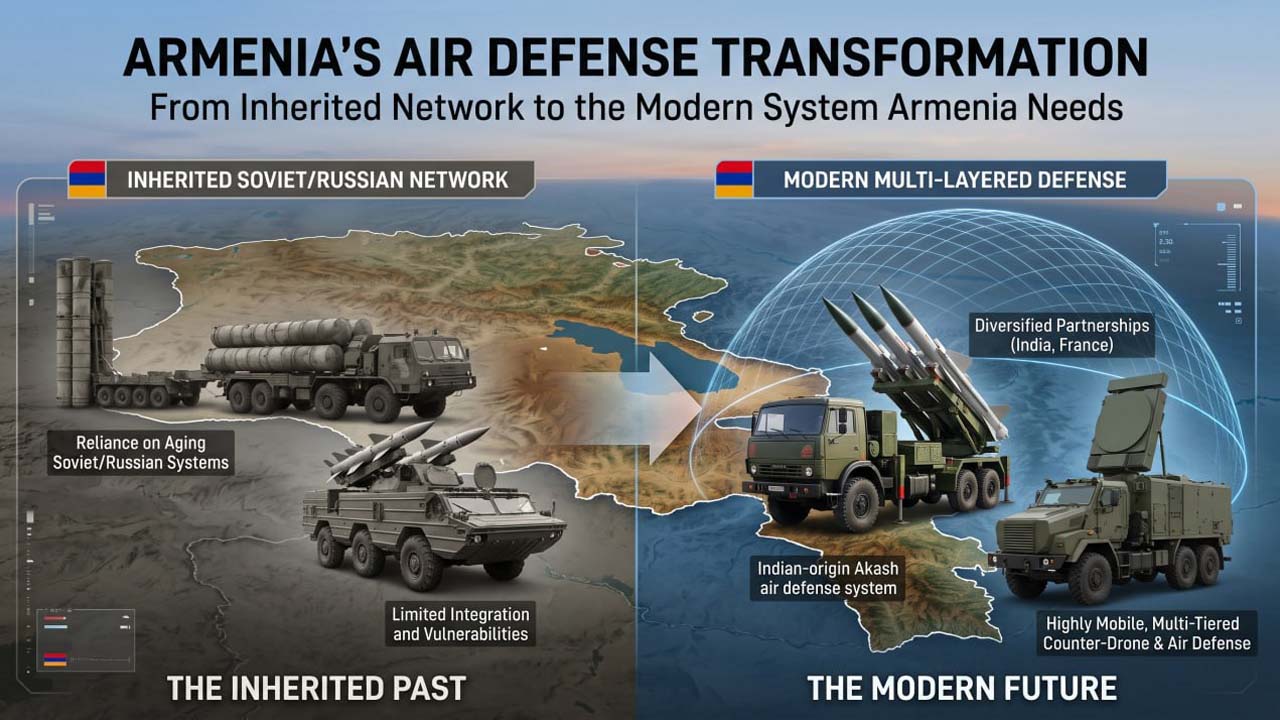
Հայաստանի ՀՕՊ-ը. ժառանգած համակարգից դեպի ապագայի բազմաշերտ պաշտպանություն
Հարությունյան Տ.
Սեղմագիր
Հայաստանի հակաօդային պաշտպանությունը (ՀՕՊ) առավելապես ժառանգված, այլ ոչ թե միասնական տրամաբանությամբ նախագծված համակարգ է։ Այն կազմված է խորհրդային և ռուսական արտադրության հեռահար, միջին և կարճ հեռահարության համակարգերից, զենիթային թնդանոթներից և կրելի զենիթահրթիռային համալիրներից, որոնց վերջին տարիներին ավելացել են հնդկական, ֆրանսիական, իրանական և տեղական արտադրության միջոցներ, ինչպես նաև նոր ավիացիոն հարթակներ։ Սույն հոդվածը հիմնավորում է, որ ՀՕՊ համակարգը պետք է նախագծվի պահանջներից և առաքելություններից ելնելով, այլ ոչ թե առկա զինտեխնիկայի ցանկի հիման վրա։ Վերլուծությունը սկսվում է համակարգի զարգացման վրա ազդող հիմնական գործոնների ուսումնասիրությամբ, ներառյալ Ռուսաստանի հետ համատեղ պայմանավորվածությունների անորոշ շրջանակը, ռուսական ծագման համակարգերի շահագործման և սպասարկման խնդիրները, բյուջետային սահմանափակումները, մատակարարների ընտրության սահմանափակ հնարավորությունները, ինչպես նաև սպառնալիքների սպեկտրը և պաշտպանության ենթակա օբյեկտների շրջանակը։ Այնուհետև ժառանգված և նոր ձեռք բերված միջոցները գնահատվում են այս պահանջների համատեքստում, և ձևակերպվում է նպատակային ՀՕՊ համակարգի տեսլականը. կենսունակ և կայուն կառուցվածք՝ մասամբ պասիվ հայտնաբերման միջոցներով, հրամանատարության և կառավարման միասնական մակարդակով, էլեկտրոնային պայքարի միջոցների կիրառմամբ՝ որպես հայտնաբերման և ընտրովի ճնշման գործիք, ինչպես նաև սպառնալիքների բնույթին և արժեքին համապատասխանեցված բազմաշերտ սպառազինությամբ, որտեղ թնդանոթային միջոցները ներկայացնում են պաշտպանության ամենացածրարժեք աստիճանը, իսկ ավիացիան գործում է ցամաքային սենսորների հիման վրա ձևավորվող միասնական օդային պատկերի շրջանակում։ Հետազոտությունն անդրադառնում է նաև դոկտրինային մոտեցումներին, անձնակազմի պատրաստությանը և տեղական ռազմարդյունաբերության հնարավորություններին։ Առաջարկվում է զարգացման ուղի, որը ներառում է առկա համակարգերի պահպանումը, արդիականացումը, այլ նպատակներով վերագործարկումը կամ ծառայությունից դուրսբերումը, միասնական չափորոշիչների հիման վրա տարբեր աղբյուրներից նոր համակարգերի ձեռքբերումը և դրանց փուլային ինտեգրումը մեկ միասնական ցանցի մեջ՝ հստակ ճանապարհային քարտեզի և գնահատման ցուցանիշների կիրառմամբ։ Հետազոտությունը հիմնված է բաց աղբյուրների տվյալների վրա և առկա միջոցները ներկայացնում է ըստ կատեգորիաների, քանի որ դրանց քանակական կազմի վերաբերյալ վստահելի տեղեկություններ հանրությանը հասանելի չեն։
ПВО Армении: от унаследованной сети к системе, необходимой Армении
Арутюнян Т.
Аннотация
Система противовоздушной обороны Армении представляет собой скорее наследие, чем результат проектирования: это советская и российская сеть систем большой, средней и малой дальности, орудий и ПЗРК, к которой добавились индийские, французские, иранские и отечественные системы, а также новые летательные аппараты. В статье утверждается, что систему следует проектировать исходя из требований, а не из перечня имеющейся техники. Анализ начинается с условий, определяющих ее развитие, включая неопределенный объем совместных договоренностей с Россией, обеспечение эксплуатации систем российского происхождения, бюджетные ограничения и ограничения со стороны поставщиков, а также со спектра угроз и перечня защищаемых объектов. Затем унаследованные и новые средства оцениваются с точки зрения этих требований и формулируется целевая система: живучее, отчасти пассивное обнаружение, единый уровень командования и управления, радиоэлектронная борьба как средство обнаружения и избирательного подавления, эшелоны вооружения (соразмерные угрозам по стоимости, где орудия образуют самый дешевый уровень), авиация, действующая в рамках единой картины воздушной обстановки. Рассматриваются также доктрина, расчёты и отечественное производство и предлагается путь, включающий сохранение, модернизацию, перепрофилирование или вывод из состава существующих систем, приобретение новых из нескольких источников по единым критериям и интеграцию всего в единую сеть, с поэтапной дорожной картой и показателями. Исследование опирается на открытые источники и описывает имеющиеся средства по категориям, поскольку надежных данных об их количестве не существует.
Tigran Harutyunyan[1]
Armenia’s air defense: from inherited network to the system Armenia needs
I. Introduction
Armenia’s air defense is usually discussed system by system: which battery was bought, which radar was displayed, which aircraft was announced. The habit is understandable, since the country’s air defense has changed substantially since 2020 and each acquisition draws attention. Yet it obscures the more important question, which is what kind of air defense Armenia needs and whether what it owns and buys adds up to it.
Earlier studies in this series addressed parts of that question. They examined the shift in cost-exchange ratios that makes defending a small state against mass-produced drones with premium missiles unsustainable [1], the role of light aircraft as a second line of counter-drone defense [2], the diversification of suppliers through India and France [3], [4], the protection of infrastructure and civilians [5], the effect of artificial intelligence on air warfare [6], and the personnel on whom all of this depends [7]. This article draws those threads together and closes the topic by asking what the whole system should look like.
The question is pressing for 3 reasons. First, Armenia’s air defense is an inheritance rather than a design: a Soviet and Russian network of long-, medium- and short-range systems, guns and man-portable missiles, to which Indian, French, Iranian and domestic systems have been added, and to which aircraft such as the L-39 Skyfox[2] are now being announced. The May 2026 parade displayed only part of this arsenal, mainly recent and domestic systems. Second, the conditions around the network are changing: the Chief of the General Staff has said that Armenia must rely solely on itself for air defense, missile defense and counter-drone protection, while the future of the Russian base in Gyumri, which is on combat duty within the joint air defense arrangement, is openly discussed. Third, the regional air threat has grown, and its character has changed [8].
The article’s thesis is that Armenia’s air defense should be designed from requirements, not from the list of what the country owns or can buy. It therefore begins with the conditions, and the threat, assesses the inherited and new assets against them, and describes a target system covering protection, sensing, command and control, electronic warfare, weapons, aviation, doctrine and people. Only then does it turn to the means of reaching that system: acquisitions, integration and the retirement of what no longer serves.
A word on evidence. No reliable public figures exist for the number or readiness of Armenia’s air defense systems, so the article describes holdings by category, and level of confidence and avoids numerical claims it cannot support. It prefers independent evidence, such as verifiable imagery and institutional data, to official statements from any side, which it treats as claims. For security reasons, it stays at the level of architecture, and omits locations, readiness levels and specific vulnerabilities.
II. Conditions shaping air defense development
A design for Armenia’s air defense has to start from the conditions in which it will be built, and the most consequential concern is the joint arrangement with Russia. It is hard to describe precisely, because the sources do not agree on its name. Russian-side statements place the 102nd Military Base in Gyumri on combat duty as part of the CIS Joint Air Defense System, while Armenia’s Chief of the General Staff refers to a joint air defense system with Russia in force since 2015. This article therefore describes functions rather than a label. The base’s own air defense assets are better documented: its 988th Air Defense Regiment is built around an S-300V battalion and a Buk-M1-2 battalion, with Strela-10 and Tunguska systems, and the Armenian Air Force has partly relied on the Russian MiG-29s stationed at the base for the defense of Armenian airspace. These are Russian assets and do not belong to the Armenian army’s inventory. What the arrangement delivers in practice, whether a shared radar picture, early warning, command arrangements or interceptor aircraft, is not public, and this article does not guess. What matters for design is that its future is open: in September 2026 Moscow said Yerevan had not requested the base’s withdrawal, while Prime Minister Pashinyan said Armenia does not consider the base vital and would not object if RF decided to withdraw it. Planners cannot know whether the arrangement will continue, narrow, or end [9]. The prudent response is to design a system that functions without it, while remaining able to use shared data where it exists.
The second condition is the sustainment of the Russian-origin systems that remain the backbone of the inherited network. Their missiles, batteries, spare parts, and repair services have historically come from Russia. In April 2026, the two sides agreed to resume implementing previously signed military-technical contracts, which suggests that supply is again possible, but it does not show what will be delivered or whether it covers air defense missiles and spares. The longer trend points the other way: Russia’s share of Armenian arms acquisitions has fallen from nearly all of them to a small fraction. A system that depends on a single supplier’s goodwill and abilities carries a structural risk, so sustainment has to be a design requirement and not an afterthought [10].
The third condition is money. Defense spending in 2022–2025 reportedly significantly exceeded the preceding two decades, yet the 2026 defense budget was planned with a reduction of about 15%. The air defense that results must be affordable to sustain as well as to buy. This supports the cost-matched structure developed in Section V, in which the cheapest adequate interceptor engages each threat, and premium missiles are reserved for targets only they can stop.
The fourth condition arises from diversification. Each new supplier brings its own export licensing, end-use restrictions, training arrangements, spares chains, and political consequences. Armenia is the first known foreign operator of the Iranian Majid[3], which adds a different kind of sensor to the network but may also affect cooperation with Western and other partners. The article raises this question without prejudging it. The partners themselves treat architecture as the open issue: France has signed a letter of intent with Armenia that includes an audit of its ground-based air defense capabilities [11].
Diversification also has limits that narrow the real supplier field. Israel is one of Azerbaijan’s principal suppliers, so Israeli systems, and systems with Israeli components, are practically unobtainable for Armenia, and Turkish suppliers are excluded for the same reason. The German defense industry is stretched by German, NATO and Ukrainian demand, which limits what it can deliver to a new customer. Russia has not been excluded: Armenia continued to acquire Russian equipment after 2020, for example Mi-17 helicopters [12]. China is a possible new source: the Defense Minister visited China in September 2026 and met the heads of Chinese defense corporations, although no official information shows what was discussed [13].
Finally, the regional context shapes both the threat and the assets to be protected. Azerbaijan’s military build-up, the uncertain course of the peace process, the promotion of the new transit routes through Armenian territory, Iran’s position after the 2026 war, and Turkey’s ongoing normalization process with Armenia all affect what has to be defended, and with what warning. The next section turns to the threat spectrum and the assets at stake, which together define the requirements the system must meet.
III. Requirements: threats, assets and terrain
Air defense is designed against capabilities, not intentions. The peace process may continue, and the border may stay quiet, as it largely was in 2025, but the system must be sized against what a neighbor could do on short notice. Azerbaijan’s inventory is the relevant benchmark. It reportedly includes Akıncı drones armed with SOM-B1 cruise missiles[4], KGK-83 glide bombs[5], Hero-120 loitering munitions, and JF-17 fighters, together with modern air defense of its own, among them reported Barak MX[6] and HQ-9 systems (the HQ-9BE was displayed again at the ADEX 2026 exhibition), and Belarusian Groza-S counter-drone stations[7]. Defense spending is reported to run at about two and a half times Armenia’s, and Turkey and Israel are the main sources of its technology. The threat spectrum therefore has 4 layers.
At the bottom are small and medium drones and loitering munitions. They are cheap, numerous, and hard to detect; they can arrive in saturating numbers, and their cost leaves the defender with the bad exchange ratio analyzed in the second article of this series. Above them are cruise missiles, glide bombs and combat aircraft, which are fewer but can reach deep and strike hard-to-replace assets. At the top are ballistic missiles and long-range precision rockets, which the earlier work identified as a threat to airfields. A 4 threat cuts across all 3: attacks on the air defense itself. In 2020, a Harop loitering munition destroyed the SNR-125 radar at an S-125 site near Stepanakert, leaving the site’s missiles without guidance [14]. The 2026 Iran war showed the same logic on a larger scale: drones were central to finding and destroying radars, air defense batteries, and electronic warfare vehicles. A system whose sensors can be hunted and destroyed has to be designed so that no single loss blinds it [15].
The second requirement is a defended-asset list. Armenia is small, and resources cannot cover everything, so priorities have to be set explicitly. The categories are clear even if the list itself is not for publication: the capital and other population centers, energy infrastructure, including generation and the high-voltage network, command posts and communications nodes, airfields and aircraft shelters, the water infrastructure analyzed in the earlier work, the logistic routes, and the radars and air defense sites on which everything else depends. Some of these deserve active defense, some hardening and redundancy, and some can only be made resilient. The distinction is a design choice, and it belongs to the target system in Section V.
Terrain is the third factor, and it cuts both ways. Mountains and valleys create radar shadows that low-flying drones and cruise missiles can exploit, and they shorten warning times because many assets lie close to borders. But the same terrain offers concealment, reverse slopes for mobile systems, high ground for sensors and natural dispersion. The earlier article on light aircraft treated the shadows from the air. The ground answer, which is a layered and partly passive sensor network, is developed in Section V. A GM200-class radar[8] is advertised as capable of detecting low-flying, small and slow targets, but no radar sees through a mountain.
These conditions yield 6 requirements. The system must detect low-and-slow targets in broken terrain, survive attacks on its own emitters, protect a prioritized asset list, engage mass threats at a cost the budget can bear, retain the means to stop the few high-end threats, and sustain itself without dependence on any single supplier or on a single piece of infrastructure.
The next section measures the inherited and new assets against them.
IV. The baseline: inherited network, additions and gaps
The inherited network combines Soviet-era equipment with Russian systems supplied since the 2000s. Open sources identify S-300PS and S-300PT systems in the air force, short-range systems such as the Kub, S-125, and Osa, ZSU-23-4 and ZU-23-2 guns, and man-portable systems of the Igla and Verba families. The Russian-era modernization added the Tor-M2KM[9] and electronic warfare equipment such as the Repellent-1[10] and Avtobaza-M[11]. The man-portable stock is large but unquantified, and it matters out of proportion to its cost. It is passive, dispersed, and hard to destroy, and it suits low-flying aircraft, helicopters, and cruise missiles. It is weaker against small drones, and its value depends on missile age, batteries, and resupply. The Buk and S-300V systems at Gyumri are Russian-operated and are excluded from the Armenian inventory. For the rest, numbers and readiness cannot be verified, so the article describes categories [16].
What can be assessed independently is the record of 2020. Oryx’s visually confirmed losses include S-300PS, Osa, and Strela-10 systems, and the loss of an S-125 radar to a Harop showed how a single emitter can disable a site. The lesson is structural: the network was largely fixed, emitting and predictable, and it lacked cheap interceptors in depth. The effectiveness of the legacy EW cannot be judged from public evidence. The gun stock is similar: ZU-23, ZSU-23-4 and S-60 guns, many mounted on trucks or on converted MT-LB hulls without radar or armor [17], and Armenian and Russian crews have exercised Shilkas against simulated drones [18].
The post-2020 additions are more modern but smaller in scale. The May 2026 parade showed the French GM200 as Vahan 200, Indian Swathi radars, the Akash as Lusan, and the Tor-M2KM. The GM200 is the main new air-surveillance radar: Armenia ordered 3, and they are advertised as able to detect low, slow targets. The Swathi is a weapon-locating radar, not an air-surveillance one. The Iranian Majid, of which Armenia is the first known foreign operator, is passive and uses infrared and electro-optical sensors. The Indian ZADS[12] adds passive surveillance and jamming. France signed a Mistral memorandum. Armenia also operates Chinese CH-4B drones[13] and ASN-301 loitering munitions[14], but no Chinese air defense system has been shown [19]. The domestic DDS-10K interceptor drone[15] adds a new cheap layer, and the Skyfox order adds an aircraft that can work with the ground network. Reports of much larger Indian orders rest on secondary sources.
Measured against the 6 requirements of Section III, the baseline has capable parts but incomplete coverage. Detection of low, slow targets in broken terrain rests on a few modern radars. Survival of emitters is weak: the legacy sites were fixed and emitting, and the survival logic of the new ones is untested. Engaging mass threats cheaply has a good foundation in guns and MANPADS, but they lack modern fire control and cueing, so premium missiles risk being spent on cheap drones. For the high-end threat, no system in the Armenian inventory is known to be designed for ballistic missile defense, and the S-300V at Gyumri, which has such a role, is Russian-operated. Sustainment is easier than before, with suppliers diversified, but it adds a new burden: different spares chains, training pipelines, and data standards. Finally, there is no public evidence of a common command layer that links these systems.
| Category | Systems | Confidence | Main limitation |
| Long range | S-300PT/PS | Medium | Numbers, readiness and missile stocks unknown |
| Medium and short range | Tor-M2KM, Akash-1S, Osa, Strela-10 | Medium to high | Osa aged; Tor and Akash scale unknown |
| Legacy static | S-125, Kub | Low | Mobility, radar vulnerability |
| Guns | ZSU-23-4, ZU-23-2, S-60 | Medium | Age, fire control, cueing |
| MANPADS | Igla, Verba | High (existence) | Quantity, shelf life, small-drone performance |
| Sensors | GM200, SAM-organic radars, Majid | Medium | Few radars; legacy radars unidentified |
| EW | Legacy Russian, Local, ZADS | Low | Effectiveness unverified |
The baseline is therefore neither empty nor coherent. Section V sets out the target system that would turn it into one.
V. The target system
A system is defined by what it does, not by what it contains. The target system therefore has 7 functions: protection, sensing, command and control, electronic warfare, layered engagement, aviation, and defense of critical assets. 4 principles organize them. The system survives first and engages second, because a network that can be blinded is not a network. It sees cheaply, using many inexpensive sensors where it can and a few expensive ones sparingly. It decides in a common picture but shoots autonomously when links fail. And it matches the cost of each interceptor to the value of the target, keeping premium missiles for the few threats only they can stop.
Survivability. The first design rule follows from Section III: sensors and sites are the primary targets, and Armenia has few of them. Protection begins with dispersion, concealment, decoys, hardening, mobility, and strict emission control. A radar should emit only when needed, move after emitting, and have alternate positions. Each radar and each premium battery needs its own close-in cover, made of guns, short-range missiles, and jamming. This “defend the sensors first” principle keeps the expensive layers from being stripped away by cheap drones.
Sensing. The target network has 3 levels. A few radars, among them the GM200-class systems already ordered, provide wide-area surveillance and cueing, used sparingly. Many cheaper passive sensors, namely electro-optical and infrared, acoustic, and radio-frequency detectors, fill the radar shadows of the mountains from high ground and near priority assets. They emit nothing, so they cannot be targeted by anti-radiation weapons, and passive systems of the Majid type belong here. Shooters carry organic sensors. A final, low-technology element is a network of human observers in border and mountain communities, linked to the reserve units.
Command and control. The decisive missing element is a national command-and-control layer that fuses data from systems of different origins. It should accept tracks through adapters from every sensor, assign common track identities, and distribute one air picture. It needs multi-standard identification of friend and foe, because Soviet-era, Western, and Indian identification systems do not interoperate on their own, and a shared sky between ground batteries and aircraft invites fratricide. Engagement authority should be delegated to sector commanders under rules based on target type, altitude, and cost, in line with the mission-command approach of the human-factor study. When links are jammed or cut, each shooter must still be able to act alone. The layer should rely on open interface standards and domestic software capacity, and it needs redundant and protected communications.
Electronic warfare. Experience warns against treating electronic warfare as a shield. In the target system, it has 2 roles. As a sensor, it detects drone control links and other emissions, extending the passive tier. As a selective means of denial, it jams or spoofs identified links and protects navigation signals, as the Indian ZADS (passive surveillance and jamming) is designed to. Spectrum management is essential so that Armenia does not jam its own radios or data links. Because fiber-optic and autonomous drones are immune to jamming, electronic warfare has to be paired with kinetic defenses. A high-power microwave, which damages the electronics of many drones at once and works regardless of the control link, could add a short-range layer for radars, command posts and airfields against swarms and fiber-optic drones. Prototypes exist in India and the United States, but the technology is immature, so it belongs in a later pilot and a research partnership, not a purchase [20], [21]. Domestic production should be encouraged.
Layered engagement. The cost-matched structure of the earlier studies is shown in the table below, which is indicative.
| Layer | Threat | Typical means | Role |
| Passive | All | Dispersal, decoys, hardening, concealment |
Reduce what must be intercepted |
| Point defense | Small and medium drones |
Guns with electro-optical fire control, jammers, interceptor drones | Cheapest adequate response |
| Short range | Helicopters, low aircraft, cruise missiles, larger drones | Igla and Verba, Tor-M2KM, Majid-type systems |
Backbone against mid-cost threats |
| Medium range | Aircraft, cruise missiles | Akash-class mobile systems | Protect priority areas |
| Long range | Aircraft, ballistic missiles where capable | S-300-class, held in reserve | Stop only what others cannot |
| Airborne | Slow and low threats; high-end intruders | Turboprops, L-39 Skyfox, Su-25, Su-30SM | Flexible reaction and second line |
Rules of engagement should forbid spending a premium missile on a cheap drone unless it threatens a high-value asset.
Guns deserve a specific role. They are the cheapest engagement available and the backbone of the point-defense layer, in 3 rungs: networked machine-gun fire teams with thermal sights for the cheapest threats; modernized 20–23 mm guns with electro-optical fire control for most sites; and, for priority sites, one modern 40 mm gun with programmable airburst ammunition. Guns suit drones and subsonic cruise missiles at short range, not ballistic missiles or fast aircraft, and they need cueing from the common picture and protection, since unarmored, radar-less guns were among the vehicles lost in 2020.
Aviation. The aircraft are most useful when fed by the ground picture. Turboprops provide a cheap, persistent second line against low and slow targets, as proposed in the first study of this series. The Su-25 and the L-39 Skyfox (whose Armenian order was revealed in October 2026), adds speed, so it suits the faster threats that turboprops cannot reach. The Su-30SM remains the high-end interceptor, covered by the ground network. All 3 need defined engagement zones shared with ground batteries, common identification, and dispersed basing [22].
Critical assets. Not everything can be defended, so the target system divides assets by treatment. A few receive active defense, more receive hardening and redundancy, and the rest are made resilient, meaning they can be repaired and restored quickly. Spares, repair teams, and alternative supply for power and water link this part of the system to the protection model developed in the earlier work.
Taken together, the target system is not a larger collection of platforms but a network with defined properties: sensors that survive, a picture that is shared, electronic warfare that serves both sensing and denial, interceptors matched to threats, and aircraft that operate within the ground network. Section VIII turns these properties into measurable indicators.
VI. Doctrine, crews and the domestic industry
The effectiveness of a target system will be determined by how well-conceived its operating rules are, the competence of the people who manage it, and the level of development of the industry that sustains its existence. All 3 of these elements require careful design.
Doctrine. The first need is an integrated air defense doctrine, which assigns each layer its role, sets rules of engagement by threat type, altitude, and cost, and fixes who may order fire in which zone. The cost-matched logic is a doctrine problem as much as a technical one: crews must be trained not to spend premium missiles on cheap drones, and commanders must be trusted to decide when links fail. This applies the mission-command principle of the human-factor study. Airspace control needs its own procedures, so that aircraft and ground batteries share sectors without blue-on-blue incidents. Doctrine means little without rehearsal, and regular exercises that simulate saturation attacks, loss of radars and jammed links, and that include aircraft and ground units together are the cheapest way to find integration faults before an adversary does.
Crews. Armenia’s air defense now has equipment from several suppliers and generations, and each needs trained operators and maintainers. Multiplying systems multiplies training pipelines, so the number of types and the skills needed to run them should be weighed in every purchase decision. Several measures follow from the human-factor study: a professional NCO corps that can lead small air defense teams; simulators that train decision-making under saturation, which is cheaper than live firing; and career tracks for scarce technical specialists, such as radar, electronic warfare and command-and-control operators, with incentives competitive with the private sector. The command layer and the electronic warfare and air-picture roles also suit the fields in which the earlier study proposed to expand women’s service, since they do not depend on physical strength. Reserve teams armed with man-portable systems, anchored in local communities, would add depth cheaply.
The domestic industry. The domestic industry cannot replace imports, but it can fill specific roles. The DDS-10K jet interceptor drone, shown by Davaro Defence Systems at the May 2026 parade, points to one: low-cost interceptors produced at scale, in line with the argument for mass production in the economics article of this series. Others are electro-optical fire-control kits that modernize existing guns, decoys, counter-drone electronic warfare, spares and refurbishment for legacy systems, and above all the software for the common command layer, where Armenia’s IT sector is a real asset. Each depends on imported components and on exportable designs, so the plan has to include secure supply of those parts. Domestic output is also not a substitute for scarce premium missiles. It should serve the lower layers of the ladder, which frees imported systems for the layers that only they can fill [23].
Armenian-made electromagnetic systems are the most promising extension of the domestic role, because they are accessible, require little capital, and can be tested quickly. They fall into 3 groups in order of realism. The first is jammers, radio-frequency detectors, and anti-jam navigation receivers for the lower layers, together with the software that fuses their output. Reported items already exist: the 2026 parade showed a domestic complex designed to detect air targets and suppress satellite systems and another intended to jam tactical radio communications, and the DDS-10K carries an anti-jam navigation receiver. The second group is compact radars for small, low-flying targets. The third group is a high-power microwave. No Armenian program is public, and the technology requires specialized components, pulsed power and cooling, and safety rules for friendly and civilian electronics, so it belongs in a research demonstrator with a partner such as India’s DRDO, not in the procurement plan.
4 conditions decide whether this works. Critical components such as amplifiers, power semiconductors, and processors are imported and subject to export controls, so designs should allow substitution and critical stocks should be held. Performance claims need independent testing on a range that reproduces the threats, including fiber-optic and autonomous drones. Spectrum use must be planned so that domestic jammers do not disrupt the Armenian network, and domestic electronics need hardening against interference. And small firms need predictable orders: the government has decided to sign long-term contracts worth 190 billion AMD, and these should be tied to performance milestones and open interface standards so that domestic products feed the common picture and do not become isolated systems. State investment of about 171 billion AMD in local defense companies in 2023–2025, and a review pointing to growing localization in drones, electronic warfare, communications, and command systems [24], suggest that a base exists.
The 3 elements share a rule. Each should be built so that the system degrades gracefully, with trained crews who can act without orders, doctrine that tolerates lost links, and production that continues when one source is cut off.
VII. The pathway: retain, modernize, retire, acquire, integrate
Reaching the target system requires 3 kinds of decisions about equipment: what to do with what exists, what to add, and how to make every system part of one network. They are linked, because each choice changes the others.
| Decision | Systems (by category) | Rationale |
| Retain and protect | S-300 family, Tor-M2KM, Akash | They fill layers 2 to 4. Keep radars and launchers dispersed, with close-in cover |
| Modernize cheaply | ZU-23, ZSU-23-4, S-60 and similar guns, man-portable systems | Add electro-optical fire control and network cueing to build layer 1. Test stocks and batteries, and secure resupply |
| Repurpose | Fixed, emitting legacy sites (S-125, Kub class) | Use as decoys and emitter bait to draw fire away from real assets |
| Retire or cannibalize | Weakest short-range vehicles whose upkeep exceeds their value | Release crews, spares and funds for the layers that matter |
What to do with the existing network. The inherited network should be sorted by function. The sorting below is a planning logic, and it needs to be checked against the real condition of each system, which open source cannot show.
The rationale is the same throughout spend where the system gains the most. Upgrading guns is cheap and fills the gap that was missing. Keeping obsolete radars on the air for their own sake only adds targets.
What to acquire. New acquisitions should be judged against capability gaps, not against catalog performance. Section IV identified 4: detection of low-and-slow targets in broken terrain, survival of emitters, cheap mass engagement, and defense against the few high-end threats. A candidate system is worth buying if it fills a gap, can be sustained without a single point of failure, can join the network, and has a cost per engagement that fits its layer. Within the supplier limits described in Section II, these criteria give the following picture.
| Gap | Candidate additions | Comment |
| Detection in terrain | More passive sensors, additional surveillance radars, aerostat-type elevated sensors; compact low-level radars | Passive sensors scale cheaply. Radar purchases should be paired with survivability measures. The Indian LLLR-I low-level radar was reportedly ordered by India in October 2026; export is unverified [25] |
| Emitter survival | Decoys, close-in guns and jammers, mobile mounts | Largely domestic and low-cost |
| Cheap mass engagement | Interceptor drones; electro-optical kits for 20-23 mm guns; machine-gun fire teams; 40 mm programmable-ammunition gun (Swedish Bofors Tridon or French RapidFire); counter-drone jammers | The DDS-10K and other interceptors display the internal route. Tridon is on order in Sweden and is being sent to Ukraine [26]; RapidFire’s airburst round is still maturing [27]; German systems are not realistic given industry capacity |
| Medium range and key-site defense | Akash-NG; VL MICA and Mistral; Russian S-350 or Buk-M3 class; a Chinese HQ-16-class system as a conditional hedge | The Akash-NG has been considered, and its timing is uncertain. The MR-SAM, also named in reports, has Israeli components and is practically unavailable. France signed a Mistral memorandum and a letter of intent that includes an audit of ground-based air defense. Russian options fit the existing network but carry delivery risk, and a Chinese system would need independent testing and an isolated gateway |
| Short range with drone capability | Additional Tor-M2KM batteries and missiles; a Pantsir-type gun-and-missile system; Chinese HQ-17-class | Tor shares crews and logistics with the existing network. No Pantsir order is reported |
| High end and ballistic | SAMP/T NG-class (France); Russian long-range options | Very costly, and realistic only after the lower layers exist. The S-300V at Gyumri is Russian-operated. Interim measures are dispersal, early warning and a limited S-300 reserve |
| Sustainment of the existing network | Missiles, spares and repair for the S-300, Tor-M2KM, Osa and the Igla and Verba stocks | Russian supply is the most urgent need; third-country support and domestic refurbishment are the hedge |
| Command and control | Open-architecture fusion layer; an Akashteer-class system[16] as a possible base; domestic software | Needs adapters for Russian-origin, French, Indian and any Chinese systems; vendor claims are unverified |
| Domestic EW and detection | Domestic jammers, radio-frequency detectors and anti-jam receivers | Fast and cheap, but needs independent tests and spectrum control |
| Compact radars and HPM | Co-development of compact radars with Indian, French or other partners; a high-power microwave research demonstrator with a partner such as India’s DRDO | No Armenian surveillance radar or microwave program is public; a horizon of three to five years or more |
| Aircraft integration | Data links and multi-mode identification for existing and new aircraft | The Skyfox, Su-25, and the Su-30SM must join the common picture |
Russian options remain open and should be judged on the same tests. Sustainment comes first: the S-300, Tor-M2KM, Osa and the large Igla and Verba stocks depend on Russian-origin missiles and spares, and although the sides agreed in April 2026 to resume implementing earlier contracts, future supply is uncertain. For new systems, further Tor-M2KM batteries are the simplest addition, since they share crews and logistics with what exists. A Pantsir-type gun-and-missile system would fit the drone layer where Armenia is thin; the upgraded Pantsir-SMD[17] can carry 48 missiles. I found no report of an Armenian Pantsir order, while Russia is reported to be pursuing a Pantsir-S1 sale to Azerbaijan, with no contract announced. Against these options stand the delivery record, since Armenia said at the end of 2023 that some paid-for weapons had not arrived, the system’s reported losses against drones in Ukraine, and Russia’s own demand for medium-range systems such as the S-350 and Buk-M3.
India and France are the main sources of recent additions. The Indian Akash-NG[18], with an AESA radar and a reported range of 70 to 80 km, has been considered by Armenia, but its delivery timing is uncertain and the reports come largely from trade press. The MR-SAM, also named in reports, has Israeli components and can be ruled out. Indian command-and-control and radar products, such as the Akashteer system and the LLLR-I low-level radar, are natural complements to the Akash-1S already in service, though their export availability needs confirmation. France has signed a Mistral memorandum and a letter of intent that includes an audit of Armenia’s ground-based air defense. The Mistral and the VL MICA[19] suit point defense of priority sites, and the SAMP/T NG[20] is the only realistic non-Russian option with ballistic-missile capability, although its cost places it well in the future.
China is a new and still unconfirmed possibility. Armenia already operates Chinese drones and loitering munitions, and analysts note that Chinese suppliers have kept delivery deadlines; Chinese radars, jammers, gun-based systems and medium-range missiles such as the HQ-16[21] could be offered quickly and cheaply. The risks are real. Their combat record is contested, and reliability problems have been reported with other Chinese exports. Azerbaijan also buys from China [28]. Chinese systems usually come with their own command and data standards, so integration with French, Indian and Russian-origin systems is the hardest problem, and partners may object to Chinese equipment in the same network. The prudent use is limited: guns, jammers, radars and perhaps a medium-range hedge, tested independently and connected through a gateway that keeps the Chinese segment isolated. Copying Azerbaijan’s high-end HQ-9BE purchase would be neither affordable nor strategically sound.
Guns deserve their own comparison because they fill the cheapest layer. For the existing 20–23 mm guns, the best route is modernization with electro-optical fire control, small radars and proximity ammunition from Russian or domestic sources, which keeps the Soviet-standard ammunition base; Belarus, reported to be overhauling Shilkas for Azerbaijan, is a poor source. For priority sites, a 40 mm gun with programmable airburst ammunition would add range and effect. Two candidates stand out. The Swedish Bofors Tridon[22] was ordered by Sweden in April 2026 and is being sent to Ukraine, and its fire-control software accepts radars and electro-optical sensors from other makers, which helps integration [29]. The French RapidFire[23] was qualified in 2025, but its airburst round is still maturing and full operation is not expected before 2027. Choosing one avoids adding a 4th ammunition chain. German systems are unrealistic given the industry’s workload. Pantsir (30 mm) and Chinese 35 mm systems are alternatives, judged as above. The cheapest rung remains machine-gun fire teams with thermal sights and cueing, which need no new supply chain. Further Iranian purchases beyond the Majid are unconfirmed.
4 scenarios frame the choice: continued diversification, selective re-engagement with Russia for spares, ammunition and Tor-M2KM, a stronger domestic low-cost layer, and a limited opening to Chinese sources for the lower layers. They are not mutually exclusive, and the article does not predict which will occur. On the tests above, the most valuable additions are those that fill the lower layers fastest and join the network most easily: sensors and cueing, guns and interceptor drones, and the sustainment of what already works. Medium-range and high-end systems follow once those layers exist. The domestic route, including jammers, detectors, compact radars and a possible microwave demonstrator, is described in Section VI.
How to integrate. Integration is a set of concrete steps, not a slogan.
1. Build the national command-and-control layer first, with adapters for every sensor and shooter already in service, so that each later acquisition arrives at a working network.
2. Make open interface specifications and multi-standard identification a condition of every contract, whatever the supplier. A system that cannot share its tracks is of less value, however capable.
3. Establish a test environment, even a modest one, where the combined network is exercised with real data links before it is relied on in a crisis.
4. Plan sustainment jointly with acquisition, covering spares, training, software updates and repair for each supplier’s equipment.
5. Treat aircraft as part of the network: common picture, shared identification, defined engagement zones.
The 3 decisions fit together. Retiring weak systems frees money and crews for acquisitions that fill real gaps, and the common command layer makes each acquisition more valuable than it would be alone. Section VIII turns this sequence into a phased plan with indicators.
VIII. Roadmap and indicators
The target system cannot be built at once, and the sequence matters. Capabilities that take years, such as the command layer, trained crews, and sustainment, should start first. Cheaper measures with quick payoff, such as decoys, gun upgrades, and emission discipline, can run in parallel. The phases below are indicative and should be adjusted to budget and institutional capacity.
| Phase | Priorities | Indicators |
| 1
(first year): foundations |
Audit the real condition of holdings, including stocks and batteries of man-portable systems; prototype the command layer with adapters for the main sensors and shooters; adopt emission-control and decoy doctrine; write open-interface and sustainment conditions into all new contracts; plan spectrum use; begin integrated exercises; secure missiles and spares for the legacy systems and choose the supplier path for each layer; build a counter-drone and electronic warfare test range with independent evaluation, audit critical imported components, and place performance-based orders for domestic jammers and detectors | Audit completed; prototype showing a common picture from at least two suppliers’ systems; contract clauses in force |
| 2
(years 2-3): build |
Extend the command layer to legacy and new systems and to aircraft; upgrade guns with electro-optical fire control; start series production of interceptor drones; add passive sensors in radar shadows; fill the most urgent gaps through selected acquisitions, such as 40 mm programmable-ammunition gun system, compact low-level radars and a medium-range mobile SAM; set up simulators and specialist career tracks; begin series production of domestic jammers and detectors and co-development of compact radars, with a stock of critical components | Share of systems feeding the common picture; time from detection to engagement decision; cost per intercept by layer |
| 3
(years 4-5): consolidate |
Run the full layered network in regular integrated exercises with aircraft; retire or repurpose weak systems; secure sustainment from more than one source; review remaining gaps, including high-end defense, against the current threat; decide on radar series production from the test results, and run a microwave demonstrator with a partner against defined range and safety tests | Exercise results with sensors deliberately removed; stock depth for sustained engagement; share of spares with two sources |
8 indicators cover the system’s main properties. For sensing, the proportion of priority areas with continuous low-altitude coverage. For survivability, whether the air picture stays usable in exercises after the loss of a given share of sensors. For command, the time from first detection to an engagement decision and the share of systems contributing to the common picture. For economy, cost per intercept in each layer, and the stock depth of interceptors measured in days of intense engagement. For electronic warfare, the number of incidents of self-interference. For people, qualification rates and time to train crews. For domestic production, the share of each system’s value made in Armenia, independent test results against defined scenarios, and unit cost compared with imports. Indicators should be tracked internally in full detail, and only aggregate results should be published, to hold the balance between accountability and security.
Funding should come first from reallocation: retiring systems that cost more to keep than they contribute, and redirecting purchases from prestige to gaps. New commitments, such as series production of interceptors and sustainment contracts, should be introduced gradually and tied to results. Detection, communications and command software are the natural candidates for external, non-lethal assistance, while lethal systems need national or bilateral financing [30].
IX. Conclusion
Armenia’s air defense is neither empty nor coherent. It has an inherited network with large reserves of guns and man-portable missiles, a modern core that has grown since 2020, aircraft that are being renewed, and a domestic industry beginning to contribute. What it lacks is a design that joins these parts into a system matched to the threat, to the terrain and to a budget that is under pressure.
This article has argued that such a design should start from requirements, not from the equipment list. 6 requirements follow from the threat and the conditions: detect low-and-slow targets in broken terrain, survive attacks on its own sensors, protect a prioritized list of assets, engage mass threats cheaply, keep the means to stop the few high-end threats, and sustain itself without dependence on a single supplier. The target system that meets them is built on survivability first, a layered and partly passive sensor network, a common command layer that fuses systems of different origin, electronic warfare used as a sensor and selective denial, interceptors matched to the value of targets, aircraft that work within the ground picture, and doctrine, crews, and industry designed to keep functioning when links or supplies are cut.
The means of reaching it are 3 decisions that must be taken together: retaining, modernizing, repurposing, or retiring what exists; acquiring what closes real gaps, including options from Russia, India, France, China, Iran and other sources, judged by the same criteria as any other; and integrating every system into one network, with open interfaces written into every contract. None of the 3 is more important than the others, and none replaces the target system.
The article has limits. Open sources do not reveal the number or readiness of Armenia’s systems, so it describes categories, and several recommendations, such as the phasing and the indicators, are proposals and not findings. Foreign experience offers lessons but not templates. Conditions around the joint air defense arrangement with Russia and the supply of Russian-origin equipment may change quickly, so the design deliberately avoids depending on any single arrangement. Decisions on resources and priorities rest with the competent authorities.
The overall conclusion is that Armenia’s air defense should be judged by whether it meets the country’s real requirements, not by the number or prestige of its systems. A modest network that sees, decides, and engages as one under pressure is worth more than a larger collection that cannot.
[1] PhD, worked at the “Noravank” Foundation as a Deputy Director; at the Public Administration Academy of Armenia as a Head of the Center for Regional Studies; researcher at the Institute for Armenian Studies (Yerevan State University), and at the “Enterprise Incubator Foundation” as a Program Coordinator. Specialized in science and higher education management and regional security issues.
[2] The Aero L-39 Skyfox (formerly the L-39NG) is a modern subsonic jet trainer and light-attack aircraft developed by the Czech aerospace manufacturer Aero Vodochody. It is the next-generation successor to the widely used L-39 Albatros.
[3] Majid (AD-08) is an Iranian short-range mobile surface-to-air missile (SAM) system designed to intercept unmanned aerial vehicles (UAVs), cruise missiles, helicopters, and other low-flying targets at low altitudes.
[4] The SOM-B1 is a Turkish air-launched, low-observable stand-off cruise missile developed by TÜBİTAK SAGE and manufactured by Roketsan, designed to strike heavily defended stationary ground and surface targets from beyond enemy air defense range.
[5] The KGK-83 is a Turkish wing-assisted precision guidance kit developed by TÜBİTAK SAGE and manufactured by ASELSAN and Kale Arge. It bolts onto standard unguided (450 kg) Mk-83 general-purpose bombs, converting them into long-range, all-weather stand-off glide bombs.
[6] The Barak MX is an Israeli modular, network-centric air and missile defense system developed by Israel Aerospace Industries (IAI). Designed for both land and naval platforms, it combines a single Battle Management Center (BMC) and 3D AESA radars with a family of vertical-launch interceptors to counter drones, aircraft, cruise missiles, glide bombs, and tactical ballistic missiles.
[7] The Groza-S is a Belarusian self-propelled counter-UAV electronic warfare (EW) station developed by KB Radar. Designed to detect, track, and neutralize unmanned aerial vehicles without kinetic weapons, it disrupts drone command links and satellite navigation systems.
[8] The Thales Ground Master 200 (GM200) family is a series of tactical 3D/4D Active Electronically Scanned Array (AESA) medium-range S-band radars developed by Thales Group. Designed as multi-mission sensors, GM200-class radars simultaneously provide air surveillance, target designation for short- to medium-range air defense (VSHORAD/MRAD), and counter-rocket, artillery, and mortar (C-RAM) detection.
[9] The Tor-M2KM (9K331MKM) is a Russian modular, short-range surface-to-air missile (SAM) system developed by Almaz-Antey. Unlike standard tracked or wheeled Tor variants, the Tor-M2KM packages the radar, fire-control electronics, operator cabin, power supply, and vertical-launch missile bay into a single self-contained 15-ton Autonomous Combat Module (ACM) that can operate independently on the ground or be mounted onto various trucks, trailers, rooftops, or naval vessels.
[10] The Repellent-1 is a Russian mobile counter-unmanned aerial system (C-UAS) electronic warfare (EW) complex unveiled in 2016. Weighing over 20 tons and mounted on a MAZ-6317 (6×6) or KAMAZ heavy truck chassis, it is designed to detect, track, and electronically suppress small reconnaissance and strike drones as well as their ground control stations.
[11] The 1L222M Avtobaza-M is a Russian ground-based passive electronic intelligence (ELINT) and signals intelligence (SIGINT) system developed by Almaz-Antey. Unlike active radars that broadcast detectable beams, it silently intercepts electromagnetic emissions from enemy airborne and naval radars, Identification Friend or Foe (IFF) transponders, and Tactical Air Navigation (TACAN) systems, feeding target coordinates to air defense command posts and electronic warfare jamming units.
[12] The Zen Anti-Drone System (ZADS) is an Indian modular, multi-sensor counter-unmanned aerial system (C-UAS) developed by Hyderabad-based Zen Technologies. Designed to protect borders, critical infrastructure, and mobile formations from hostile UAVs and swarm attacks, it combines passive and active detection with both electronic (“soft-kill”) and physical (“hard-kill”) neutralization.
[13] The CH-4B (Caihong-4B / “Rainbow-4B”) is a Chinese medium-altitude, long-endurance (MALE) reconnaissance and strike unmanned combat aerial vehicle (UCAV) developed by the China Academy of Aerospace Aerodynamics (CAAA), a subsidiary of the China Aerospace Science and Technology Corporation (CASC).
[14] The ASN-301 is a Chinese anti-radiation loitering munition designed for Suppression and Destruction of Enemy Air Defenses (SEAD/DEAD).
[15] The DDS-10K is an Armenian jet-powered counter-UAS interceptor drone developed by domestic manufacturer Davaro Defence Systems. It is designed as a cost-effective, high-altitude kinetic interceptor to hunt down medium-altitude reconnaissance/strike drones (such as the Bayraktar TB2) and long-range loitering munitions without expending expensive surface-to-air missiles.
[16] Akashteer is an indigenous, AI-enabled, automated Air Defence Control and Reporting System (C4ISR) developed by Bharat Electronics Limited (BEL), DRDO, and ISRO for the Indian Army. Rather than acting as a single missile or radar, it serves as a mobile command-and-control network that links sensors, communications, and air defense weapons into a unified picture.
[17] The Pantsir-SMD (and its export variant, Pantsir-SMD-E) is a Russian modular, missile-only short-range air defense (SHORAD) system. It eliminates the twin 30 mm automatic cannons found on earlier Pantsir models in favor of a quadrupled interceptor capacity, specifically engineered to counter drone swarms, loitering munitions, and precision-guided weapons.
[18] The Akash-NG (Akash New Generation) is an Indian mobile, medium-range surface-to-air missile (SAM) system. Engineered as a major generational leap over the legacy Akash-1S and Akash Prime systems, it replaces the heavy ramjet-powered rail-launched missile with a lighter, canisterized, dual-pulse rocket interceptor paired with an active electronically scanned array (AESA) radar to counter low-radar-cross-section (RCS) jets, cruise missile saturation attacks, and drones.
[19] The VL MICA is a French short- to medium-range, all-weather ground-based and naval surface-to-air missile (SAM) system developed by MBDA. It is the only surface-to-air system in service that allows a single launcher to mix and fire 2 distinct, interchangeable seeker variants: active radar (RF) and imaging infrared (IRI), from vertical canisters without modifying the missile airframe.
[20] The SAMP/T NG (Surface-to-Air Missile Platform/Terrain – New Generation) is a Franco-Italian mobile, long-range air and missile defense system. Built as a major successor to the original SAMP/T (Mamba), it pairs next-generation 360-degree Gallium Nitride (GaN) AESA radars with the Aster 30 B1NT interceptor and optional short-range VL MICA launchers to defeat tactical ballistic missiles, hypersonic threats, stealth aircraft, cruise missiles, and saturation drone attacks.
[21] The HQ-16 is a Chinese mobile, medium-range surface-to-air missile (SAM) system. It bridges the gap between short-range SHORAD systems (such as the HQ-7 and HQ-17) and long-range strategic SAMs (such as the HQ-9). Unlike the tracked Russian Buk, the land-based HQ-16 uses vertical-launch canister tubes mounted on wheeled 6×6 trucks:
[22] The Bofors Tridon (specifically Tridon Mk2) is a Swedish mobile, remotely controlled 40 mm anti-aircraft artillery and counter-UAV system. It adapts the naval Bofors 40 Mk4 automatic cannon onto a modular, truck-mountable turret to provide a low-cost-per-shot defense against drones, loitering munitions, cruise missiles, low-flying aircraft, and lightly armored ground threats, bridging the gap between short-range electronic warfare and expensive surface-to-air missiles.
[23] RAPIDFire is a remotely operated 40 mm close-in air defense and counter-drone gun system. Built around the compact 40CT (Cased Telescoped) automatic cannon, where the projectile is seated inside the propellant cylinder rather than protruding from it. It is produced to defeat drone swarms, loitering munitions, cruise missiles, helicopters, and armored ground or surface threats.
References
- Harutyunyan, The economy of modern warfare: Balancing mass production, cheap weapons, and Armenia’s defense strategy.
ARVAK Analytical Center, 16.09.2026,
https://arvak.am/en/the-economy-of-modern-warfare-balancing-mass-production-cheap-weapons-and-armenias-defense-strategy/ - Harutyunyan, Asymmetric skies: Light turboprop aviation as Armenia’s second-line counter-UAS shield.
ARVAK Analytical Center, 14.08.2026,
https://arvak.am/en/asymmetric-skies-light-turboprop-aviation-as-armenias-second-line-counter-uas-shield/ - Harutyunyan, Armenia–India military cooperation: emerging strategic partnerships in a shifting geopolitical landscape.
ARVAK Analytical Center, 11.11.2025,
https://arvak.am/en/armenia-india-military-cooperation-emerging-strategic-partnerships-in-a-shifting-geopolitical-landscape/ - Harutyunyan, Armenia–France defense cooperation։ strategic realignment in the South Caucasus.
ARVAK Analytical Center, 18.12.2025,
https://arvak.am/en/armenia-france-defense-cooperation%d6%89-strategic-realignment-in-the-south-caucasus/ - Harutyunyan, Institutional and engineering model of Armenia’s defense infrastructure and civil protection system.
ARVAK Analytical Center, 08.04.2026,
https://arvak.am/en/institutional-and-engineering-model-of-armenias-defense-infrastructure-and-civil-protection-system/ - Harutyunyan, AI technologies in recent wars and armed conflicts (2010–2026).
ARVAK Analytical Center, 25.05.2026,
https://arvak.am/en/ai-technologies-in-recent-wars-and-armed-conflicts-2010-2026/ - Harutyunyan, The human factor of Armenia’s defense: Personnel value, command autonomy, and combat readiness in the era of cheap mass and machine speed.
ARVAK Analytical Center, 19.10.2026,
https://arvak.am/en/the-human-factor-of-armenias-defense-personnel-value-command-autonomy-and-combat-readiness-in-the-era-of-cheap-mass-and-machine-speed/ - Armenia should not rely on others for air defense, says top brass on ex-government’s Russia deal.
Armenpress, 06.06.2026,
https://armenpress.am/en/article/1252520 - Russian Foreign Ministry stated that Armenia has not requested the withdrawal of its military base from Gyumri.
ARKA News Agency, 15.09.2025,
https://arka.am/en/news/politics/russian-foreign-ministry-stated-that-armenia-has-not-requested-the-withdrawal-of-its-military-base-f/ - Nazaretyan, May 28 Parade: What’s New in Armenia’s Arsenal.
EVN Report, 28.05.2026,
https://evnreport.com/new-updates/may-28-parade-whats-new-in-armenias-arsenal/ - Savage, Armenia procures equipment from France in bid to strengthen defences.
Janes, 26.10.2023,
https://www.janes.com/defence-intelligence-insights/defence-news/c4isr/armenia-procures-equipment-from-france-in-bid-to-strengthen-defences - Ghazanchyan, Armenian Air Force equipped with new multifunctional helicopters.
Public Radio of Armenia, 25.01.2022,
https://en.armradio.am/2022/01/25/armenian-air-force-equipped-with-new-multifunctional-helicopters/ - Nazaretyan, Azerbaijan Continues to Arm Itself While Talking Peace.
EVN Report, 19.03.2026,
https://evnreport.com/politics/azerbaijan-continues-to-arm-itself-while-talking-peace/ - Overlooked And Underfunded: Armenia’s S-125 SAM Upgrade.
ORYX, 19.12.2021,
https://www.oryxspioenkop.com/2021/12/overlooked-and-underfunded-armenias-s.html - Stein, The UAV-Enabled Anti-Air Defense Campaign in the Third Gulf War.
FPRI, 07.04.2026,
https://www.fpri.org/article/2026/04/the-uav-enabled-anti-air-defense-campaign-in-the-third-gulf-war/ - Grasser, RETEX – 44 days over Nagorno-Karabakh.
IRSEM, 03.10.2025,
https://www.irsem.fr/storage/file_manager_files/2025/03/10-retex-44-days-over-nagorno-karabakh.pdf - Mitzer, J. Oliemans, A Caucasian Contraption: Armenia’s BMP-1-ZUs.
ORYX, 14.11.2022,
https://www.oryxspioenkop.com/2022/11/a-caucasian-contraption-armenias-bmp-1.html - Armenian, Russian electronic warfare and air defense troops hold anti-UAV drills.
Armenpress, 14.09.2020,
https://armenpress.am/en/article/1027596 - A. Potera, Armenia seeks new military partners. Why is Yerevan turning to China? // Defence24, 28.09.2026,
https://defence24.com/defence-policy/armenia-seeks-new-military-partners-why-is-yerevan-turning-to-china - Kadidal, India unveils ground-based directed energy weapon.
Janes, 21.01.2026,
https://www.janes.com/defence-intelligence-insights/defence-news/defence/india-unveils-ground-based-directed-energy-weapon - H. Seck, Marine Corps to get ‘production-ready’ microwave drone swarm killer.
Military Times, 10.08.2026,
https://www.militarytimes.com/news/your-military/2026/08/10/marine-corps-to-get-production-ready-microwave-drone-swarm-killer/ - Jennings, Armenia revealed to be previously undisclosed L-39 Skyfox customer.
Janes, 21.10.2026,
https://www.janes.com/defence-intelligence-insights/defence-news/defence/armenia-revealed-to-be-previously-undisclosed-l-39-skyfox-customer - Malyasov, Armenia unveiled a homemade jet-powered drone interceptor.
Defence Blog, 29.05.2026,
https://defence-blog.com/armenia-unveiled-a-homemade-jet-powered-drone-interceptor/ - Arakelyan, RISE 2026: The State of Armenia’s Defense Industry.
RCDS, 09.06.2026,
https://rcds.am/rise-2026-the-state-of-armenias-defense-industry - Singh, Defence ministry inks Rs 770cr contract with BEL to procure improved low level light weight radars for Army for protection against UAS. The Times of India,
https://timesofindia.indiatimes.com/defence/news/defence-ministry-inks-rs-770cr-contract-with-bel-to-procure-improved-low-level-light-weight-radars-for-army-for-protection-against-uas/articleshow/135090444.cms - Fiorenza, Sweden signs air defence contracts to improve C-UAS capabilities.
Janes, 02.04.2026,
https://www.janes.com/defence-intelligence-insights/defence-news/c4isr/sweden-signs-air-defence-contracts-to-improve-c-uas-capabilities - F. Foss, CTAI’s 40mm cannon gains new A3B airburst round for UAV defence.
Shephard Media, 20.06.2025,
https://www.shephardmedia.com/news/landwarfareintl/more-roles-for-ctas-40mm-cannon/ - Azerbaijan deploys new Chinese HQ-9BE air defense systems to extend range beyond Russian S-300 limits.
Army Recognition, 04.10.2026,
https://www.armyrecognition.com/archives/archives-defense-exhibitions/2026-archives-news-defense-exhibitions/adex-2026-defense-news/azerbaijan-hq-9be-air-defense-system-adex-2026 - Kossov, Sweden to send Tridon anti-air cannon to Ukraine to gain valuable experience for its drone defense.
Euromaidan Press, 02.04.2026,
https://euromaidanpress.com/2026/04/02/sweden-to-send-tridon-anti-air-cannon-to-ukraine-to-gain-valuable-experience-for-its-drone-defense/ - Strategic agenda for the EU-Armenia partnership between the European Union and Armenia.
MFA of the Republic of Armenia, 02.12.205,
https://www.mfa.am/filemanager/%D5%80%D5%80-%D4%B5%D5%84/Strategic%20Agenda%20for%20the%20EU-Armenia%20Partnership.pdf