
Publication
Asymmetric skies: Light turboprop aviation as Armenia’s second-line counter-UAS shield

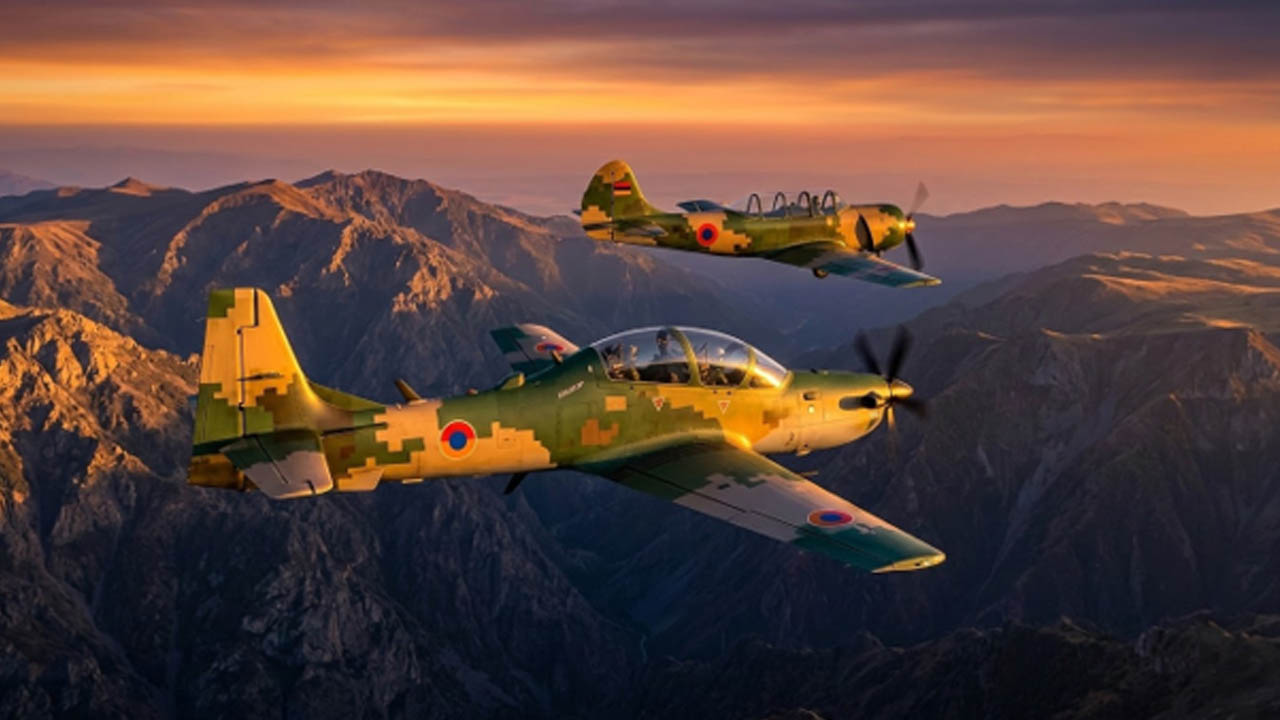
Expert opinion, August 14, 2026
Harutyunyan T.[1]
PART I: The attrition trap and the mountain shadow
In the opening months of 2026, the global defense community reached a stark, mathematical consensus: classical, ground-based air defense architectures are losing the economic war against low-altitude asymmetric threats. For decades, military planners envisioned air defense as an elite shield designed to swat down high-value assets – multirole supersonic jets, tactical ballistic missiles, and heavy strategic bombers. The weapons designed to achieve this, from Medium-Range Surface-to-Air Missiles (MRSAM) to Man-Portable Air Defense Systems (MANPADS), were engineered for extreme precision, packed with complex seeker heads and solid-fuel rocket boosters.
However, the proliferation of cheap, mass-produced plastic loitering munitions and tactical reconnaissance UAVs has turned this paradigm into a dangerous financial trap [1].
The mathematics of exchange ratios
To understand the crisis facing the air defense network of a nation like Armenia, one must look closely at the modern logistics of interception. When a swarm of potential aggressor kamikaze drones – such as the ADS Orbiter[2], Elbit Skystriker[3], or the Baykar Sivirsinek[4] – crosses the border, they represent a total material investment of roughly $50,000 to $150,000 per unit. Their airframes are composed of radar-absorbent plastics, their engines are small, commercial-grade two-stroke or electric motors, and their guidance loops rely mainly on commercial GPS or low-cost optical cameras.
To counter this threat, modern armed forces are forced to engage these swarms with standard, layered anti-aircraft missile systems.
- Deploying a single interceptor missile from a modern medium-range system like the Indian-supplied Akash[5] costs approximately $500,000.
- Resorting to short-range point defense, such as a French Mistral missile, costs roughly $550,000 per launch [2] [3].
The resulting economic exchange ratio is catastrophic: 1:3–1:10. A defending military is burning over half a million dollars of irreplaceable, high-tech inventory to neutralize a dispensable lawnmower with wings. In a sustained, high-intensity conflict, this does not just drain the national treasury; it triggers the dreaded “magazine starvation” effect. An adversary does not need to destroy a nation’s SAM batteries with kinetic strikes; they simply need to launch enough cheap drones to force the defenders to fire off every available missile in their warehouses. Once the premium interceptor stocks are depleted, the sky lies completely open to heavy tactical aviation and ballistic strikes [4].
The terrain-masking challenge of the South Caucasus
This economic imbalance is severely compounded by the physical geography of the Armenian Theater of Military Operations[6]. Virtually all of Armenia, except for the Ararat Valley, is characterized by extreme alpine topography, with jagged mountain ranges, deep, winding river gorges, and sharp elevation changes.
This terrain presents a challenge for traditional ground-based air defense radars [5]. Radar waves travel in straight lines of sight. When a radar station is placed on a mountain peak, it can scan the open horizon perfectly, but it cannot peer down into the adjacent valleys. Conversely, if a radar is placed within a valley, its detection range is choked by the surrounding rock walls.
This creates vast “radar shadows”[7] or terrain-masking corridors[8]. Highly trained drone operators exploit these blind spots intentionally. They program loitering munitions to hug the valley floors, flying just 50 meters above the ground, shielded by mountains. By the time a low-flying drone emerges over a ridge line and appears on a ground-based radar screen, it is often just seconds away from its target [6]. The defense network is left with no reaction time, rendering even the most advanced ground-based SAM systems blind and highly vulnerable to ambush.
To break out of this trap and seal the mountain valleys, air defense must be decoupled from the ground. It requires an agile, elevated asset that can look down into the gorges, detect the thermal signature of low-flying drones against the cold backdrop of the earth, and neutralize them using weapon systems that cost hundreds, not hundreds of thousands, of dollars. This is the front of the second-line propeller-driven interceptor echelon.
PART II: Infrastructure independence and a flexible air force
For a small nation facing peer adversaries with advanced ballistic missiles and long-range artillery capabilities, the traditional concept of an air force is an existential liability. Modern, supersonic multirole fighter jets, such as the Sukhoi Su-30SM or the Lockheed Martin F-16, are not just expensive to buy; they are tethered to massive, fragile, and highly visible ground infrastructure.
A modern jet fighter requires a pristine, debris-free concrete runway measuring at least 2,500 meters. It demands multi-million-dollar Hardened Aircraft Shelters (HAS) with specialized climate control systems to protect its delicate radar components and stealth coatings. It requires a small army of specialized technicians, specialized diagnostic computers, and a constant, heavy flow of high-grade aviation fuel.
In a high-intensity conflict in the South Caucasus theater, every permanent military airfield in Armenia is a pre-registered target for Azerbaijani and Turkish long-range precision weapons, such as the LORA[9] ballistic missile or TRG-300 Tiger[10] guided rockets. In the opening hours of a war, these fixed runways would be cratered, leaving expensive supersonic jets trapped on the ground or forced to land on compromised surfaces that would ruin their landing gear.
The light turboprop interceptor completely breaks this dependency. It allows a military to shift from centralized, vulnerable airbases to a highly survivable, distributed “Guerrilla Air Force”[11] model.
Rough-field capability and highway operations
Unlike premium jet aircraft, platforms like the Embraer A-29 Super Tucano[12], the KAI KT-1C[13], and even the legacy Yak-52[14] were engineered from the ground up for maximum ruggedness and austere operations.
A traditional jet fighter requires a 2500m long, pristine concrete runway and a climate-controlled hangar (a high-value fixed target). A light turboprop (A-29) requires less than 500m of rough terrain/rural highway and can be camouflaged even in a barn (high range and survivability).
The Super Tucano, for instance, features a heavy-duty, reinforced landing gear system fitted with low-pressure tires. This design allows the aircraft to operate safely from unpaved surfaces, rough dirt fields, and semi-prepared gravel airstrips. It requires less than 500 meters of clearance to take off and even less to land.
For the Armenian General Staff, this capability unlocks radical tactical flexibility:
- Rural Highway Integration: any straight, 600-meter section of a public asphalt highway in the Ararat valley or the Lori region can instantly be converted into a forward arming and refueling point (FARP).
- High-Altitude Adaptability: these rugged turboprops can be stationed directly in the tactical depth, hidden within mountain plateaus closer to the border, slashing response times against incoming drone swarms.
Barns instead of bunkers: The art of dispersal
The survival strategy of a light turboprop fleet does not rely on thick layers of reinforced concrete, but on absolute invisibility and mobility. Because these aircraft lack delicate stealth skins and hyper-sensitive electronic arrays, they do not require climate-controlled hangars.
Instead of building a $10 million hardened hangar that satellite intelligence can easily spot from space, a turboprop fleet can be hidden inside ordinary civilian and industrial infrastructure. A standard agricultural barn, a rural warehouse, or a highway maintenance shed can serve as a perfect hangar.
When a Super Tucano or a Yak-52 lands on a rural road, it can be taxied directly under the cover of a dense tree line, covered with a commercial camouflage net to defeat satellite optical sensors, or rolled into a village barn. Without a massive infrared signature or a constant stream of fuel trucks, these aircraft blend seamlessly into the civilian landscape.
If an enemy reconnaissance drone scans the area, it sees only a farming community, not a frontline air defense asset. This level of dispersion makes it statistically and financially impossible for an adversary to eliminate the air force via a pre-emptive missile strike.
The economics of sustained flight
Beyond survivability, the infrastructure independence of light aircraft directly translates into economic sustainability during a prolonged war of attrition.
Flight economy
| Aircraft type | Cost per flight hour (USD) |
| F-35 Lightning II | $30,000 – $35,000 |
| F-16 Fighting Falcon | $8,000 – $11,000 |
| Su-30SM Flanker-H | $7,000 – $9,000 |
| A-29 Super Tucano / KT-1C | $800 – $1,500 |
Light aircraft technical and price comparison
| Aircraft model | Engine power (hp) | Stall speed (km/h) | Flight ceiling (m) | Estimated unit cost ($) |
Cost per flight hour ($) |
| Yakovlev Yak-52 |
360 (Radial engine) | ~110 km/h | 4,000 m | $30,000–$60,000 (Used/upgraded) | $150–$250 |
| KAI KT-1C Woongbi | 950 (Turboprop) | ~135 km/h | 11,580 m | $5 mln–$7 mln | $800–$1,100 |
| Embraer A-29 Super Tucano |
1,600 (Turboprop) | 148 km/h | 10,670 m | $12 mln–$15 mln | $1,000–$1,500 |
The maintenance footprint of a turboprop is minimal. The Pratt & Whitney PT6 turboprop engine, which powers both the A-29 and the KT-1C, is one of the most reliable and widely used commercial aircraft engines in the world. Its maintenance can be performed with standard tools, and its fuel consumption is a fraction of a jet engine’s.
While a jet fighter requires dozens of maintenance hours for every hour of flight, a turboprop can be serviced by a small crew of 3 to 4 mechanics right in the field, turning the aircraft around for its next sortie in under 20 minutes. This low logistical footprint ensures that the fleet can maintain a high operational tempo, keeping eyes in the sky and protecting critical infrastructure without breaking the national defense budget.
PART III: Platform matchup & Armenian military-industrial complex integration
Deploying a light aviation tier requires selecting the right airframe and, crucially, integrating it with domestic technology to ensure operational sovereignty. For the Armenian Ministry of Defense, three distinct platforms offer varying trade-offs between aerodynamic capability, cost, and geopolitical availability.
When constructing a low-altitude Counter-UAS (C-UAS) tier for the Armenian Theater of Military Operations, selecting the appropriate airframe requires a strict balancing of aerodynamic power-to-weight ratios, rugged field survivability, and geopolitical export feasibility. While global defense markets offer various light attack and counter-insurgency (COIN) platforms, a rigorous filtering process eliminates the alternatives proposed by contemporary procurement models, specifically the Textron AT-6E Wolverine[15], Air Tractor AT-802U Sky Warden[16], Cessna AC-208 Combat Caravan[17], Pilatus PC-9M[18], and the Calidus B-250[19], leaving the triad of the Embraer A-29 Super Tucano, KAI KT-1C Woongbi, and Yakovlev Yak-52 as the only viable operational matrix.
Technical and geopolitical exclusions of competitive platforms
- Textron AT-6E Wolverine (USA) & Cessna AC-208 Combat Caravan (USA): Although the AT-6E is highly optimized for precision C-UAS effectors (such as the APKWS laser-guided rocket), both platforms are strictly bound by the United States Foreign Military Sales (FMS) and ITAR frameworks [7]. Obtaining US Congressional approval for frontline combat airframes to Armenia remains a diplomatic impossibility due to regional alignments. Furthermore, the AC-208 is a modified civilian passenger aircraft that lacks forward-firing integrated guns and exhibits high aerodynamic vulnerability to frontline SAM networks.
- Air Tractor AT-802U Sky Warden (USA): Built on a heavy agricultural airframe, the Sky Warden possesses high structural inertia and an excessively wide turning radius. Inside Armenia’s narrow, rocky mountain gorges (e.g., Vorotan and Debed canyons), it lacks the angular velocity to pursue maneuvering loitering munitions without risking Controlled Flight Into Terrain (CFIT). Its massive physical profile also prevents covert concealment within standard civilian infrastructure.
- Pilatus PC-9M (Switzerland): The Swiss-made PC-9M is a highly reliable turboprop, but Switzerland’s federal neutrality laws legally prohibit the export or third-party transfer of military-adaptable hardware to active or frozen conflict zones, enforcing an immediate legislative veto on Armenian procurement.
- Calidus B-250 (UAE): Despite strong bilateral ties between Yerevan and Abu Dhabi, the B-250 is operationally non-viable for rugged, decentralized theater logistics. Its 100% carbon-fiber composite airframe requires specialized laboratory autoclaves and vacuum equipment for battle-damage repair, failing the criteria for rough-field field maintenance. Additionally, as a low-rate initial production platform, it lacks operational combat history and carries hidden ITAR vulnerabilities due to its U.S.-sourced Pratt & Whitney engine and Rockwell Collins
The contenders: A-29, KT-1C, and Yak-52
- Embraer A-29 Super Tucano: The undisputed gold standard for high-altitude, low-velocity combat. Driven by a 1,600-horsepower Pratt & Whitney PT6A-68C engine, the Super Tucano provides the necessary power-to-weight ratio to operate effectively in the thin, rarefied air of Armenia’s mountain passes. Its 148 km/h stall speed allows it to match the slow cruise velocity of tactical UAVs perfectly. However, because it contains sensitive U.S.-sourced components, any sale requires Washington’s approval through the ITAR framework, introducing geopolitical hurdles [8] [9][10].
- KAI KT-1C Woongbi: South Korea’s frontline combat trainer offers a highly capable alternative, featuring an integrated under-fuselage Forward-Looking Infrared (FLIR) turret straight from the factory. While its 950-horsepower engine is less optimized for extreme mountain climbs than the A-29’s, its advanced digital cockpit simplifies single-pilot operations. The primary risk is geopolitical: Turkey is a major operator of the KT-1 platform, meaning Seoul might face heavy diplomatic pressure from Ankara to restrict sales to Yerevan.
- The Upgraded Yakovlev Yak-52: The ultimate asymmetric, budget-friendly option. Dozens of these robust, Soviet-era radial-engine trainers exist across the post-Soviet space and within civilian flying clubs. Flying at speeds between 150–200 km/h, a modified Yak-52 serves as a highly effective daytime drone hunter. It can be maintained for pennies, operated by civilian volunteer pilots, and modified locally without foreign oversight [11].
Aircraft comparison
| Aircraft platform | Main role for Armenia |
Political availability |
Economic efficiency |
| Upgraded Yak-52 | Ultra-low-cost tactical UAV interceptor (Daytime) | Maximum (available in CIS/Civilian clubs) | Extremely high (negligible flight hour cost) |
| Embraer A-29 Super Tucano |
High-altitude, multi-sensor C-UAS rear-guard shield | Medium (requires ITAR / U.S.-Brazil approval) |
High (under $1,000 per hour) |
| KAI KT-1C Woongbi | Factory-ready night hunter with under-fuselage FLIR | Low (subject to Turkish-Azerbaijani diplomatic pressure) | High (underpowered engine for extreme terrain) |
Engineering sovereignty: The role of the Armenian military-industrial complex
To prevent foreign suppliers from holding a structural veto over Armenia’s airspace security, imported airframes must be heavily modified using domestic defense technologies. The Armenian Military-Industrial Complex has matured rapidly, shifting from basic assembly to edge-tier software engineering and ordnance production. By integrating domestic subsystems, Armenia can transform basic training and light attack platforms into specialized, network-centric drone killers completely decoupled from foreign ITAR restrictions or source-code locks.
-
AI-driven optical scanners and thermal targeting nodes
The primary sensor for an aerial drone hunter is not a heavy, power-hungry radar, but a passive Optical-Electronic Station (OES). Armenian defense firms like UAV LAB and Davaro specialize in manufacturing stabilized, multi-sensor gimbals equipped with mid-wave infrared (MWIR) cameras and laser designators.
The critical upgrade for the 2026 theater is the integration of domestic computer vision and AI target scanning algorithms directly into the OES software loop. Armenian Locator specialized in AI-Driven Target Tracking, Sensor-to-Weapon Synchronization, Dual-Camera Feed Management and GNSS-Denied Navigation.
- Automated threat detection: Rather than relying solely on the pilot’s visual fatigue-prone scanning, the onboard AI processes the thermal feed in real-time. It automatically filters out ground clutter, birds, and mountain thermal glare to isolate the specific friction heat of a drone’s plastic airframe or the exhaust of its two-stroke engine.
- Bypassing proprietary avionics: By routing this AI-analyzed telemetry directly to a ruggedized cockpit tablet, Armenian engineers can bypass proprietary Western or Soviet avionics. This ensures that even an analog platform like the Yak-52 can hunt low-RCS (Radar Cross Section) enemy UAVs at night or through thick mountain fog using entirely sovereign algorithmic targeting.
-
The “Airborne Carrier” and FPV-interceptor fleet
One of the most revolutionary tactical integration options for Armenia is converting turboprops and trainers into flying motherships for high-speed FPV interceptor drones. While a Super Tucano or a Yak-52 has excellent flight characteristics, they are too large to safely dive into narrow, rocky gorges to chase a maneuvering quadcopter or a low-flying loitering munition.
To solve this problem, specialized anti-drone FPV quadcopters, such as the RD-1, can be mounted on the wings of these aircraft.
- The intercept loop: The manned aircraft patrols at an economical altitude of 3,000 meters, acting as a high-visibility surveillance and relay node.
- Kinetic release: Once a hostile Harop or Orbiter is flagged by the onboard AI deep within a valley, the pilot releases an Armenian FPV interceptor drone from the wing station.
- Extended lethal reach: The drone drops, ignites its high-RPM rotors, and is guided directly to a kinetic impact by the aircraft’s rear-seat operator using a short-range, jam-resistant data link. This effectively extends the weapon system’s reach into topographical dead zones without risking the pilot or the airframe.
-
Sovereign precision and kinetic ordnance
Beyond electronic warfare and interception, these light aircraft can be turned into highly flexible strike platforms by capitalizing on Armenia’s newly expanded domestic munitions production lines. This includes a wide array of specialized ordnance tailored for both C-UAS and counter-diversionary operations:
- Armenian guided glide bombs: For targeting enemy mobile drone control stations, communication relays, or forward launchers deep in rugged terrain, platforms like the Super Tucano can be fitted with locally developed smart glide bombs, such as the Dev-50 and GSA-155. Utilizing GPS/GLONASS correction coupled with Armenian laser-seeker heads, these munitions allow the aircraft to release ordnance from a safe distance, well outside the range of frontline man-portable air defense systems (MANPADS).
- High-explosive fragmentation (HE-Frag) bombs: For maximizing area-denial against low-altitude threats or forward operating positions, domestic HE-Frag bombs can be deployed. The fragmentation jackets are locally optimized to generate dense, predictable shrapnel clouds, which are highly effective at shredding the composite wings and internal electronics of grouped UAVs or soft-skinned vehicles.
- Air-dropped mortar mines: To maximize the utility of the ultra-low-cost Yak-52 tier, the industry can adapt standard, mass-produced domestic mortar mines for aerial release. By utilizing simple, locally manufactured mechanical wing racks with electrical release latches, a Yak-52 can carry clusters of modified mines. This provides a dirt-cheap, highly effective carpet-bombing capability to neutralize enemy Sabotage and Reconnaissance Groups (SRGs) infiltrating mountain paths.
-
Domestic firepower: The rationale for indigenous 12.7mm gun pod development
While guided missiles and smart bombs are optimal for high-value assets, the most cost-efficient method for downing a tactical drone remains heavy machine-gun fire. For the unarmed Yak-52 and the wing-station-dependent Super Tucano, the Armenian Military-Industrial Complex possesses the foundational capacity to develop lightweight, aerodynamic podded gun systems locally. By leveraging Armenia’s existing industrial infrastructure for the assembly, maintenance, and repair of standard 12.7mm heavy machine guns (such as the NSV Utes, Kord, or DShK platforms), local defense engineers could construct self-contained pods designed to mount directly onto standard NATO or Soviet bomb racks. Integrating a basic, locally wired electrical solenoid firing system connected to a trigger on the pilot’s control stick would allow a flight of modified aircraft to pour hundreds of rounds of heavy ammunition into a target airframe. This approach offers a highly sustainable, low-cost method to shatter composite drone wings and destroy internal guidance systems using readily available domestic small-arms ammunition inventories [12] [13] [14] [15] [16].
Armenian possible improvements and integration
| High-Tech Tier: A-29 / KT-1C Turboprop | Mobilization Tier: Upgraded Yak-52 |
| Thales GM200, Data Link & AI target scanning algorithms | Tactical AI computer for automated target identification |
| Local gyro-stabilized optics, FLIR | Local gyro-stabilized optics, FLIR |
| Armenian guided glide bombs & HE-Fragmentation bombs | Indigenous 12.7mm podded gun systems, Modular wing racks for local mortar mines & HE bombs |
| Aerial deployment of wing-launched FPVs | Cockpit-controlled Armenian interceptor drones |
PART IV: Tactical realism and the strategic blueprint
The introduction of light turboprops into the Armenian airspace architecture is not a panacea, and its success hinges on strict operational discipline. To pitch this concept successfully to defense planners, one must draw a hard line between where these platforms excel and where they will catastrophically fail.
Operational boundaries: Where propellers dare not fly
A common pitfall in evaluating aircraft like the Super Tucano is treating them as modern replacements for heavily armored, Soviet-era close air support (CAS) jets like the Sukhoi Su-25. In the context of a potential conflict with peer state actors in the South Caucasus theater, sending a slow, unstealthy propeller plane anywhere near the Line of Contact (LOC) is an immediate death sentence.
The front lines of modern warfare are blanketed by heavy, multi-layered air defense umbrellas. Long-range strategic surface-to-air missiles, mobile medium-range systems, and an intense saturation of radar-guided anti-aircraft artillery will easily lock onto and destroy a turboprop long before it can drop ordnance on an enemy trench. Furthermore, these platforms are utterly defenseless against high-altitude, supersonic multirole fighters like the F-16 or modern JF-17 Block III, which can fire active radar-guided missiles from deep within their own sovereign territory.
Therefore, the light aviation tier must be deployed strictly as a Rear-Guard Mobile Intercept Patrol.
Operating 20 to 40 kilometers behind the front lines, the turboprop fleet functions as an internal security mesh. Their patrol sectors are positioned directly over key economic and logistical arteries – shielding the capital city of Yerevan, the Metsamor Nuclear Power Plant, energy infrastructure, AI data centers, the transit corridors connecting the country to the southern and northern borders, etc. By flying in the rear, they stay safely out of range of frontline enemy radars while serving as an active netting that catches any low-flying kamikaze or reconnaissance drones that slip past the primary air defense border screens.
Estimated fleet size for effective patrols
To establish a continuous secondary defensive echelon, defense analysts typically use the “rule of 3” for military aviation (one aircraft on patrol, one returning/ready, one in maintenance).
- The Minimum Fleet: 12 to 16 aircraft would allow Armenia to keep a constant 24/7 combat air patrol (CAP) of 4 aircraft airborne simultaneously, covering key geographic vectors.
- The Ideal Fleet: 24 aircraft would provide deep coverage, allowing 6 to 8 planes to be airborne during high-alert periods while maintaining pilot rotation and maintenance cycles without gaps.
Conclusion: The strategic transformation of Armenian aviation
For the Republic of Armenia, the era of relying on prestige weapons systems as a metric of national security is over. The acquisition of multi-million-dollar heavy fighter jets like the Su-30SM provided a visual show of force but left the military with an unsustainable logistical burden and an asset too valuable and vulnerable to risk in localized drone conflicts.
The modern battlefield demands a transition to a distributed, highly resilient, and network-centric aviation ecosystem.
By establishing a secondary air defense echelon centered on rugged turboprops and modified trainers, Armenia can achieve a series of critical strategic objectives simultaneously:
- Economic symmetry: Shifting the interception cost from a $500,000 Akash or Mistral missile to a fraction of that amount using heavy machine guns or light laser-guided rockets, effectively neutralizing the enemy’s economic advantage in drone warfare.
- Infrastructure resilience: Eliminating the military’s reliance on large, fixed runways that can be targeted on day one of a conflict, moving instead toward a survivable “guerrilla” model based on dirt roads, barns, and rural highways.
- Industrial independence: Fueling the growth of the domestic Armenian military industry by creating an immediate, high-priority requirement for local optical sensors, FPV drone mounts, integrated AI decisions, and specialized modular weapons pods.
Ultimately, air superiority in the 21st century is no longer about who flies the fastest or the highest. It is about who can sustain a war of technological and financial attrition the longest. For a small mountain nation, looking down from a rugged, locally armed turboprop might just be the most practical and lethal way to keep the skies clear.
[1] PhD, worked at the “Noravank” Foundation as a Deputy Director; at the Public Administration Academy of Armenia as a Head of the Center for the Regional Studies; researcher at the Institute for Armenian Studies (Yerevan State University), and at the “Enterprise Incubator Foundation” as a Program Coordinator. Specialized in science and higher education management and regional security issues.
[2] ADS Orbiter is an Israeli tactical UAV family providing stealth reconnaissance and strike capabilities. It features runway-independent catapult launching, parachute recovery, and GPS-denied navigation, with unit prices ranging from $115,000 for loitering munitions to millions for full tactical multi-drone system packages.
[3] Elbit SkyStriker is an Israeli autonomous loitering munition providing stealth precision strikes. It features a modular 5-10kg warhead, a 100km range, and parachute recovery, with a base price per unit estimated at $105,000 to $110,000.
[4] Baykar Sivrisinek (Mosquito) is a Turkish low-cost tactical loitering munition designed for deep-strike swarm warfare. It features catapult launching, an internal combustion engine, AI visual navigation, and a 1,000 km range, with pricing undisclosed but designed as a high-volume, hyper-affordable asset.
[5] Akash is an Indian medium-range surface-to-air missile system offering autonomous air defense against aircraft, cruise missiles, and drones. It features mobile launchers, a ramjet engine, and multi-target tracking, with individual missiles priced at approximately $500,000.
[6] Theater of Military Operations is a specific geographic area – including land, sea, and air – where military forces conduct strategic combat operations during a war.
[7] Radar shadow is a blind zone created when physical obstacles like mountains, buildings, or dense storms block radar signals. Because radar waves travel in a straight line of sight, targets hidden inside these obstructed areas remain completely invisible to sensors.
[8] Terrain-masking corridors are low-altitude flight paths through valleys or behind ridges where terrain creates radar shadows. Pilots fly through these natural defiles to stay hidden from enemy radar systems by keeping landmasses between themselves and the sensors.
[9] LORA (Long Range Artillery) is an Israeli-developed, precision-strike quasi-ballistic missile. It travels at supersonic speeds up to 430 km, utilizing a low, unpredictable trajectory and mid-flight maneuvers to evade missile defense systems.
[10] TRG-300 Tiger is a Turkish-made, 300mm precision-guided artillery rocket developed by Roketsan. It fires from mobile launcher trucks, utilizing GPS/INS guidance to deliver surgical, long-range strikes against high-value ground targets up to 120 kilometers away.
[11] Guerrilla Air Force model involves a weaker military utilizing unconventional, asymmetric tactics to challenge a technologically superior air power. It relies on low-altitude ambushes, mobility, strict concealment, and quick hit-and-run strikes to bypass traditional air defense systems.
[12] Embraer A-29 Super Tucano is a Brazilian-designed, turboprop light attack aircraft. It is purpose-built for counter-insurgency, close air support, and reconnaissance, operating reliably from unpaved runways in low-threat environments with exceptionally low operational costs.
[13] KAI KT-1C is an upgraded, armed export variant of South Korea’s indigenous turboprop basic trainer. It functions as a light attack and reconnaissance aircraft, equipped with an upgraded glass cockpit, a centerline infrared pod, and wing hardpoints for gun pods, rockets, or bombs.
[14] Yakovlev Yak-52 is a Soviet tandem-seat, radial-engine trainer aircraft known for its robust metal construction and excellent aerobatic performance. Designed to train civilian and military pilots, its high maneuverability makes it highly effective for precision flight training.
[15] Beechcraft AT-6E Wolverine is an American single-engine turboprop light attack and reconnaissance aircraft. Developed by Textron Aviation Defense based on the T-6 Texan II trainer, it is purpose-built for counter-insurgency (COIN) operations, close air support (CAS), and maritime patrol. In 2022, the U.S. Air Force granted it a Military Type Certification, clearing the path for international export.
[16] Air Tractor AT-802U Sky Warden, officially designated by the U.S. military as the OA-1K Skyraider II, is an American single-engine, turboprop light attack and armed reconnaissance aircraft. Developed jointly by Air Tractor and L3Harris, it was selected in 2022 for the U.S. Special Operations Command (SOCOM) Armed Overwatch program. Modified from a rugged agricultural and firefighting aircraft, it is heavily up-armored and optimized for close air support (CAS) and intelligence gathering in austere, low-threat environments.
[17] Cessna AC-208 Combat Caravan is an American single-engine turboprop light attack and reconnaissance aircraft. Developed by Alliant Techsystems (ATK) – now part of Northrop Grumman – it is a heavily modified military variant of the ubiquitous Cessna 208 Grand Caravan civilian utility plane. Designed as an affordable, commercial off-the-shelf (COTS) solution for developing air forces, it provides light precision-strike, counter-insurgency (COIN), and intelligence, surveillance, and reconnaissance (ISR) capabilities.
[18] Pilatus PC-9M is a Swiss single-engine turboprop advanced military training aircraft manufactured by Pilatus Aircraft. Introduced as an upgraded, modernized variant of the standard PC-9, the “M” (Modernized) edition features structural refinements – such as an enlarged dorsal fin for improved longitudinal stability – and updated cockpit avionics. Though primarily designed to train future fighter pilots, its structural versatility allows it to be configured for light close air support (CAS) and target-towing duties.
[19] Calidus B-250 Bader is a next-generation light attack and advanced training turboprop aircraft developed in the United Arab Emirates (UAE) by Calidus in collaboration with Novaer and Rockwell Collins (now – Collins Aerospace). Unveiled at the Dubai Airshow in 2017, it is unique for being the first combat aircraft designed and built entirely from carbon-fiber composite materials, resulting in a lighter airframe with superior maneuverability and corrosion resistance.
References
- The State of Integrated Air and Missile Defence: How NATO and Its Allies Are Building Full‑Spectrum Air Defence for 2030. Unmanned Airspace, 20.03.2026, https://www.unmannedairspace.info/commentary/the-state-of-integrated-air-and-missile-defence-how-nato-and-its-allies-are-building-full-spectrum-air-defence-for-2030/
- S. Tiwari, Indian Missiles, Chinese UAVs & Iranian SHORAD: Armenia Showcases Diversified Arsenal Post-Nagorno Karabakh Setback. The Eurasian Times, 31.05.2026, https://www.eurasiantimes.com/armenia-showcases-diversified-arsenal/
- France to sell Thales GM 200 radars and Mistral air defense systems to Armenia. Armenpress, 24.20.2023, https://armenpress.am/en/article/1122654
- A. Burilkov, G.B. Wolff, The costs and failures of air defence in the Iran conflict and what they mean for Europe. Bruegel, 30.03.2026,
https://www.bruegel.org/first-glance/costs-and-failures-air-defence-iran-conflict-and-what-they-mean-europe - G. Gressel, Military lessons from Nagorno-Karabakh: Reason for Europe to worry. European Council on Foreign Relations, 24.11.2020,
https://ecfr.eu/article/military-lessons-from-nagorno-karabakh-reason-for-europe-to-worry/ - Sh. Shaikh, W. Rumbaugh, The Air and Missile War in Nagorno-Karabakh: Lessons for the Future of Strike and Defense. Center for Strategic and International Studies, 08.12.2020,
https://www.csis.org/analysis/air-and-missile-war-nagorno-karabakh-lessons-future-strike-and-defense - A. Spray, US military eyes Textron’s AT-6 Wolverine light aircraft as drone hunter. Aerospace Global News, 27.10.2025,
https://aerospaceglobalnews.com/news/textron-drone-hunter-aircraft/ - Embraer to expand A-29 Super Tucano capabilities to counter Unmanned Aerial Systems. Embraer, 11.11.2025,
https://www.embraer.com/media-center/en/?mediatype=NEWS&detail=23308-Embraer-to-expand-A-29-Super-Tucano-capabilities-to-counter-Unmanned-Aerial-Systems - C. Charpentreau, E. Yates-Badley, Latvia weighs Embraer A-29 Super Tucano as drone hunter. Aero Time, 12.08.2026,
https://www.aerotime.aero/articles/latvia-a29-super-tucano-counter-drone-aircraft - Intel Report, ITAR Preserving America’s edge. Key Aero, 21.03.2019, https://www.key.aero/article/itar-preserving-americas-edge
- Th. Newdick, This Is How Ukrainian Yak-52 Crews Hunt Russian Drones. TWZ, 30.08.2025,
https://www.twz.com/air/this-is-how-ukrainian-yak-52-crews-hunt-russian-drones - Armenian government invested about 450 million dollars in military-industrial complex in 2023–2025: PM. Armenpress, 08.11.2025, https://armenpress.am/en/article/1234467
- The Armenian government has allocated 150 billion drams for the development of the military industry by 2028. ARKA, 03.12.2025,
https://arka.am/en/news/economy/the-armenian-government-has-allocated-150-billion-drams-for-the-development-of-the-military-industry/ - RISE Powered by Silicon Mountains 2026 showcases Armenia’s defense and tech innovations. Armenpress, 03.06.2026,
https://armenpress.am/en/article/1251863 - Armenia intends to enter the global defense industry market: Military Industry Committee. ARKA, 03.06.2026,
https://arka.am/en/news/economy/armenia-intends-to-enter-the-global-defense-industry-market-military-industry-committee-/ - Armenian defense industry highlighted at Eurosatory 2026 as minister outlines AI and cooperation vision. Armenpress, 19.06.2026, https://armenpress.am/en/article/1253511