
Publication
A comparison of Iran and Turkey’s foreign policies in the South Caucasus and West Asia: an analysis from the perspective of regionalism

Dr. Ehsan Movahedian[1]
1․ Introduction
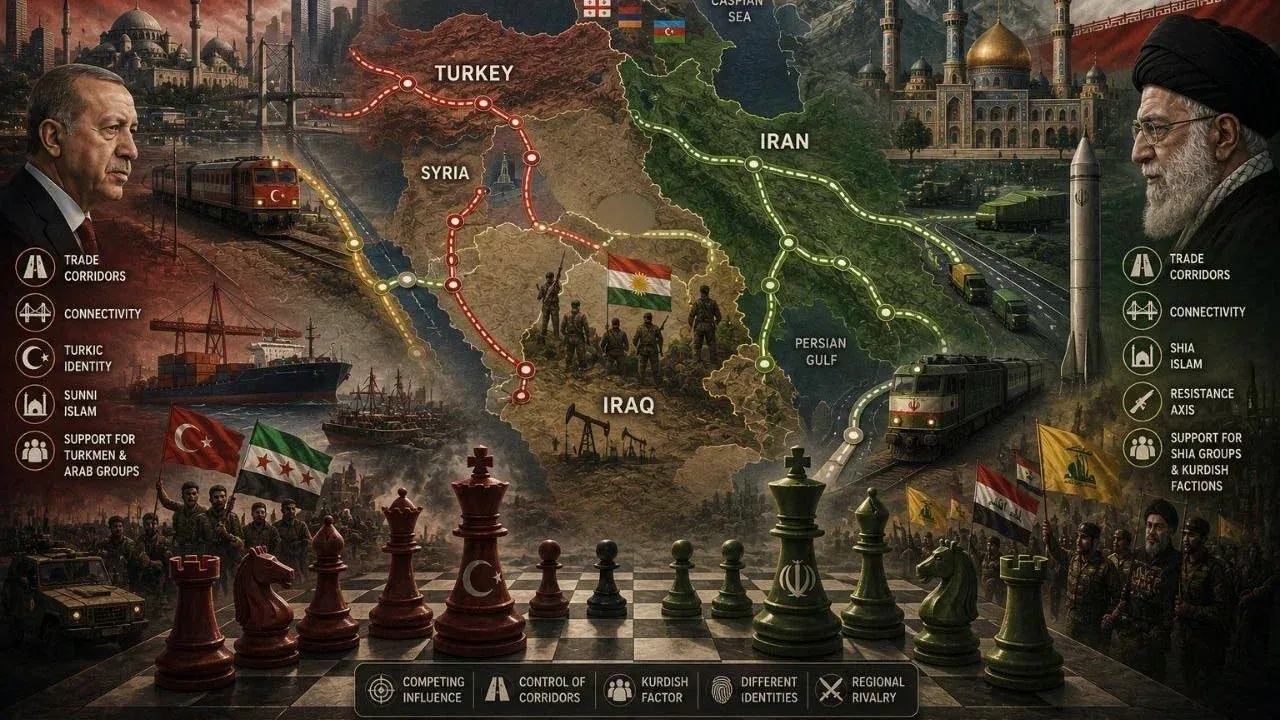
The collapse of the Soviet Union, and especially the developments from the 2010s onwards, have turned the South Caucasus and West Asia into a dynamic arena for the agency of two historical powers, Iran and Turkey. Iran, relying on its long-standing civilizational, linguistic, identity-based, and religious ties with its neighbors in the South Caucasus and West Asia, and Turkey, utilizing the discourse of Neo-Ottomanism and Pan-Turkism, each seek to play a role and exert influence in these two regions. The fundamental question is: what are the substantial differences between these two approaches, and what are their implications for the regional order? Using the theoretical framework of regionalism within constructivist theory, the present article traces this distinction at both the identity-discursive and functional-strategic levels. The main hypothesis of the article is that Iran pursues regionalism as an endogenous, participatory process based on shared culture and identity with its neighbors in the South Caucasus and West Asia, whereas Turkey, through a trans-regionalist approach and via alliances with extra-regional powers such as the U.S., UK, and NATO member states, acts to create a Turkish-Sunni hegemonic bloc and advance a policy of containing Iran.
2. Theoretical framework: regionalism in the mirror of constructivism; from the social construction of identity to patterns of competition
To fundamentally understand the difference between Iran and Turkey’s foreign policy approaches in the South Caucasus and West Asia, we need an analytical framework that goes beyond mere material and geopolitical reductionism and penetrates the deeper layers of identity and meaning in state action. Mainstream classical theories of international relations, when analyzing the phenomenon of region and regionalism, have largely been based on material foundations and instrumental rationality. In the realist tradition, a region is merely a given, predetermined geographical space where states compete for power and relative security, and the polarity structure governing the international system shapes their behavior. In this view, a region is nothing but a reflection of the material structure of power distribution. On the other hand, liberal and neoliberal institutionalist theories, although more optimistic about the possibility of cooperation, mainly view a region as a geographical domain formed through economic interactions, trade interdependence, and functionalist institution-building. For liberals, ‘regionalization’ is the product of spillover from techno-economic cooperation and the rational choice of states to maximize absolute gains. Common to both paradigms is the neglect of the identity-based, historical, and meaningful content that constructs a region in the minds and practices of its actors (Dehghani Firoozabadi, 1998, p. 569).
In contrast, constructivism, as a theoretical approach, opens a new window to understanding the region by creating an ontological and epistemological shift. Emphasizing the ‘social construction of reality’, constructivism shifts the hard core of analysis from merely material structures to semantic and normative structures. From this perspective, social and political realities, including “region”, are not natural or pre-given, but rather ‘social constructs’ built and reproduced through the continuous interaction of actors based on shared intersubjective meanings, identities, and mental images. Therefore, a region is not merely a set of neighboring countries on a map; it is a space where states and nations consider themselves part of a collective ‘us’, see their destinies as intertwined, and internalize regional identity through socialization (Wendt, 2022).
Adler and Barnett (1998), in their theory of ‘security communities’, demonstrate well how political communities, by creating collective identity, mutual trust, and defining shared interests, build a peaceful and stable region where resorting to force to resolve disputes becomes unthinkable. In such a process, ‘identity convergence’ and ‘discursive interdependence’ are far more important than mere physical proximity or economic exchanges. In other words, regions are ‘imagined communities’ whose members share a common self-awareness of belonging to an integrated whole, even if that whole is politically divided into independent units. For example, the sense of belonging to the ‘Islamic world’, the ‘Iranian civilizational sphere’, or the ‘Turkic world’ are all identity constructs that can become the basis for political action and regionalism.
Based on this theoretical foundation, two distinct ideal patterns of regionalism can be formulated, each identifiable by its identity nature, sources of legitimacy, means of advancing foreign policy, and security consequences:
2.1. The first pattern: endogenous regionalism
This pattern emerges when a region is constructed based on deep and authentic cultural, civilizational, historical, and identity ties among its societies. In this case, the driving force of convergence among countries is not the imposition of a hegemonic power’s demands, but rather the existence of natural ‘enabling factors’ for agency and the creation of a block of like-minded and aligned countries. Endogenous regionalism springs from shared language, religion, rituals, and common historical experiences, and for this reason, enjoys a high degree of acceptance and legitimacy among regional elites and the general public. This type of regionalism is inherently deterrent, balancing, and stability-oriented:
– It is deterrent because, by strengthening internal capacities and collective ties, it prevents the infiltration and destructive intervention of extra-regional powers and provides security as an intra-regional public good for the benefit of all countries.
– It is balancing because, by accepting the diversity and plurality of actors within a shared identity framework, it seeks to naturally create a balance of power among actors, prevent the emergence of unilateral hegemony, and strengthen multilateral mechanisms.
– It is stability-oriented because it preserves the existing geopolitical status quo, official borders, and national sovereignty of countries, and guides changes through peaceful and gradual paths. This pattern views stable order as the product of identity convergence and mutual trust, not the result of a balance of terror or purely economic dependence.
2.2. The second pattern: imposed or hegemonic trans-regionalism
In contrast to the previous pattern, imposed or hegemonic trans-regionalism emerges when a regional power or a set of extra-regional powers, lacking authentic identity-based commonalities with the host societies but relying on material superiority (military and economic) and soft instruments (media, education, religion), seeks to construct a region based on their own identity and interests. This pattern advances ‘regionalization’ not as a spontaneous and natural process, but as a top-down ‘political project’, often through alliances with powers outside the region (Jamshidi, 2007, p. 791). The result is the construction of an artificial, fake, or distorted identity (such as the concept of ‘Turan’ as opposed to ‘Iran’) that lacks deep roots in the historical self-awareness of the region’s societies. This pattern has an aggressive, counter-balancing, and destabilizing approach:
– It is aggressive because, to consolidate its imposed identity and interests, it resorts to military intervention, border changes, demographic engineering, identity manipulation, and the creation of coercive corridors.
– It is counter-balancing because it openly seeks to eliminate or contain rivals (especially rivals with natural ties to the region) and create a unipolar hegemonic order in its own favor, rather than establishing balance.
– It is destabilizing because, by inciting population groups and ethnicities, creating artificial identity cleavages, supporting extremist groups, and violating the national sovereignty of countries, it shatters the previous stable security architecture and plunges the region into a cycle of instability and perpetual conflict. The reason for its instability is that the imposed identity constantly faces resistance from the target societies and requires the continuous use of force and repression for its survival. This order can be described as a “fragile order resting on active identity fault lines” that could collapse at any moment.
The present article argues that the above two patterns well explain the essence of the difference between the foreign policy approaches of Iran and Turkey in the South Caucasus and West Asia. Iran’s foreign policy in this geographical area is close to the pattern of endogenous regionalism. Due to its deep civilizational, linguistic, and religious commonalities with the inhabitants of West Asia and the South Caucasus, Iran considers this region its natural civilizational sphere and possesses enabling, natural, and non-interventionist factors for creating convergence. Its approach is based on maintaining stability, respecting sovereignties and existing borders, and deterring destructive extra-regional influence. In contrast, Turkey’s foreign policy tends toward the pattern of imposed trans-regionalism. Ankara, centered on the discourse of Neo-Ottomanism and Pan-Turkism and in strategic alliance with the U.S., UK, and NATO, seeks to construct a ‘Turkish world’ as a region under its own hegemony. This project, designed to counter Iran’s natural influence and cause its geopolitical strangulation, is inherently destabilizing and crisis-creating due to the lack of authentic identity-based commonalities and its reliance on aggressive instruments. This theoretical framework will be the basis for the author’s analysis in the following sections to precisely compare the policies of the two countries in various areas.
2.3. Iran’s foreign policy: endogenous, deterrent, and stability-oriented regionalism
Due to its deep historical, civilizational, linguistic, and religious ties with the inhabitants of West Asia and the Caucasus, Iran defines the region not as an artificial sphere of influence but as its own civilizational sphere. These identity-based commonalities, ranging from Kurds and Lors to Persians and Azerbaijanis, and the Shiites of the region, provide favorable ground for a convergence policy and the creation of a bloc of like-minded powers (Masoumi, 2022). Iran, aware of this capacity, acts with a deterrent and balancing approach: on the one hand, by strengthening the ‘Axis of Resistance’ and supporting aligned states and movements, it curbs extra-regional influence and security threats; on the other hand, it consistently emphasizes the stability of borders, respect for national sovereignty, and the peaceful resolution of disputes (Jafari & Darabi, 2022, pp. 54-59). In the Caucasus, Tehran has opposed any geopolitical change of borders or imposed corridors that would lead to its encirclement or weakening and has proposed multilateral initiatives like ‘3+3’ for regional crisis management. This is endogenous regionalism, aimed at stabilizing and preventing the influence of actors outside the region.
2.4. Turkey’s foreign policy: aggressive and destabilizing trans-regionalism
In contrast, Turkey, under the discourse of Neo-Ottomanism and Pan-Turkism and in alignment with the U.S., UK, and NATO, has pursued a pattern of ‘trans-regionalism’ that redefines the region as a space for restoring historical prestige and establishing Turkish hegemony (Naghibzadeh & Khalil Tahmasebi, 2022, pp. 272-279). This approach has aggressive, counter-balancing, and destabilizing components: it is aggressive because it seeks to create a ‘Turkish world’ through coercive corridors and military intervention in the South Caucasus, Syria, Iraq, and Libya; it is counter-balancing because it openly seeks to contain Iran’s cultural, economic, political, and security influence; and it is destabilizing because, by changing demographic composition, identity manipulation, inciting ethnicities, and supporting extremist groups such as ISIS, it disrupts the region’s security architecture (Ahmadi, 2009, pp. 3-9).
Turkey’s policy complements the West’s strategy for the ‘geopolitical strangulation’ of Iran by blocking transit routes in the north, northwest, and west of the country and creating security threats, aiming to reduce Iran’s resilience and establish Turkey as the region’s hegemon. However, despite its coordination with Washington, Ankara refrains from supporting the disintegration of Iran; because it fears that Kurds and Israel might exploit Iran’s collapse to dismember the country and then threaten Turkey (Roushani & Mossaedegh, 2021, p. 127).
In the following, the dimensions of this rivalry are analyzed in 9 key areas according to the views of Iranian experts.
3-1. The Caucasus foreign policy of Iran and Turkey: the ‘NATO Turani Corridor’ vs. geopolitical sustainability
The South Caucasus region, especially after the Second Karabakh War in 2020, has become the clearest arena of confrontation between Iran’s pattern of ‘endogenous regionalism’ and Turkey’s ‘’imposed trans-regionalism’. This war, which ended with Baku’s victory thanks to Turkey’s full military, advisory, and political support for the Republic of Azerbaijan, was not merely a territorial conflict but a turning point in activating Ankara’s long-held projects to revise the region’s geopolitical architecture in its own favor and to Iran’s detriment. Turkey, maximizing the use of this development, placed the project of territorial linkage with the Republic of Azerbaijan and, beyond that, with the entire Turkic world on its agenda with unprecedented seriousness. Iranian experts analyze this project as the ‘NATO Turani Corridor’ and call it a “strategic dream for the geopolitical encirclement of Iran”. In this plan, creating a communication corridor through Armenia (Syunik province) to physically connect Nakhchivan to mainland Azerbaijan and then to Turkey is the first and most critical step. The ultimate goal of this corridor is not merely a transit route, but the elimination of the physical border between Iran and Armenia, cutting off one of Tehran’s main breathing routes to the north and the Caucasus, and ultimately, the territorial connection of Turkey to the Caspian Sea and the Central Asian republics through a route under Ankara–Baku control and influence (Kazemi, 2022).
This ambitious idea, promoted under the discourse of the ‘Turkish world’ with the aim of creating a Turkish civilizational-political bloc, is not merely a Turkish nationalist project but also enjoys the strategic backing of extra-regional powers. Iranian experts explicitly refer to this emerging structure as ‘Turkic NATO’ and argue that the goal of creating this bloc, which clearly enjoys the support of the United States, UK, and NATO, goes beyond cultural and economic convergence; Turkey seeks to establish a unified military-security front on Iran’s northern borders. This ‘Turkic NATO’, by strengthening the military capability of the Republic of Azerbaijan, holding joint exercises, intelligence and security coordination, and even inviting Armenia to join this bloc, aims to complete the encirclement ring around Iran from the north. The invitation to Tajikistan, a Persian-speaking country with cultural affinities, to join this organization shows Turkey’s effort to penetrate the depths of Iran’s civilizational sphere and change its identity in favor of the ‘Turkish world’. Iranian experts consider this policy as “a continuation of the strategy of Iran’s geopolitical strangulation”, designed in full coordination with Washington to block Iran’s transit routes in the north, northwest, and west.
However, this imposed trans-regionalism of Turkey also faces internal challenges and resistance that reveal its artificial and fragile nature. The most important example is Kazakhstan’s cautious approach as the most powerful and important Central Asian member of the Organization of Turkic States. Kazakhstan, contrary to Turkey’s wishes, does not seek the excessive securitization and politicization of this organization and accepts its function at most within the framework of cultural and economic cooperation. From Kazakhstan’s perspective, pursuing Turkey’s interventionist and anti-Iranian approaches could endanger Astana’s balanced and vital relations with Moscow, Beijing, and Tehran, and turn the region into a new hotspot of tension. This gap reveals the inherent weakness of Turkey’s imposed trans-regionalism pattern: the lack of natural identity-based commonalities and shared interests makes this imposed order fragile and dependent on the will of an extra-regional power.
In contrast to this aggressive project, Iran’s Caucasus policy, based on the pattern of endogenous regionalism, rests on 3 principles: geopolitical sustainability, respect for the national sovereignty of countries, and the creation of peaceful transit routes. This Iranian approach can be called ‘defensive regionalism’, in which Iran, perceiving extra-regional threats, focuses on ‘deterrence and balancing’ rather than offering alternative hegemonic or trans-regional projects. For Tehran, any imposed corridor that violates Armenia’s national sovereignty and limits Iran’s access to Europe and Asia has been declared a ‘strategic red line’. Therefore, Iran views the so-called ‘Zangezur Corridor’ not as a simple transit route, but as part of a comprehensive plan to sever Iran’s vital geo-economic arteries and complete its northern encirclement. Accordingly, while emphasizing Armenia’s sovereign right over its communication routes, Iran has proposed initiatives such as the ‘Peace Crossroads’ within the framework of ‘3+3’ meetings for regional crisis management. Some Iranian experts define Turkey’s policy under the West’s ‘geopolitical strangulation’ strategy against Iran and call Iran’s counter-strategy ‘geopolitical sustainability’; a strategy that seeks to preserve the existing status quo of borders, prevent the creation of coercive corridors, and strengthen alternative corridors such as the ‘North-South Corridor’ centered on Iran.
In the deeper layers of this rivalry, the identity dimension also plays a decisive role. Some Iranian experts argue that the ‘Turani Corridor’ project is not merely a transport route but the backbone of a ‘fabricated identity construction’. This corridor is supposed to implement the political concept of ‘Turan’ – constructed in opposition to the civilizational concept of ‘Iran’ – on the map through the physical connection of Turkic-speaking lands. This identity construction, by appropriating Iranian symbols and celebrities (as will be discussed in Section 3-3) and attempting to distort the true history of the region which is linked to Iran, seeks to marginalize Iran’s civilizational presence and influence in the Caucasus and Central Asia and replace it with a Turkish-Turani narrative. In the face of this aggressive wave, Iran advances its endogenous regionalism by emphasizing ‘authentic civilizational, identity-based, linguistic, and religious commonalities’ with neighboring countries and counters this imposed project by stressing shared identity based on celebrations like Nowruz, Persian literary heritage, and historical coexistence. Thus, the confrontation in the Caucasus is not just over pipelines and corridors, but a battle between two identity narratives and two patterns of regionalism: Iran’s regionalist, endogenous, and peaceful ‘geopolitical sustainability’ versus Turkey’s trans-regional, exogenous, and destabilizing ‘Turani Corridor’.
3-2. Sunnitization and Wahhabization in opposition to Iranian Shiism: manipulating religion as an instrument of trans-regionalism
One of the most complex and yet destructive dimensions of Turkey’s imposed trans-regionalism in the South Caucasus and West Asia is the instrumental use of religion to undermine Iran’s historical and civilizational influence. This strategy, which can be called ‘religious manipulation’, is operationalized at two complementary but distinct levels: at the first level, the ‘Sunnitization and Wahhabization’ of non-Sunni Muslim communities, especially Shiite communities in the Republic of Azerbaijan; and at the second level, the ‘creation and promotion of a model of non-Iranian and anti-Iranian Shiism’ that aligns identity-wise with Ankara–Baku and is defined in opposition to Iranian Shiism and the religious authority centered in the city of Qom. This policy, in its essence, is not an authentic religious act, but a political-security project within the framework of the grand strategy of ‘geopolitical strangulation of Iran’ and in continuation of the historical tradition of Neo-Ottomanism (Rafie & Mazloumi, 2012, pp. 88-89).
To understand the depth of this policy, it must be analyzed in its historical continuum. According to Iranian experts, Turkey’s religious policy in the Caucasus is a direct continuation of the Ottoman Empire’s Re-Sunnification strategy. The Ottomans, who always considered themselves the standard-bearers of the Islamic world and the Caliph of Muslims worldwide, used religion as a tool to create rifts in Shiite communities and draw them into Istanbul’s sphere of influence in their rivalry with Safavid Iran. The Justice and Development Party (AKP) under R. T. Erdogan, by redefining its Turkish-Islamic identity within the framework of Neo-Ottomanism and ‘Muslim Brotherhood’-style politics, has revived this historical strategy and, using modern educational, media, and economic institutions, seeks to promote ‘Sunni-Brotherhood’ Islamic teachings or, at the very least, make the Muslims living in the Caucasus, as well as Iraq, Syria, Palestine, and Lebanon, indifferent to Iranian Shiism. Some Iranian experts call this approach ‘covert Wahhabization’ and believe that Ankara, in cooperation with some Salafi and Wahhabi institutions also supported by Saudi Arabia, is gradually injecting Salafi-Wahhabi teachings among Shiite communities in the neighborhood. This process, by promoting ‘Salafi-Brotherhood’ values, customs, and rituals, paves the way for the emotional and intellectual detachment of these communities from Iranian Shiism and their rapprochement with Turkish-Salafi Islam.
The second dimension of this project, perhaps more complex and dangerous, is the attempt to ‘create a new model of Shiism’ whose intellectual, political, and even jurisprudential authority is defined not in Qom and Najaf, but in Baku and Ankara. The establishment of modern religious and educational institutions in the Republic of Azerbaijan, Iraq, Syria, etc., indicates that Turkey and the Republic of Azerbaijan are nurturing a generation of Shiite clerics and elites who present a ‘nationalist and Turkish’ narrative of Shiism; a narrative in which Turkish national identity takes precedence over transnational Shiite identity, and Iran is introduced as the ‘other’ or even the ‘historical enemy’. This ‘Turkish Shiism’ is explicitly defined in opposition to ‘Iranian Shiism’ and the Axis of Resistance in Iraq, Lebanon, Palestine, and Syria. The ultimate goal of this policy is to sever the organic and longstanding connection of the Shiites of the Caucasus and West Asia with the religious authority and political jurisprudence teachings of Shiism in Iran, and to draw them into the political and cultural orbit of Ankara–Baku. In other words, they seek to ‘nationalize religion’ and appropriate it for the political project of the ‘Turkish world’, so that Iranian Shiite authority loses its ability to influence neighboring countries. Turkey pursues this project in various countries through identity and ethnic groups close to it; for example, in Iraq, by investing in the Turkmen ethnicity, it tries to distance them from Iranian-style Shiism.
But this religious manipulation project is not limited to Iran’s neighbors; it is also pursued in Iran’s own Azeri provinces to promote divergence and federalism. According to Iranian experts, the ultimate goal of this policy is to export this new identity-religious model to the Azeri-populated regions of Iran, including Tabriz, Ardabil, Urmia, and Zanjan. By investing in some extremist ethnic circles inside Iran, Ankara tries, first, to weaken the sense of belonging of Iran’s Azeris to the Shiite faith and Iranian national identity by creating a ‘religious and identity-based divergence’ among them, and then, by offering an alternative ‘Turkish-Brotherhood’ Sunni identity, to create a ground for raising ethnic and political demands inside Iran in its own favor. Turkey’s religious and identity intervention in the Azeri-populated regions of Iran has led to financial, media, and educational networking by Turkey in Azeri and even non-Azeri regions of Iran over the past two decades, and groundwork for promoting the idea of federalism, which will be discussed in detail in Section 3-5.
In contrast to this aggressive and destabilizing project, Iran’s religious policy is defined entirely based on the pattern of endogenous regionalism (religious coexistence versus identity imposition). Relying on its long-standing tradition of coexistence among different religions and sects within its own geography and the region, Iran has never sought to impose a religion or create artificial, handcrafted sects to advance political goals. Iran’s religious influence in the Caucasus and West Asia, which has historical and natural roots, is exercised primarily through cultural diplomacy, religious seminaries (Howza), training of clergy, and the soft expansion of the discourse of the Islamic Revolution. Therefore, Iran’s soft power in the region does not stem from religious manipulation projects but is a natural product of long-standing civilizational and religious commonalities; for this reason, it enjoys greater depth and sustainability compared to Turkey’s artificial and imposed projects. This fundamental difference once again reveals the confrontation between the two patterns of regionalism: Iran’s endogenous regionalism, based on accepting plurality and strengthening authentic identity and religious commonalities, versus Turkey’s imposed trans-regionalism, which, through manipulation and falsification of the authentic identity and religion of the region’s people, seeks to create a uniform and hegemonic bloc to the detriment of its rival and historical other, Iran.
3.3. The transformation of the concept of Iran into Turan: identity engineering as a tool for undermining Iranian nationhood and cultural influence
If Turkey’s Caucasus policy (Section 3.1) represents the hard and geopolitical dimension of Ankara’s imposed trans-regionalism, and religious manipulation (Section 3.2) reflects its semi-hard socio-security dimension, then the project of transforming the concept of “Iran” into “Turan” may be regarded as the core of Turkey’s soft-power strategy and psychological operations in the South Caucasus and Central Asia. Rooted in the pseudo-scientific theories of Pan-Turkism that emerged in the early 20th century, this project employs a broad array of media, educational, cinematic, and literary instruments to fundamentally rewrite the history, civilization, and regional identity of a geographical sphere that, for more than two millennia, has been closely associated with Iran and the Iranian-Islamic cultural tradition.
The ultimate objective of this identity manipulation extends far beyond a mere historical claim. Rather, it seeks the comprehensive appropriation of Iran’s civilizational legacy throughout the region, the expropriation of its cultural and intellectual heritage, and ultimately the erasure of “Iran” from the mental and identity maps of the peoples of the Caucasus, Central Asia, and even segments of Iran’s own population. Such efforts aim to create the ideological and cultural foundations necessary for the consolidation of a broader “Turkic world” under Turkish leadership. Similar, albeit less intensive, initiatives can also be observed in Iran’s western neighborhood, particularly in Iraq and Syria. This process may be viewed as the soft-power complement to the broader strategy of Iran’s geopolitical containment; before Iran can be physically encircled, it must first be subjected to cultural and civilizational encirclement (Kazemi, 2010).
The most visible manifestation of this project is the appropriation and reinterpretation of shared regional symbols and traditions. The most prominent example is the attempt to appropriate Nowruz – the oldest Iranian festival and one of the most significant civilizational symbols of the Iranian cultural sphere – and redefine it as a “Turanian holiday” or a specifically “Turkic spring festival. State-affiliated media outlets in Turkey and the Republic of Azerbaijan frequently seek to downplay the Iranian origins of Nowruz and recast it as an ethnic Turkic celebration. This historical distortion, which disregards extensive archaeological, historical, and literary evidence, serves a broader political purpose: severing the emotional and cultural connection between millions of people who celebrate Nowruz and the Iranian civilizational tradition, while attaching the festival to a newly constructed and politically motivated Turanian identity. Such actions may be interpreted as a form of identity appropriation on a civilizational scale and constitute an important component of a broader cognitive struggle over the historical memory of the peoples of the region.
Following the appropriation of cultural traditions, attention shifts toward the appropriation of historical personalities and intellectual heritage. In this regard, few examples are as illustrative as efforts to redefine the identity of the poet Nizami Ganjavi, one of the greatest narrative poets in the history of Persian literature. Historical, linguistic, cultural, and geographical evidence overwhelmingly confirms Nizami’s Iranian cultural identity. He composed exclusively in Persian, lived within the cultural environment of the Iranian world, and his works are deeply infused with themes derived from pre-Islamic Iranian traditions as well as Iranian-Islamic intellectual thought. There is no evidence that he ever composed poetry in Turkic.
Nevertheless, Pan-Turkist intellectual and political circles have systematically sought to reinterpret Nizami as a Turkic figure through conferences, monuments, publications, and media productions. According to critics of this process, these efforts have even involved alterations to the presentation of Nizami’s mausoleum in the Republic of Azerbaijan, including the removal of Persian inscriptions and the attribution of fabricated Turkish verses to the poet. Such practices, which stand in contradiction to established scholarly and academic standards, are interpreted by these critics as part of a broader political effort to diminish the Iranian cultural identity of the Caucasus.
A similar process is often identified in relation to Jalal al-Din Rumi (Mawlana). Through extensive investment in the cultural and tourism industries centered in Konya, Turkey has sought to present Rumi primarily as a “Turkish Sufi”, thereby incorporating another major component of the Iranian-Islamic intellectual tradition into a Turkish national narrative. These efforts may be understood as attempts to appropriate the soft-power assets of Iranian civilization and relocate them within an alternative identity framework.
These individual cases of cultural appropriation should be understood within the context of a broader project aimed at transforming the geographical and civilizational concept of “Iran” into that of “Turan”. This project involves the construction of an imagined geography and a manufactured collective identity. In classical Iranian historical and mythological narratives, “Turan” referred to lands beyond the Amu Darya (the Ceyhon River) inhabited by people of Iranian origin but were not under the rule of the Iranian government and had no identity or civilizational connection with the Turks of Central Asia. Pan-Turkist ideology, however, has reinterpreted the concept as the ancient homeland of all Turkic peoples and positioned it in direct opposition to Iran.
Beginning in the early 20th century, Pan-Turkist intellectuals constructed an expansive historical narrative portraying “Turan” as a transcontinental homeland extending from the Balkans to Siberia while simultaneously depicting Iran as the historical adversary of this imagined community. Today, this constructed geography serves as the conceptual foundation for political and cultural representations of the “Turkic World” and is increasingly reflected in educational materials, official maps, and political discourse in both Turkey and the Republic of Azerbaijan. This phenomenon may be described as “fake geographization”, whereby an imagined geographical construct is employed to legitimize political influence and geopolitical claims in territories that have historically formed part of the broader Iranian civilizational sphere. The increasing use of the term “Turkestan” in Turkish educational materials to describe Central Asia may also be interpreted within this broader context.
The domestic dimension of this identity-construction project focuses on Iranian Azerbaijanis. The objective is to weaken their connection to the broader components of Iranian national identity that are shared among all citizens of the country. Through satellite television channels, social media networks, local activists, and expanded cultural and diplomatic initiatives – including efforts to establish additional consular representations in major Iranian cities – Pan-Turkist networks seek to redefine the identity of Iranian Azerbaijanis, who have historically constituted an integral component of the Iranian nation.
The goal is to promote an alternative “Turkic-Turanian” identity in which Iranian Azerbaijanis are portrayed not as participants in Iranian history and nationhood but as a distinct nation allegedly subjected to Persian domination. By emphasizing linguistic differences and mobilizing ethnic sentiments, this narrative seeks to create a process of identity divergence whose long-term objective is to facilitate federalist projects and deepen centrifugal tendencies within Iran. From this perspective, identity manipulation is viewed as a prerequisite for any future political challenge to Iran’s territorial integrity, which explains the considerable investment devoted to such efforts.
In response to these developments, Iran’s approach – consistent with the model of endogenous regionalism – is based upon cultural resilience and the reinforcement of authentic historical and civilizational ties among the peoples of the region. This strategy may be described as a return to civilizational self-awareness. Rather than constructing rival identity projects, Iran has emphasized historical documentation, scholarly cooperation, joint academic conferences, support for impartial research, and the promotion of a shared Iranian-Islamic cultural identity rooted in centuries of coexistence.
Examples include multinational celebrations of Nowruz, commemorations of figures such as Nizami and Rumi as contributors to the shared heritage of humanity rather than the exclusive property of any particular ethnic group, and the promotion of Persian language and literature as a historical lingua franca of regional civilization. This approach rests on the assumption that authentic historical realities and deeply rooted cultural affinities possess an inherent deterrent capacity against imposed and artificial identity projects and that there is no need to manufacture antagonistic identities in order to advance the interests of extra-regional powers whose objectives frequently diverge from those of the peoples of the region.
This policy may therefore be characterized as a form of “identity deterrence, whereby Iran relies upon the depth of its civilizational heritage to counteract the influence of externally driven trans-regional identity projects.
Ultimately, the struggle over the concepts of “Iran” and “Turan” should not be viewed merely as a historical, literary, or cultural dispute. Rather, it constitutes one of the most significant fronts in the confrontation between two competing models of regionalism: an Iranian model grounded in authenticity, pluralism, and the coexistence of historically rooted identities, and a Turkish trans-regional model which, according to its critics, relies upon appropriation, historical revisionism, and the promotion of a constructed supranational identity in pursuit of broader hegemonic objectives and the strategic interests of its Western partners.
3-4. Turkey’s role in NATO against Iran: the military arm of trans-regionalism for the security encirclement of Iran
If Turkey’s Caucasus policies (Section 3-1), religious policies (Section 3-2), and identity policies (Section 3-3) constitute the soft and semi-hard dimensions of Ankara’s imposed trans-regionalism, then Turkey’s role in the North Atlantic Treaty Organization (NATO) against Iran reveals the hard, military dimension of this strategy. Turkey, as NATO’s second-largest army in terms of manpower and possessing a strategically critical geographical position among the alliance’s members, is not considered merely an ordinary member of this military coalition but rather acts as a “forward arm” to advance the West’s strategic objectives in a region directly linked to Iran’s national security. This role, analyzed as a continuation of the historical strategy of containing Iran and within the framework of the goal of Iran’s geopolitical strangulation, is operationalized on the one hand using NATO’s own infrastructure against Iran, and on the other hand, by attempting to extend the alliance’s security umbrella to the South Caucasus and Central Asia, tightening the ring of military encirclement around Iran.
The clearest and most tangible dimension of Turkey’s role in NATO against Iran is making its territory available for the deployment of the alliance’s military and intelligence infrastructure, which directly targets Iran’s security and has been used in the recent U.S. and Israeli wars against Iran. Two strategic facilities in Turkey – Incirlik Air Base and the Kürecik Radar Station – play a vital role in this regard. Incirlik Air Base in southern Turkey, at a relatively short distance from Iran’s borders, is not only a major logistical hub for U.S. and NATO forces but also a location for the deployment of tactical fighter jets and some U.S. tactical nuclear weapons (within NATO’s nuclear sharing program). Incirlik could serve as one of the primary air launch pads in any military action against Iran. However, a more direct and permanent threat is the Kürecik Radar Station in Malatya province, southeastern Turkey. This station, which is part of NATO’s Integrated Air and Missile Defense System, utilizes advanced AN/TPY-2 radars capable of tracking missiles launched from deep within Iranian territory. This radar, said to be able to detect targets up to a range of 3,000 kilometers, effectively acts as an ever-watchful eye over Iran’s skies, transmitting vital information about Iran’s missile and space capabilities to U.S., Israeli, and NATO command centers. This station is specifically a key element in the U.S. and Israeli “regional deterrence architecture” against Iran. These facilities have turned Turkey into an “accomplice” in any Western military adventure against Iran.
The second and more ambitious dimension of Turkey’s role is Ankara’s systematic effort to extend NATO’s influence and security umbrella to the South Caucasus and Central Asia – regions directly on Iran’s northern and northeastern borders, historically considered part of Iran’s natural and security sphere of influence. Iranian experts refer to this project as “Turkic NATO” and argue that Turkey, with two complementary goals, seeks to bring NATO into these regions: first, to legitimize and create a powerful coalition for its hegemonic project in the Turkic world; and second, to complete the ring of military encirclement of Iran from the north. In this regard, holding joint military exercises with Caucasus and Central Asian countries under various banners is not merely tactical maneuvers, but carries a clear strategic message for Iran. These maneuvers can be seen as shows of force on Iran’s borders and as tests of operational scenarios for intervention in northern and northwestern Iran, especially following the recent U.S. and Israeli wars against Iran. More important than the maneuvers is Turkey’s massive sale of advanced weaponry to the Republic of Azerbaijan, which proved its worth in the Second Karabakh War. These weapons, especially Bayraktar TB2 drones, guided missiles, and electronic warfare systems, have injected NATO standards into the arsenal of the Azerbaijani army and have significantly increased the interoperability of that country’s armed forces with the Turkish army and, consequently, with NATO. This process can be called the gradual NATO-ization of the Republic of Azerbaijan’s army, considered a major step towards turning its territory into a “NATO operational base on Iran’s northern borders”.
These efforts have also met with implicit or explicit approval from the U.S. and NATO. Washington and Brussels, seeking after the Ukraine war to reduce the dependence of Central Asian and Caucasus countries on Russia and also to counter China’s growing influence, see the “Turkic NATO” project as a useful tool to advance their own goals. According to Iranian experts, the ultimate goal is to transform the Organization of Turkic States into a new NATO on Iran’s borders; a NATO that, alongside U.S. bases in the Persian Gulf region and Israel’s military presence in Azerbaijan, would complete the 360-degree encirclement of Iran. Corridors such as the so-called ‘Zangezur Corridor’ and the ‘Tramp route’ are not merely economic routes but “military corridors” for the rapid movement of NATO forces and equipment from Turkey to the South Caucasus and Central Asia and vice versa in the event of a crisis with Iran. This directly and severely threatens Iran’s strategic depth on its northern and northwestern borders. According to Iranian experts, to complete this scenario, the U.S. and Turkey are vigorously pursuing a peace agreement between Azerbaijan and Armenia so that the accession of these two countries to NATO, followed by the security threat to Iran as well as China and Russia, can be operationalized by the West in the near future, and NATO can be deployed in a region with rapid access to these three countries.
The Turkish government’s role against Iran’s security is not limited to the framework of NATO but is also pursued through bilateral security and intelligence cooperation. Turkey’s National Intelligence Organization (MİT) closely cooperates with Western intelligence agencies and some regional countries to monitor Iran’s movements and its aligned forces and networks. Alongside supporting NATO infrastructure on its soil, Ankara has used its intelligence channels to gather intelligence from deep within Iran and its territory for sabotage activities and covert operations against Iranian interests. All these actions have turned Turkey into a neighbor with destructive behavior towards Iran, which, within the framework of the trans-regionalism strategy, prioritizes advancing Western security interests over respecting good neighborly relations and regional stability.
In the face of this extra-regional security encirclement, Iran’s policy, based on the pattern of endogenous regionalism, relies on defensive balancing and strengthening non-NATO coalitions. The goal of this action is not to create a rival aggressive military bloc, but to neutralize threats and create endogenous deterrence. Accordingly, Iran has pursued two parallel paths: first, the development of fully indigenous defense capabilities, especially in the missile and drone fields, which are not dependent on any external coalition or extra-regional power, and which guarantee Iran’s independent deterrent power against NATO threats. In fact, Iran’s defense doctrine, learning from the experience of countries dependent on NATO, is based on “strategic self-reliance”.
The second path is strengthening bilateral and multilateral cooperation with powers independent of NATO, such as Russia and China, as well as pursuing intra-regional security initiatives. Iran’s firm opposition to the presence of extra-regional forces in the Caucasus, Central Asia, and West Asia, and its pursuit of regional security formats such as “3+3”, is precisely aimed at preventing the realization of the “Turkic NATO” scenario and maintaining the security of its northern and western borders. By emphasizing that regional security must be provided by the region’s countries themselves, Iran is presenting an “alternative model” for the region’s security architecture: a model that, unlike Turkey and NATO’s imposed trans-regionalism, is based on national sovereignty, mutual respect, and the collective cooperation of the region’s countries. This confrontation goes far beyond a simple military rivalry and represents a battle between two different security orders: the imposed trans-regional order (NATO-centered with a “Turkish arm”) versus the endogenous regional order (centered on Iran).
3-5. Interventionist policy towards Iran’s Azerbaijani-speaking population: identity engineering and groundwork for internal divergence
If the Caucasus projects (Section 3-1) seek the external encirclement of Iran, and the religious (Section 3-2) and identity (Section 3-3) projects aim to change the cultural and religious fabric of the region to Iran’s detriment, then Turkey’s interventionist policy towards Iran’s Azerbaijani-speaking population must be considered the “final stage and most dangerous layer” of Ankara’s imposed trans-regionalism – a layer that directly targets Iran’s territorial integrity and national cohesion. This policy, pursued with particular subtlety and complexity by Turkey’s intelligence, cultural, and media institutions, is not a sporadic reaction but a long-term, systematic strategy to create ethnic rifts, weaken Iranian national identity among Azerbaijani-speakers, and ultimately, pave the way for changing Iran’s political structure from a centralized state to a federal system based on ethno-linguistic cleavages. This policy of Turkey can be called the “internal front of the strategy for Iran’s geopolitical strangulation”; a front intended to cause social and political divergence within Iran simultaneously with external pressure.
Ankara’s extensive networking and financial and media support for extremist ethnic circles inside Iran is for this very reason. Turkey’s National Intelligence Organization (MİT) and Turkish government-affiliated cultural institutions such as the Turkish Cooperation and Coordination Agency (TİKA) and the Yunus Emre Foundation, by creating and strengthening non-governmental organizations (NGOs), Telegram and Instagram groups, satellite channels, and news websites, and by implementing apparently neutral cultural, recreational, and educational programs, are engaged in promoting extreme and divergent ethnic literature among a portion of Iran”s Azerbaijani-speaking population. Some Turkish media outlets, such as the television channels “Günaz TV” and “Araz TV”, which broadcast from outside Iran, with large budgets and under the direct or indirect guidance of Baku and Ankara, systematically incite ethnic sentiments, exaggerate economic and social problems in Azerbaijani-populated regions, and promote the false narrative of “suppression of Turks in Iran”. By creating a poisonous “information bubble”, these media seek to detach their audience from Iran’s public sphere and expose them to a one-sided, anti-Iranian narrative.
The goal of this networking is to create an “ethnic civil society” and strengthen the authority of “alternative elites” using individuals from across the borders who can act as the vanguards of divergent political, economic, and security demands in the future. This process can be called “cultivating a fifth column”. By granting scholarships, inviting Azerbaijani students and civil activists to training courses in Turkey, and financially supporting ostensibly cultural organizations, Ankara is building a generation of Azerbaijani-speaking elites who prefer a Turkish-Turani identity over Iranian national identity and act as a pressure lever against the central Iranian government. The goal of this policy is not to defend the cultural rights of Azerbaijanis (which are recognized in Iran’s Constitution) but to “politicize ethnic identity”and turn it into a tool of political and security pressure. Historical records show that Turkey, on behalf of Western countries, has always tried to incite Iran’s Azerbaijanis against the central government by highlighting their demands, and then, ignoring those demands, use the resulting weakening of the central government to impose its own political, security, and economic demands on Iran. Thus, it considers Azerbaijanis only as a pressure lever to intensify divergence in Iran.
The beating heart of this interventionist policy is the promotion of the idea of “ethnic federalism” as an alleged solution to the “Azerbaijani issue” in Iran. This idea, which has been increasingly raised in recent years by Pan-Turkist circles with the implicit or explicit support of Ankara, is not merely a political proposal but a “step-by-step strategy for divergence and weakening Iran from within”. This idea, which encompasses identity engineering to changing Iran’s political structure, can be summarized in several main axes, all of which stand in direct opposition to Iran’s unified and historical structure:
– Territorial division based on language: Under this idea, in any region of Iran where “Turkic-speaking” individuals (according to the Pan-Turkists’ definition) live, “independent Turkish provinces” should be established. This would effectively mean the fragmentation of East Azerbaijan, West Azerbaijan, Ardabil, Zanjan, and significant parts of North Khorasan, Hamadan, Qazvin, Fars, Isfahan, Gilan provinces, etc., and turning them into autonomous political units with their own flags, local governments, and specific laws.
– Imposition of Turkish as an official language: This plan would make education in the Turkish language mandatory in schools and universities and introduce Persian – which as a common language connects all Iranians – as an “imposed language” and a “symbol of oppression”. The goal is to sever the new generation of Iran’s Azerbaijanis from the vast literary and scientific heritage of the Persian language (which Azerbaijanis themselves have played an irreplaceable role in creating throughout history) and replace it with a language that serves as the link between Azerbaijanis and Ankara and Baku, thereby weakening the connection of this segment of the Iranian people with other Iranians.
– False emphasis on the suppression of Azerbaijanis and ethnic hatred: The narrative of “suppression of Turks in Iran”, constantly repeated by these circles, is designed to create anger, mistrust, and a sense of victimhood among Azerbaijanis. Alongside this, a deep “cultural dichotomization” is carried out to completely separate Azerbaijani identity from Iranian identity. Iranian experts point to specific examples of this fabricated dichotomization: emphasizing the authority of the “Book of Dede Korkut” (the epic tales of the Oghuz Turkic tribes) against Ferdowsi’s “Shahnameh” as a symbol of Iranian identity; introducing poets like “Fuzuli of Baghdad” (who wrote poetry in both Persian and Turkish) as a literary symbol of Azerbaijanis against Ferdowsi or “Nizami Ganjavi”, whose Iranian identity is denied or distorted. These dichotomizations place Azerbaijanis in an “either/or” identity trap: either they are Turks and Turanians and must break ties with Iran, or they are Iranian and thus considered “traitors to their people”. This action constitutes “engineering historical memory” and “constructing an artificial identity schism within the body of a single nation”.
– Stoking ethnic identity in public arenas: This policy has even extended to ostensibly non-political arenas such as sports. Efforts are underway to stoke ethnic identity in sports teams from Turkic-speaking regions, such as “Tractor Sazi” of Tabriz, and even attempts are made to steer other Iranian ethnic groups down the same path, turning famous and popular football or volleyball teams in these regions into tools for advancing the policy of fabricated identity construction. The transformation of these clubs and their fans from a national-sports phenomenon into an “ethnic symbol” and a “center of political protests” against the central government is also being seriously pursued by Baku and Ankara, and articles on this subject have been published in Israeli and British think tanks and publications in recent years, indicating the identity of the behind-the-scenes supporters of these policies. The goal is to exploit pure sports sentiments to create a popular base for promoting divergent and anti-national unity ideas in Iran.
The central core of this intervention is a widespread psychological operation to deny the existence of deep identity, civilizational, religious, and historical ties between Azerbaijanis and other Iranian ethnic groups. Pan-Turkist discourse, ignoring a wealth of historical evidence, presents Azerbaijanis as “people of Turkic origin” whose land has “been occupied by Persians” and to whom Iranian and Shiite identity has been “imposed”. This observation holds true even though Azerbaijanis represent one of the most ancient Iranian ethnic groups. Their original tongue, Old Azari, constituted a northwestern branch of the Iranian language family, and the shift toward Turkic linguistic influence was a gradual process spanning several centuries. This historical distortion can be called “ethnic manipulation through fabricated narrative-building”; an attempt to erase Iran’s footprint among the country’s Azerbaijanis. This historical fabrication not only distorts the past but also targets the future: if Azerbaijanis believe they “are not Iranian”, then the path is paved to incite them to take any political action against Iran’s unity and territorial integrity.
A noteworthy point in this policy is its inherent paradox. Turkey, on the one hand, tries with all its might to weaken Iran’s unified structure and promote ethnic federalism, but on the other hand, it greatly fears the complete collapse and disintegration of Iran. Ankara wants a weak Iran that cannot compete with it in the region, but especially after the recent U.S. and Israeli wars against Iran and Israel’s concrete threats against Turkey, it treats the disintegration of Iran as a “red line”. Because the disintegration of Iran would mean the creation of an independent Kurdish state in northwestern Iran, which could directly encourage Turkey’s own Kurds to engage in armed struggle and separatism. Furthermore, Israel, which has historically supported the disintegration of Iran and the creation of a “second Israel” in northwestern Iran, would exploit this collapse to advance its own goals and could, in the next step, become a threat to Turkey itself. Thus, Ankara’s support for federalism is a “dangerous game on the edge of a cliff”: creating enough instability to weaken Iran, but not so much that Iran collapses and the consequences affect Turkey (this will be discussed further in Section 3-7).
In contrast to this extensive interventionist project, Iran’s policy, based on the pattern of endogenous regionalism, rests on two pillars: “national cohesion” and “historical coexistence” as a defensive shield. Iran’s greatest strength against these threats is the historical loyalty and deep sense of belonging of Iran’s Azerbaijanis to the Iranian nation and homeland. Throughout history, from the Safavid era to the Sacred Defense (Iran-Iraq war) and especially during the recent U.S. and Israeli military attacks on Iran, Azerbaijanis have always been at the forefront of defending Iran. Prominent figures such as Sattar Khan, Baqer Khan, Martyr Bakri, and the late Leader of the Islamic Revolution, Ayatollah Ali Khamenei, are symbols of this unwavering loyalty of Azerbaijanis to Iran. Relying on this reality, Iran has pursued policies of “balanced development”, “equal political participation”, and “recognition of cultural and linguistic diversity” (including teaching the Azerbaijani language at universities, publishing books, and allowing local newspapers and publications in that language). These policies, contrary to the claims of Pan-Turkists, have made Azerbaijanis an inseparable and influential part of Iran’s national sovereignty. This model can be called “convergence within plurality”; a pattern in which ethnic and linguistic identity is seen not as a threat, but as part of the colorful mosaic of Iran’s national identity. This endogenous and historical cohesion is the most important obstacle to the success of Turkey’s imposed projects and fake federalism.
3-6. Turkey’s anti-Iranian policy in Syria and Lebanon: from the illusion of eliminating the Axis of Resistance to being trapped in Israel’s snare
If the South Caucasus and Central Asia are considered the arena for Turkey’s economic, security, and cultural operations against Iran (Sections 3-1 to 3-5), then Syria, Lebanon, and Palestine must be regarded as the “main battlefield of direct confrontation” between Ankara and Tehran’s regional influence and the Axis of Resistance. The Syrian crisis, which began in 2011, was not merely a civil war but quickly turned into a “regional cold war battleground” in which Turkey emerged with full force as the “shock absorber of Iran’s influence” and the “driver of the Greater Middle East plan”. Some experts analyze this policy under the heading “Turkey’s implicit support for the U.S. Greater Middle East plan” and believe that Ankara, from the very beginning, pursued the overthrow of Bashar al-Assad’s government not only to eliminate a regional rival but also as a vital step to sever the vital arteries of the Axis of Resistance and contain Iran in the Eastern Mediterranean, so that it could dominate the region and pursue its own plans for creating corridors for the transfer of goods and energy and becoming the sole security savior of West Asia with whom everyone must deal. However, what happened on this ground was not the realization of Turkey’s goals, but its entrapment in a strategic trap as vast as the entire Middle East; a trap that not only did not weaken Iran but also left Ankara disarmed against Israel and stuck in an endless quagmire, and now Syria must bear the heavy security and economic costs of Israel’s increased role-playing in Turkey.
From the very first months of the Syrian crisis, Turkey, through full logistical, financial, weapons, and intelligence support for armed opposition groups against the Assad government, effectively became one of the main players on the battlefield. The unstated but entirely obvious goal of this intervention was to “reduce Iran’s Shiite influence” and sever the geographical and operational link of the Axis of Resistance from Tehran to Beirut. Initially, by carrying out several cross-border military operations and occupying large parts of northern Syria, from Afrin to Jarabulus and Idlib, and then participating in the overthrow of Bashar al-Assad’s government, Ankara effectively created a “safe zone” under its control that pursued two strategic goals: first, to cut or disrupt the Iran–Iraq–Syria–Lebanon land corridor, which is the logistical backbone of the Axis of Resistance; and second, to create a “Sunni belt” under Turkish influence that could be used to pressure the Assad government and contain Iran’s and Hezbollah’s influence. In fact, Turkey’s occupation of northern Syria and then the establishment of the Jolani puppet government in that country is part of the broader U.S. and NATO strategy to “encircle Iran from the west” and complete the encirclement ring that starts from the Caucasus (Section 3-1), continues to the Persian Gulf, and ultimately leads to Iran’s geopolitical strangulation.
But the most important and at the same time tragic aspect of Turkey’s policy in Syria was Recep Tayyip Erdoğan and Hakan Fidan’s misguided and simplistic understanding of Israel’s strategic intentions. In analyzing the consequences of Turkey’s Syria policy for the Axis of Resistance, one must note that Erdoğan and his foreign policy team, with the “illusion” of being able to simultaneously confront Iran and contain Israel, effectively did the greatest strategic service to Tel Aviv. Turkey first, by weakening the Syrian central government and creating areas under the control of armed groups, “effectively put Syria on the path to partition”, and finally, by bringing to power a puppet government composed of mercenary terrorists loyal to itself, created a space in which Israel could easily advance. With its “low strategic understanding”, Ankara imagined it could use Israel as a lever against Iran, unaware that Israel sees Turkey as well as Iran as a civilizational and strategic rival in the Islamic world and seeks to weaken both regional powers simultaneously.
The result of this miscalculation was a strategic disaster for Turkey and its allies, which had two consequences:
– Handing Syria over to Israel: By weakening Syria’s national sovereignty, Turkey effectively turned that country into an “Israel’s playground. The Israeli army, which was previously concerned about the influence of Iran and Hezbollah in Syria, intensified its airstrikes and ground operations deep inside Syrian territory, taking advantage of the security vacuum created by Turkey, and has now also occupied parts of southern Syria. This situation can be described as the “realization of Israel’s long-held desire to occupy from the Nile to the Euphrates” through the exploitation of Turkey’s misguided policies.
– Leaving Lebanon defenseless: Hezbollah in Lebanon, as the most powerful arm of the Axis of Resistance, always considered Syria its “strategic depth” and “logistical bridge”. Turkey’s anti-Syrian and anti-Iranian policies made this bridge highly vulnerable. According to the firm belief of Iranian experts, “Erdoğan and Fidan left Lebanon defenseless against Israeli attacks”. During the successive Israeli wars against Lebanon, the weakness of the Syrian corridor due to Turkey’s presence and obstruction made Hezbollah’s reconstruction and logistical capacity difficult and shifted the balance of terror on Israel’s northern borders in Tel Aviv’s favor. This facilitated Israeli airstrikes on Lebanon and the assassination of Resistance commanders.
But Turkey’s anti-Iranian policy in Syria did not only harm Iran and Lebanon; it also trapped Ankara itself in “Israel’s strategic snare”. Iranian experts point out that Turkey is now in direct tension with Israel in northern Syria. Israel, which sees Turkey as an ambitious rival in the Islamic world, by advancing in Syria and supporting Kurdish groups, has effectively limited Ankara’s sphere of influence and even threatens its military interests. Turkey, which once entered the Syrian crisis hoping to use the Israel card against Iran, now finds itself facing Israeli expansionism in Syria. According to international experts, this situation is the result of “Erdoğan and Fidan’s low understanding of the international system and Israel’s intentions”, which “ended up harming Turkey itself, but it is now too late to compensate”. Turkey is now facing accumulated crises in Syria: increasing Arab public hostility to Turkey’s occupation, the strengthening of Syrian Kurds under the protection of the U.S. and Israel, the Syrian refugee crisis inside Turkey, and growing international isolation. In other words, Ankara, with its own hands, has turned the alleged “strategic depth” of former Prime Minister Ahmet Davutoğlu into a “strategic quagmire”.
One of the less-examined but highly critical dimensions of Turkey’s policy in Syria is the role this country has played in facilitating Israeli and U.S. airstrikes on Iran. Turkey’s control of Syrian airspace and the presence of its forces, given the destruction of Syria’s military infrastructure by Israel, have effectively created a “safe corridor” for Israeli and American warplanes. Israel, which previously had to take complicated and risky routes through Jordan or Iraq to attack targets deep inside Syria or near Iran’s borders, can now more confidently use the “security vacuum” created in northern Syria due to Turkey’s occupation and the weakness of the central government to approach Iran’s borders. In effect, by weakening Syria’s air defense and sovereignty, Turkey has punctured “Iran’s defensive shield on its western borders” and left Israel’s hand freer for aerial adventures against Iran. This has made Turkey an “indirect partner” in Israeli and US airstrikes on Iran and the infrastructure of the Axis of Resistance; strikes aimed at weakening Iran, which Turkey exploits as a tool to advance its strategy of Iran’s “geopolitical strangulation”, but has effectively lost control over how this strategy is realized due to its own misguided policies, ceding it to the U.S. and Israel.
In contrast to this aggressive and destabilizing Turkish policy, Iran’s approach in Syria and Lebanon has been entirely based on the pattern of endogenous, stability-oriented regionalism. Iranian experts describe this policy as “defending the national sovereignty and territorial integrity of the region’s countries against terrorism and foreign and extra-regional intervention”. From the very beginning, Iran, through advisory presence and support for the legitimate government of Bashar al-Assad and the Lebanese Resistance, has sought to preserve the existing political structure, prevent the collapse of border integrity and the authority of the central government in Syria and Lebanon, and counter secessionist and terrorist projects in the region. Therefore, Iran’s goal is not to create a Shiite empire, but to “establish a resistance bloc against extra-regional intervention” and consolidate a regional order based on respect for the sovereignty of states. Iranian experts call this approach “defensive regionalism against aggressive trans-regionalism” and argue that Iran, unlike Turkey which has resorted to occupation and artificial geopolitical changes, has always emphasized a political solution and maintaining the unity of Syria and Lebanon. This fundamental difference once again displays two opposing patterns: Iran’s endogenous regionalism, which seeks stabilization and preserving the existence of regional states, versus Turkey’s imposed trans-regionalism, which, through military intervention and occupation, has driven the region towards partition and absolute instability. In this arena, although Turkey sought to weaken Iran, it fell into the trap it had dug for others.
3-7. Turkey’s stance in the U.S. and Israeli war with Iran: the paradox of weakening and disintegration
Among all the dimensions of Turkey’s aggressive trans-regionalism against Iran, the country’s stance regarding the two full-scale wars of the U.S.–Israel axis against Iran is the most complex, contradictory, and at the same time revealing aspect of this strategy. In this scenario, Turkey has not been a marginal player but one of the main pillars of the U.S.-led “anti-Iranian coalition”. However, unlike a simple ally, Ankara is grappling with a deadly “strategic paradox” on this field: on the one hand, it is eager to severely weaken Iran to eliminate its civilizational and regional rival and consolidate its hegemony in the Caucasus and West Asia; but on the other hand, it is deeply worried about the collapse and disintegration of Iran. This paradox, rooted in Turkey’s own ethnic and security vulnerabilities, defines Ankara’s “red line” not based on “confronting Iran” but on the “extent and result of this confrontation”. Therefore, “Erdoğan wants a weak and crippled Iran, but still unified, not disintegrated”.
In the event of a large-scale military conflict between Iran and the U.S.–Israel axis, Turkey’s role as the “logistical and intelligence arm” of this coalition has been far beyond that of a neutral neighbor. Examining Turkey’s stance and performance in the U.S. and Israeli war against Iran has increased speculation by Iranian experts about 3 main areas of Turkey’s cooperation with the aggressors as follows:
– Use of Turkish airspace and some military bases: Turkey, possessing numerous airbases, especially Incirlik Air Base (hosting U.S. fighter jets and tactical nuclear weapons) and more eastern bases like Batman and Diyarbakır, could serve as the main “launching pad” for airstrikes deep into Iranian territory. This would drastically reduce the flight time of attacking warplanes to sensitive targets in northwestern, western, and even central Iran, enabling “surprise and successive attacks”. The Kürecik radar station is also considered “NATO’s eyes” for tracking Iranian missile launches and providing early warning to Israel and U.S. forces.
– Intelligence support and sabotage: Turkey’s National Intelligence Organization (MİT), given its years of infiltration and networking in Iran’s Azerbaijani- and Kurdish-populated regions (Sections 3-5 and 3-8), is capable of acting as a vital source of Human Intelligence (HUMINT) for identifying targets, assessing damage, and even directing sabotage operations inside Iran. The close cooperation of MİT with the Mossad and the CIA in recent years for “mapping Iran’s critical infrastructure” and “cultivating infiltration agents” has been seriously criticized by Iranian experts. Turkey could also infiltrate special operations teams through its long borders with Iran to carry out sabotage against Iran’s vital facilities.
– Benefiting from the destruction of Iran’s energy and military infrastructure: Turkey’s main strategy is not participation in destruction, but the “targeted and calculated weakening” of Iran’s regional competition capability. Therefore, Ankara does not seek the complete destruction of Iran, but benefits from the destruction of its rival’s “economic and military arteries” – such as refineries, export terminals, power plants, drone and missile manufacturing factories, and command centers of the IRGC and regular army – by the U.S. and Israel, so that Iran’s position is downgraded to a second-tier regional power, no longer able to compete with Turkey in the Caucasus, Syria, and Iraq. This development is considered the final stage of the “strategy of Iran’s geopolitical strangulation”, in which, after the transit and economic encirclement (Section 3-9), the final military blow is struck to paralyze Iran.
It is here that the inherent contradiction in Turkey’s strategy becomes apparent. Ankara, while eager to weaken Iran, is deeply worried about the “structural collapse” and “disintegration of Iran”. This is the “most important strategic constraint on Ankara” vis-à-vis Iran, and two main reasons for this concern can be cited:
– The nightmare of a “second Israel” in northwestern Iran: Turkey’s most important concern is Israel’s exploitation of Iran’s collapse to create a “puppet state” in the Azerbaijani-populated regions of Iran (using the fake term “South Azerbaijan”). Experts believe that Israel, which has deep strategic relations with the Republic of Azerbaijan and has long sought to dismember Iran and create a “second Israel” on Iran’s northwestern borders, will exploit the instability caused by war – which may arise due to economic problems and subsequent internal protests – to advance this project. They warn that the emergence of a “Turani-Zionist” state in northwestern Iran, backed by Tel Aviv, would not only challenge Turkey’s influence in the Turkic world but would also establish a new “strategic enemy” precisely on Turkey’s eastern borders. This state, due to its ideological affinity with extreme Pan-Turkism but under Israeli tutelage, could also raise territorial and identity claims against Turkey itself, placing Ankara in a weaker position than today.
– The Kurdish uprising and the risk of Turkey’s disintegration: The second and perhaps most critical concern is the “Kurdish issue”. In their analyses, Iranian experts point out that the disintegration of Iran would mean the creation of a “Kurdish autonomous or independent region’ in western and northwestern Iran. This would directly ignite a Kurdish uprising in southeastern Turkey. Iran’s Kurds, with an independent base and receiving weapons aid, would become a hub for armed struggle against Turkey and revive the dream of a “Greater Kurdistan”. This scenario is “Ankara’s absolute nightmare”, and Turkey knows well that Israel and the U.S. will use the Kurdish card against both Iran and Turkey. Israel, which has always supported Kurdish secession as a tool to weaken regional states, would, in the event of Iran’s collapse, not only use this opportunity to create an independent Kurdistan but would also use it as a permanent pressure lever against Turkey’s territorial integrity. Therefore, Turkey fears that a “decisive US and Israeli victory over Iran” could ultimately lead to “Turkey’s own defeat” through ethnic disintegration.
Accordingly, Turkey’s strategic “red line” in the U.S. and Israeli war against Iran is not the principle of confronting Iran, but “managing the extent of Iran’s collapse”. This policy can be described as “weakening up to the brink of collapse, but not beyond”. Ankara wants an Iran weak enough that it can no longer compete in the Caucasus, Syria, Iraq, and Lebanon, downgraded to a second-rate power, but at the same time preserves its political structure and territorial integrity so that it does not turn into a “mosaic of secessionist states”. This is a “dangerous game on the edge of a cliff” that requires very precise coordination and control over the course of the war and its outcomes. Therefore, “Turkey does not overstep in coordination with the U.S. to advance this aggressive anti-Iranian policy, because it knows well that crossing the “red line” of disintegration would have consequences far more devastating for Ankara than for Tehran”. This paradox can be considered the “inherent contradiction of aggressive trans-regionalism”; a contradiction arising from the fact that a hegemonic power, using destructive tools, seeks to create a stable order in its own favor, unaware that those destructive tools naturally fuel uncontrollable instabilities that sooner or later will affect the country itself.
In contrast to this complex and paradoxical strategy, Iran, relying on the pattern of endogenous regionalism and the doctrine of “comprehensive deterrence”, manages the threats. Iran’s defense strategy is not merely military but “multi-layered and hybrid”, based on “creating regional coalitions, increasing the strategic depth of the Resistance, and fostering national cohesion”. By strengthening its indigenous missile and drone capabilities, Iran has conveyed the message that any aggression will be met with a devastating response across the region, including attacks on U.S. bases in regional countries and Israel. This deterrence is “based on Iran’s ability to impose unacceptable costs” on its enemies. On the domestic front, contrary to Ankara’s assumption, national cohesion and the historical loyalty of Iran’s ethnic groups (especially Azerbaijanis and Kurds) to the homeland will be the most important defensive shield against secessionist projects. This endogenous cohesion and cross-border deterrent power complicate the equation for Turkey: any military adventure against Iran could be not an “easy victory” but the beginning of a “strategic quagmire” for Ankara itself. This once again reveals the contradiction of the imposed trans-regionalism pattern: a pattern designed to destroy the rival but ultimately endangers the very existence of its executor and supporter.
3-8. Cooperations and rivalries in the Kurdish issue: instrumental policy and the destabilizing paradox
The Kurdish issue in West Asia is one of the most complex and multi-layered arenas of interaction between Iran and Turkey; an arena where “limited and tactical cooperation” and “deep and strategic rivalry” occur simultaneously and paradoxically. This duality is not accidental but a direct reflection of the confrontation between the two patterns of endogenous regionalism and imposed trans-regionalism. On the one hand, both countries share common interests in opposing increased autonomy or independence for Kurds in the region and defending the existing geopolitical status quo and the territorial integrity of regional states. But on the other hand, Turkey, within the framework of the “geopolitical strangulation of Iran” strategy and with a completely instrumental and opportunistic approach, does not hesitate to use Kurds against Iran and even actively seeks to destabilize Iran’s Kurdish regions by supporting Kurdish groups opposed to Tehran. This dual policy, which simultaneously pursues “fighting the PKK” and “supporting anti-Iranian Kurds”, not only reveals the inherent contradiction of Turkey’s trans-regionalism but also exposes the region to the risk of “escalating Kurdish tensions” and growing instability.
Iran and Turkey, as two regional powers with significant Kurdish populations, agree on one strategic principle: firm opposition to any Kurdish secessionist project and preventing the formation of an independent Kurdish state in the region. This common position, rooted in the security concerns and territorial integrity of both countries, has in some cases led to tactical cooperation and implicit coordination. The most prominent example was the coordinated opposition of Iran and Turkey to the 2017 Kurdish independence referendum in Iraq’s Kurdistan Region. At that time, both countries played an important role in neutralizing this project by applying political and economic pressure, threatening military action, and coordinating with the central Iraqi government. This cooperation indicated a “temporary overlap of security interests” between the two countries and was based on “defending the principle of national sovereignty and territorial integrity of regional states”, which is a fundamental principle of Iran’s endogenous regionalism. According to Iranian experts, this agreement was a “natural result of a shared understanding of the secessionist threat”, but this consensus should not obscure the deep rivalry between the two countries in other dimensions of the Kurdish issue.
While Iran’s policy towards the Kurds is based on the pattern of endogenous regionalism, grounded in “stabilization and respect for citizenship rights within the framework of national sovereignty”, Turkey’s approach is highly “instrumental, selective, and opportunistic”. Turkey, which considers the Kurdish movements affiliated with the PKK inside its own territory and in northern Iraq and Syria as the “number one enemy of its national security”, at the same time uses other Kurdish groups as a “pressure lever and destabilization tool” against Iran. Some Iranian experts call this dual policy “Ankara’s strategic hypocrisy” and believe that Turkey, while brutally suppressing the People’s Protection Units (YPG) and the PKK in Syria, provides financial, logistical, and intelligence support to some anti-Iranian Kurdish groups based in areas under Turkish occupation or in adjacent regions of Iraqi Kurdistan. These groups, mainly composed of Kurdish opposition parties from Iran, operate under Ankara’s protective umbrella, engaging in intelligence, propaganda, and sometimes sabotage activities against Iran, and they can operate more easily given the conditions in Iraqi Kurdistan. Through this policy, Ankara is effectively pursuing the destabilization of Iran’s Kurdish regions, which is precisely in line with weakening Iran geopolitically and in clear contradiction with its claims of cooperating with Iran against separatist forces.
This behavior can be analyzed within the grand strategy of “encirclement and geopolitical strangulation”. By supporting anti-Iranian Kurds in neighboring countries, Turkey seeks to “open a new internal front against Tehran” and “preoccupy Iran’s security on its western borders”. Turkey’s goal is to create a “chronic security crisis” in Iran’s Kurdish provinces so that Tehran’s military, intelligence, and economic capabilities are weakened, and Iran’s focus on other fronts of rivalry, especially in the Caucasus and Syria, is reduced. In fact, Turkey’s support for anti-Iranian Kurds is “an important part of the puzzle of Iran’s geopolitical strangulation” and complements the pressures coming from the north (Caucasus), west (Syria and Lebanon), and south (Persian Gulf) in the current situation.
This instrumental policy of Turkey contains a fundamental and very dangerous contradiction. According to Iranian experts, “Turkey, on the one hand, fights the Kurdish movement in Turkey, Iraq, and Syria with all its might and considers it an existential threat, but on the other hand, by strengthening and arming anti-Iranian Kurdish groups in all three countries, it lights the same fire that will sooner or later burn itself”. By supporting anti-Iranian Kurds and transferring some elements of the PKK to its Iranian branch, PJAK, Turkey increases the military and intelligence experience and capability of the Kurds; a capability that can easily cross borders and later be used again by the PKK or other Kurdish groups opposed to Turkey. Referring to ethnic dynamics in the region, Iranian experts warn that “the Kurdish movement is not a monolithic phenomenon, but its ethnic and ideological solidarity networks are such that destabilizing one part of the Kurdish regions inevitably spreads to other parts, and Turkey cannot confine this fire within Iran’s borders”.
In other words, Ankara is “playing with matches in a gunpowder depot” with this policy. Although one of the reasons for Turkey’s opposition to the disintegration of Iran is precisely the “fear of the formation of an independent Kurdistan in western Iran” that could inspire and support Turkey’s Kurds, Ankara’s current policy of supporting anti-Iranian Kurds is effectively planting the seeds of the very tree whose poisonous fruit Turkey dreads. This contradiction reveals the “counter-balancing and destabilizing” nature of Turkey’s imposed trans-regionalism: a pattern that, to weaken its rival, resorts to destabilizing tools whose consequences it cannot control even for itself.
In contrast to this instrumental and contradictory Turkish approach, Iran’s policy towards the Kurds, both domestically and regionally, is based on the pattern of endogenous regionalism and the principles of “stabilization, respect for citizenship rights, and opposition to foreign intervention”. This approach can be called “crisis management through convergence and participation”. Historically, Iran has not considered Kurds as a mere “security threat” but as an authentic and inseparable part of the Iranian nation. By adopting policies of balanced development, political participation (wide presence of Kurds in the parliament, government, judicial, military, and security institutions), and recognition of cultural and linguistic rights, Iran has sought maximum inclusion and reduction of ethnic cleavages. Therefore, unlike Turkey’s ethnic manipulation projects, the Iranian model is based on historical coexistence and a multi-layered national identity, in which ethnic identity and national identity are not defined in opposition to each other, but rather ethnic identity is a subset of national identity.
On the regional level as well, Iran has consistently supported the national sovereignty of Iraq and Syria and the rights of Kurds within the framework of those countries’ constitutions and has opposed any foreign intervention and secessionism. This policy can be called “responsible regionalism”, which seeks to “create a stable order based on mutual respect and intra-regional cooperation”, not “instrumental exploitation of ethnic cleavages to weaken rivals”. This approach is, in the long term, more “stabilizing and less costly” than Turkey’s adventurous and tension-creating strategies. While Ankara plays with the Kurdish fire, Tehran, relying on historical ties and mutual trust, seeks to neutralize this potential threat and turn it into an opportunity for regional convergence.
Ultimately, the Kurdish issue serves as a “final test” for measuring the different approaches of Iran and Turkey, revealing the substantial difference between the two patterns of regionalism. Turkey’s imposed trans-regional pattern views Kurds merely as a “tool for pressure” and a “lever to destabilize the rival”, to be either suppressed (PKK) or strengthened (anti-Iranian Kurds) according to tactical needs. This instrumental and unprincipled view is inherently “destabilizing” and, by creating endless cycles of violence and insecurity, drives the region towards chaos. In contrast, Iran’s endogenous pattern, by accepting the reality of ethnic plurality and striving for integration and participation, seeks “sustainable stabilization” through “establishing justice and strengthening coexistence”. This pattern views Kurds not as a threat but as part of the solution to the region’s security dilemma. Turkey’s contradictions in this arena are the best evidence of the instability and inherent dangers of imposed trans-regionalism; a strategy that sacrifices the stability of the entire region in the name of weakening Iran.
3-9. Energy hub and transit projects: the economic encirclement of Iran within the framework of the geopolitical strangulation strategy
If Turkey’s security-military policies (Sections 3-4 and 3-7) seek the hardware encirclement and weakening of Iran, and its identity-religious policies (Sections 3-2, 3-3, and 3-5) aim for its software collapse, then Turkey’s projects to become an energy hub and transit corridors should be considered the “geo-economic dimension” of the grand strategy of “Iran’s geopolitical strangulation”. This dimension, ostensibly wrapped in a cloak of economic cooperation and regional development, is in fact orchestrating an “all-out economic war” against Iran. The ultimate goal of this war is not merely to reduce Iran’s transit and energy revenues, but to “sever the vital geo-economic arteries” of the country and turn it into a “landlocked island”; a country excluded from all major regional trade and energy corridors, whose economy is inevitably weakened and downgraded to a dependent country lacking regional competition capability. This strategy is a “creeping economic encirclement” being implemented in full coordination with Washington and using the West’s financial, logistical, and diplomatic levers. By defining itself as the “energy and transport hub” between China, Central Asia, the Caucasus, the Middle East, and Europe, Turkey has effectively designed a new “corridor architecture” for the region, at the center of which is Ankara, not Iran, and these actions complete the final ring of Iran’s encirclement. In the following, the 4 main tools of this strategy are examined:
3-9-1. The so-called “Zangezur Corridor” and the “Trump Route”: the northern lock on Iran’s encirclement
The so-called “Zangezur Corridor”, also referred to as the “NATO Turani Corridor” and “Turkic NATO” (Section 3-1), is not merely a geopolitical-military project, but the backbone of Turkey’s “anti-Iranian geo-economic architecture” north of Iran. The goal of this corridor is to directly connect Baku–Nakhchivan–Turkey and then extend it eastward towards the Caspian Sea and Central Asia. The geo-economic significance of this corridor is that it completely bypasses “Iran’s historical route” in east-west trade, which passed through the ancient Silk Road (Ostovar & Nazar, 2024, pp. 295-304). Therefore, the so-called “Zangezur Corridor” is considered a “complement to the U.S.-backed corridors for containing Iran”. In this context, the “Trump Route” or the “Middle Corridor”, which starts from China and Central Asia, crosses the Caspian Sea, and reaches Europe through the Caucasus and Turkey, has been designed precisely along these lines. This route, which will take shape with active U.S. support, explicitly excludes Iran from one of the world’s most profitable transit routes. This coordination has been interpreted as a “Turkey–West synergy to lock Iran’s geo-economic capacity on its northern borders”. In contrast, Iran-centered corridors such as the China–Iran–Europe railway (which could deliver goods to Europe in less time and at lower cost) have faced political and logistical obstacles due to this trans-regional rivalry and Turkey’s lack of cooperation.
3-9-2. The Iraq–Turkey Corridor (“Development Road”) and the revival of the Turkey–Saudi Arabia railway: the western and southern locks
Simultaneously with locking Iran’s north, Turkey is pursuing complementary projects to encircle Iran from the west and southwest. The most important of these is the “Iraq–Turkey Corridor”, known as the “Development Road”, which, with massive investment from Turkey and some Arab countries, connects Basra port in southern Iraq to Turkish ports on the Mediterranean via railway and highway. Dr. Ahmad Kazemi considers this project “part of a larger plan for the geo-economic isolation of Iran” and argues that it aims to directly compete with Iran’s Chabahar port and its transit routes to Iraq and Syria. With the completion of this corridor, goods from India, China, and the Persian Gulf will be transported via sea to Basra and then through Turkey to Europe, instead of passing through Iranian territory. Hence, this project is also seen as an “economic bypass of Iran from the south”.
Alongside this project, the plan to revive the historic Turkey-Saudi Arabia railway (which during Ottoman times was part of the Hejaz railway) is also on Ankara’s agenda. This railway, which connects Turkey to Saudi Arabia via Syria and Jordan, if completed, will complete the “southern ring” of Iran’s transit encirclement and create a rival corridor to the Iran–Iraq–Syria routes. This corridor network can be called an “anti-Iranian economic belt” that subjects Iran to geo-economic encirclement from 4 directions (north, west, southwest, and south). Turkey’s emphasis on reviving this railway route has intensified especially at the same time as the U.S. conflict with Iran in the Strait of Hormuz, and in Turkish media and statements by Turkish officials, the creation of the so-called “Zangezur Corridor” and the Turkey–Saudi Arabia railway is explicitly described as a tool to bypass the Strait of Hormuz.
3-9-3. Qatari gas exports to Europe via Syria: excluding Iran from Europe’s energy equation
Energy is one of the most critical battlegrounds in the geo-economic struggle between Iran and Turkey. Turkey, seeking to become “Europe’s energy hub” and a replacement for Russia and Iran, is seriously pursuing the project of “Qatari gas exports to Europe via Syria” after the overthrow of the Assad government. This project is the “most dangerous threat to Iran’s energy position”. Under this plan, Qatari gas – which has the world’s largest gas reserves after Russia and Iran – will be transported via a pipeline through Saudi Arabia, Jordan, and Syria to Turkey, and from there to European markets. This plan is seen as “Turkey’s attempt to seize Iran’s geopolitical heritage in Syria and turn it into an energy corridor for its own benefit”. If realized, this pipeline could completely replace Iranian gas in the European market, not only depriving Iran of a vital source of revenue but also severely reducing Tehran’s geopolitical leverage. This project has been one of the main reasons for Turkey’s intervention in Syria and its efforts to overthrow Bashar al-Assad; because only a Syria under Turkish influence could issue a permit for the pipeline’s passage.
3-9-4. The non-connection of Iran’s Railway to Turkey’s network: silent obstruction to weaken Iran
Among all these major projects, perhaps none reveals Ankara’s anti-Iranian policy in transit as much as the “non-connection of Iran’s railway to Turkey’s national network”. This action is a “silent but highly effective obstruction” against Iran. Turkey, which has connected its rail network to all its western (Bulgaria, Greece), southern (Syria, Iraq), and eastern neighbors (Georgia, Republic of Azerbaijan), and is even connecting it to Nakhchivan and Central Asia, still refrains from connecting this network to Iran’s national railway. This non-connection occurs even though Iran could offer a much shorter, safer, and cheaper route for transporting goods from China and Central Asia to Europe. This action is “fully aligned with U.S. trans-regional policies to economically weaken Iran”, and its aim is to prevent Iran from being established as a “major and indispensable transit route” in international trade. Because in a world where corridors are the arteries of power, being connected to major networks means increased geopolitical weight, economic security, and political bargaining power, and Turkey, with its hegemonic outlook, does not want Iran to enjoy such an advantage. Therefore, this policy is “part of Turkey’s effort to monopolize control over regional corridors”, which, with Western support, marginalizes Iran.
3-9-5. Iran’s endogenous regionalism: The North-South Corridor and Economic Resistance
In the face of this extensive geo-economic encirclement, Iran’s strategy, based on the pattern of endogenous regionalism, focuses on “diversifying transit routes” and “deepening cooperation with the East”. This strategy has been called by some experts the strategy of “creating a Resistance Axis corridor network”. The main axis of this strategy is the “International North-South Transport Corridor” (INSTC), which connects Iran via Russia to northern Europe and via Chabahar and Bandar Abbas to international waters and South Asian and African markets. This corridor, whose main actors are Iran, Russia, and India, is precisely a rival to Western-backed corridors (such as the “Middle Corridor” and the “Trump Route”) and is independent of routes under Turkish or Western control. The development of Chabahar port as Iran’s “golden gateway” to the East, and investment in east-west rail connections (such as the Khaf–Herat railway and connection to China via the Eastern Corridor), are other components of this strategy. Relying on its “unique geographical position” and “neighborhood with 15 countries”, Iran has the capacity to become the region’s transit hub, provided that with active diplomacy and infrastructure investment, it can neutralize Turkey’s encirclement projects carried out on behalf of the United States. This corridor confrontation goes far beyond economic rivalry and represents a battle between two geo-economic orders: Turkey–West’s imposed order seeking “monopoly and encirclement”, versus Iran’s endogenous order emphasizing “balanced interaction and connection” with all neighbors and independent Eastern powers. In this battle, Iran’s economic resilience and its ability to create alternative routes will be a vital test for its geopolitical survival.
4. Conclusion and recommendations: beyond rivalry; towards an endogenous and balanced regional order
The comparative analysis of the foreign policies of Iran and Turkey in the South Caucasus and West Asia from the perspective of constructivist regionalism presents a clear picture of two opposing and conflicting patterns of regional order-building. These two patterns differ not merely in the choice of tools or tactical priorities, but in their ontological foundations, sources of legitimacy, and ultimate horizons. Iran sees the region as an “endogenous civilizational and identity sphere”; a space where deep cultural, linguistic, religious, and historical ties provide natural grounds for convergence and the creation of a bloc of like-minded and aligned countries. This regionalism, rooted in the “historical self” and “collective memory” of the peoples of this expanse, adopts a “deterrent, balancing, and stability-oriented” approach. This approach does not seek to impose hegemony, but rather aims for “collective threat management”, “preserving the national sovereignty of states”, and “developing intra-regional cooperation” based on mutual respect and shared interests. In this paradigm, security is a “regional public good” that must be provided by the region’s own actors through trust-building and identity convergence, not through alliances with interventionist extra-regional powers.
In contrast, Turkey has chosen a pattern of “imposed and hegemonic trans-regionalism”. In this pattern, the region is defined not as a shared civilizational sphere, but as a “space for restoring historical prestige” and “consolidating Turkish-Sunni hegemony”. This constructed regionalism, rooted in Neo-Ottomanist and Pan-Turkist discourses and lacking authentic identity-based commonalities with the region’s societies, is forced, in order to sustain itself, to rely on “strategic alliances with extra-regional powers” (the U.S., UK, and NATO), the “use of aggressive hard and soft tools”, and the “pursuit of destabilizing projects”. This pattern, with its “aggressive, counter-balancing, and destabilizing” approach, seeks the “elimination or containment of civilizational rivals” (especially Iran), “identity and religious engineering” in its own favor, and the “geopolitical and geo-economic encirclement” of Iran through coercive and monopolistic corridors.
The detailed comparison of the two countries in 9 key areas (Caucasus policy, religious engineering, Turani identity construction, role in NATO, intervention in Iran’s Azerbaijani regions, policy in Syria and Lebanon, stance on potential war, Kurdish issue, and transit and energy projects) clearly confirms this paradigmatic confrontation. In all these areas, Turkey, in full or partial coordination with the West, pursues the project of “Iran’s geopolitical strangulation” in order to reduce Tehran’s regional competition capability and establish itself as the region’s undisputed hegemon. However, this aggressive strategy faces a “fundamental paradox”: Turkey wants a weakened and marginalized Iran, but it greatly fears the disintegration and collapse of Iran, because it knows that this would lead to the emergence of a “second Israel” in northwestern Iran, a Kurdish uprising, and a threat to Turkey’s own territorial integrity. This contradiction reveals the “inherent limitation and fragility” of the imposed trans-regionalism pattern: a pattern that, with destabilizing tools, seeks a stable order, but plants the seeds of uncontrollable chaos and instability that will sooner or later engulf itself. The crises Turkey is grappling with in Syria, Iraq, Libya, and the Eastern Mediterranean are evidence of this claim.
In the face of this trans-regional project, Iran, relying on the pattern of endogenous regionalism, despite enormous pressures, has been able to defend its existence and interests through “hybrid deterrence”, “national cohesion”, and “alternative Eastern coalitions”. The analysis of this rivalry shows that the security dilemma of the Caucasus and West Asia can only be resolved not by exogenous hegemonic projects, but by accepting and strengthening “endogenous, identity-based, and participatory regionalism” – the path that Iran emphasizes. Now, to transform this successful defense into a “sustainable strategic initiative”, Iran needs to adopt more active, multi-layered, and long-term policies.
In this regard, Iran should take greater advantage of its historical advantage in the South Caucasus region, which is a long-standing civilizational and identity bond with the countries of this region. Defining Caucasian politics as a multidimensional competition solely to secure the interests of Iran, Turkey, Russia, Israel, and the United States is a strategic mistake. Iran also has a distinct advantage due to its deep historical ties with the nations of Armenia and Georgia. Both of these nations have played pivotal roles in regional civilization and Christian civilization. For example, dynasties with Iranian roots ruled Armenia, Georgia, and Caucasian Albania long before the emergence of the Turkish element in the region, and the historical peaceful coexistence of Iranians with these dynasties lays the groundwork for Iran to play an effective role in the Caucasus against the influence of Turkey and Israel in this region.
Accordingly, Discussions of “Iranian Culture” should extend beyond the concept of “Iranian Shia Culture”. While the latter is a vital component, it is part of a broader cultural legacy tied to an Iranian statehood that dates back to the earliest periods of recorded history. Ancient history provides a shared foundation for many Iranian peoples – such as Tajiks, Afghans, and Kurds – whereas other frameworks may emphasize their separation. By comparison, Turkey’s “Turkic policy” relies on “linguistic proximity” to unite diverse groups across racial and religious lines; an Iranian framework could potentially offer even more profound historical and cultural links.
In this regard, drawing on the lessons of this research and considering the opinions of experts, the following strategic recommendations are offered to increase Iran’s influence against Turkey’s destructive trans-regional approach in its interaction with the Republic of Armenia:
4.1. Armenia: Iran’s natural and strategic ally to halt Turkey’s aggressive process
Armenia, at the heart of the South Caucasus, has a completely unique and decisive role as a “natural and strategic ally of Iran” against the expansionist projects of Turkey, the Republic of Azerbaijan, and NATO. From a constructivist perspective, Iran and Armenia are not just two neighbors, but two ancient civilizations with a shared historical experience of coexistence and a shared threat from Pan-Turkism and Ottoman-Turkish hegemony-seeking. The collapse of Armenia or its excessive weakening would be not only a humanitarian catastrophe but also a “geopolitical catastrophe” for Iran, as it would mean the completion of the NATO “Turani Corridor”, the complete encirclement of Iran from the north, and the severance of one of Tehran’s most vital breathing routes to the Caucasus and Europe. Accordingly, Iran’s strategy towards Armenia should be upgraded from “implicit support” to a “comprehensive and operational strategic alliance”, paying attention to the following points:
– Guaranteeing Armenia’s geopolitical security: Iran must declare the independence, national sovereignty, and territorial integrity of Armenia (including the preservation of Syunik province) as a “red line” as an “official doctrine”. Any attempt to change international borders by force or to create imposed corridors on Armenian soil through the intervention of extra-regional powers must be met with a “decisive and costly response” from Iran. This security guarantee is the cornerstone of any strategic cooperation.
– Deep economic and transit cooperation: Iran and Armenia must develop alternative and complementary corridors to those under Turkey’s control with speed and seriousness. The rapid completion of the Persian Gulf–Black Sea corridor via Iran–Armenia–Georgia will not only save Armenia from geographical isolation but also turn it into a “vital transit bridge” between Iran and Europe, reducing its dependence on Turkish and Georgian routes. Establishing a joint free trade zone on the Meghri border and making large-scale Iranian investments in Armenia’s energy, road, and rail infrastructure will tie Armenia’s economy to Iran’s and make it resilient to economic pressure from Turkey and Azerbaijan.
– Defense-security cooperation: Given the increasing military threats from the Republic of Azerbaijan (backed by Turkey and Israel) and the equipping of its army with advanced NATO weapons, Iran and Armenia need “joint defense cooperation” to create deterrence. This cooperation could include joint border exercises, intelligence sharing on enemy military movements, and advisory-technical assistance to strengthen Armenia’s defense capabilities. Signing a “bilateral defense pact” or designing a “regional security mechanism” involving Iran, Armenia, and other countries aligned with their views, such as India, could shift the security dilemma of the Caucasus in favor of stability.
– Increasing cultural and civilizational convergence: Iran and Armenia are two ancient civilizations with shared historical enemies (Pan-Turkism). Strengthening cultural diplomacy, jointly registering and preserving cultural heritage (especially in areas threatened by fake Turkish-Turani identity construction), and mutual support in international forums to counter the distortion of the two countries’ authentic history, identity, and civilization can institutionalize this strategic alliance at deeper levels.
Iran must understand that in order to increase its cooperation and partnership with Armenia and other countries in the South Caucasus and Central Asia, it cannot only focus on its religious heritage. Rather, it must use its other civilizational and identity capacities in the fields of literature, philosophy, and other humanities to attract Armenia’s cooperation and participation in its Caucasus strategy. One can suggest the term “historically evolved Iranocentrism” to better capture this complexity.
Besides, the religious aspect is equally significant. Beyond the foundational Iranian influence on Armenian religious life in antiquity (such as Gregory the Illuminator), the contemporary treatment of religious heritage and the traditional freedoms afforded to Christian and Jewish minorities in Iran serve as a compelling example of the differences between Iranian and Turkish regional policy approaches.
4.2. Implementing active corridor diplomacy and neutralizing geoeconomic encirclement
Iran must respond to the Turkey–West geo-economic encirclement with an “aggressive corridor diplomacy”:
– Iran’s dependence on other countries such as Turkey and Azerbaijan for connection to Armenia via railway is a strategic mistake. Because it allows these two countries to block Iran’s access to Armenia if they wish and to put pressure on Iran and gain concessions. Therefore, Iran should pursue a policy of direct connection to Armenia via railway. Previously, during the presidency of Mr. Kocharyan and Mr. Ahmadinejad, agreements in this regard were made with financial support from China, but they were not followed up in subsequent governments.
– Immediate completion of the North–South Corridor (INSTC): This corridor must be turned from a project on paper into an operational reality. Removing logistical, customs, and banking obstacles with Russia, Azerbaijan (if possible), and India, and massive investment in the Rasht–Astara and Chabahar–Zahedan rail lines should be Iran’s absolute priority.
– Activation of the East–West Corridor through Iranian territory: Connecting Iran’s railway to Afghanistan (Khaf–Herat) and from there to China and Central Asia could create an alternative route to the Western-backed Middle Corridor through the South Caucasus. However, to complete this route, Iran’s rail lines need to be connected to Iraq’s railway network and, if possible, to Turkey’s network.
– Turning Chabahar into a regional hub: Competing with the Iraq–Turkey Corridor (“Development Road”) through the comprehensive development of Chabahar port and its connection to the country’s rail and road network and offering competitive tariffs and special facilities to economic partners (India, Afghanistan, Central Asia) to make the port attractive.
4.3. Smart resistance against manipulation of identity, civilizational, and religious components
In the face of the projects of “Brotherhoodization”, “Wahhabization”, and so-called “Turani identity construction” (Sections 3-2 and 3-3), the following measures should be taken:
– Establishing of an “international scientific-cultural institution” with the participation of scholars from Iran, Armenia, Tajikistan, and other like-minded countries within Iran’s civilizational sphere, to provide reasoned and academic opposition to the distortion of history and the appropriation of the celebrities of these countries by Baku and Ankara.
– Strengthening media diplomacy in Turkish, Azerbaijani, and Kurdish languages to present alternative narratives and reflect the historical realities and peaceful coexistence in Iran.
– Creating a “regional religious dialogue mechanism” with the participation of independent Shiite and Sunni scholars to neutralize the divisive Salafi-Wahhabi projects supported by Turkey and foster religious empathy in the South Caucasus region.
4.4. Intra-regional political and security front-building
Iran must seize the initiative to create an “endogenous political-security bloc” in the Caucasus and West Asia through the following methods:
– Strengthening the “3+3” format: Iran, with greater initiative, can upgrade this platform from a consultative forum to a “regional organization for cooperation and security” with a permanent secretariat, aimed at resolving disputes in the South Caucasus without the intervention of extra-regional powers.
– Creating a “defense-economic pact” with independent countries of the region: Proposing the formation of a “cooperation and security bloc” involving Iran, Armenia, Syria, Iraq, and other aligned countries based on the principles of respect for sovereignty, territorial integrity, and countering foreign intervention. This bloc could act as a counterweight to “Turkic NATO”.
– Deepening cooperation with Russia and China: RF and PRC, as great powers dissatisfied with the U.S. unipolar order and NATO expansionism, are natural partners for Iran in countering Turkey’s transregionalism. Strategic coordination with Moscow and Beijing is essential to contain the projects of “Turkic NATO” and “anti-Iranian corridors”.
5. Strategic management of the Kurdish issue: breaking Turkey’s paradox
Iran can turn Turkey’s paradox of instrumentally using Kurds against Iran (Section 3-8) into an opportunity through “smart Kurdish diplomacy”. By strengthening security and intelligence cooperation with the governments of Iraq and Syria, as well as deepening dialogue with moderate Kurdish currents that respect the national sovereignty of states, Iran could – not use Kurds as a “pressure lever against Turkey” (which would contradict Iran’s foreign policy principles) – but rather alert them to the “common threat of Pan-Turkism and Israeli expansionism” and form a “united front” of actors harmed by Turkey–Israel projects. The goal is to neutralize Turkey’s project of strengthening “anti-Iranian Kurds” and turn the Kurdish regions from an arena of threat into a bulwark against secessionism and foreign intervention.
The security dilemma of the South Caucasus and West Asia is the product of the confrontation between two readings of regional order. Turkey’s imposed and hegemonic order, which advances through “falsification of history”, “identity manipulation”, “economic encirclement”, and “recourse to hard power” in alliance with extra-regional powers, is inherently fragile, crisis-prone, and ultimately self-destructive, as Turkey today is trapped in the Syrian quagmire and its own ethnic contradictions. In contrast, Iran’s endogenous regionalism, based on “civilizational authenticity”, “historical coexistence”, “respect for state sovereignty”, and “deterrence against foreign intervention”, is not only a moral choice but the sole “sustainable and realistic solution” for ensuring long-term peace and stability in this turbulent region. Strengthening the “Armenia–Iran axis” as the backbone of resistance against Pan-Turkism and the influence of destructive extra-regional powers and NATO, and pursuing an “active, multilateral, and identity-based regional diplomacy”, can shift the balance of power in favor of the endogenous order and open a new horizon of cooperation and convergence in the Caucasus and West Asia. This is the path prescribed by the history, geography, and shared identity of the peoples of this region.
[1] Dr. Ehsan Movahedian is a well-known Iranian international relations scholar and lecturer at Allameh Tabataba’i University (ATU) in Tehran, where he specializes in international affairs and South Caucasus geopolitics. A PhD graduate in international relations from Allameh Tabataba’i University, he has been extensively cited and interviewed by various international media outlets for his in-depth analyses of regional dynamics, particularly concerning Armenia, Azerbaijan, and Iran. He advocates peace, sovereignty, and balanced cooperation in the region. He criticizes Azerbaijan’s use of ultimatums in peace talks, warning that external interference risks turning the South Caucasus into a “geopolitical playground”. Movahedian also opposes projects like the “Zangezur Corridor”, viewing them as threats to Iranian security and regional sovereignty.
References
- Adler, Emanuel, & Barnett, Michael. (1998). Security Communities. Cambridge: Cambridge University Press.
- Ahmadi, Hamid. (2009). Turkey, Pan-Turkism and Central Asia. Central Eurasia Studies Quarterly, Year 2, No. 5.
- Dehghani Firoozabadi, Seyyed Jalal. (1998). Neoliberal Institutionalism Theory and International Cooperation. Foreign Policy Journal, Year 12, No. 3.
- Jafari, Mohammad., & Darabi, Mohammad. (2022). The Role of the Resistance Axis in Enhancing the National Security of the Islamic Republic of Iran with an Emphasis on the Defensive Doctrine of Imam Khamenei. Islamic Social Research, Vol. 28, No. 125.
- Jamshidi, Mohammad. (2007). Single Power-Centric International Systems: Unipolarity, Hegemony, Empire. Strategic Studies Quarterly, No. 4, Serial No. 38.
- Kazemi, Ahmad. (2010). A Look at Iran-Turkey Cultural Relations. Personal website. https://ahmadkazemi.com/?p=3743
- Kazemi, Ahmad. (2022). The Conspiracy to Create the “NATO Turani Corridor” with Geopolitical Consequences against Iran, Russia, and China. Strategic Council on Foreign Relations. https://scfr.ir/fa/?p=145964
- Masoumi, Javad. (2022). Explaining the Key Drivers of the Islamic Republic of Iran in the Caucasus Region by Horizon 2031. Center for Political and International Studies of the Iranian Ministry of Foreign Affairs. https://ipis.ir/portal/newsview/707381
- Naghibzadeh, Ahmad., & Khalil Tahmasebi, Nozar. (2022). A Reflection on Turkey’s Neo-Ottomanism Policy and Its Difficulties for Iran. Central Eurasia Studies, Vol. 15, No. 2.
- Ostovar, Majid., & Nazar, Harmik. (2024). The Role of the Zangezur Corridor on Iran’s National Interests and Diplomatic Relations in the South Caucasus. Diplomatic Interactions Quarterly, Year 2, No. 6.
- Rafie, Hossein., & Mazloumi, Esmaeil. (2012). Obstacles to Iran-Turkey Convergence in Central Asia and the Caucasus. Central Eurasia Studies, Year 5, No. 10.
- Roushani, Reza., & Mossaedegh, Massoud. (2021). Requirements for Managing Political Borders between Iran and Turkey and Its Impact on the National Security of the Islamic Republic of Iran. Geographical Journal of Territory, No. 71.
- Wendt, Alexander. (2022). Social Theory of International Politics. Translated by Homeira Moshirzadeh. Tehran: Center for Political and International Studies of the Ministry of Foreign Affairs.