
Publication
Israeli initiative to recognize the Armenian Genocide: a false start or the beginning of an irreversible process?

ARVAK Center comment, July 24, 2026 [1]
The process of state recognition of the Armenian Genocide by Israel predictably encountered serious resistance. The constraining factors were both Turkey’s tough retaliatory steps and the active work of Azerbaijani lobbying structures, which possess significant influence in the Jewish state. Furthermore, the positions of Washington and American Jewish organizations may have influenced the slowdown in the implementation of this initiative by Benjamin Netanyahu’s cabinet.
1. Chronicle of a political maneuver: from a unanimous decision to a parliamentary deadlock
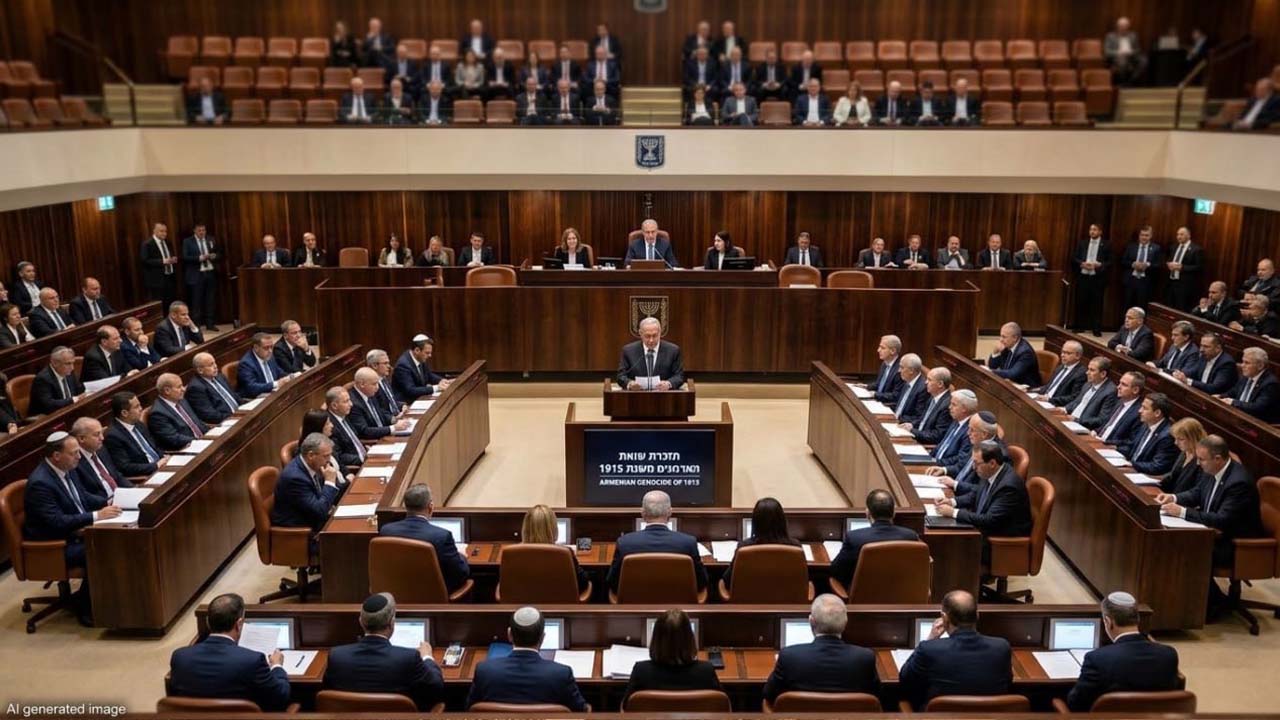
At the Israeli cabinet meeting on June 28, 2026, where cabinet members unanimously voted to recognize the Armenian Genocide, a decision was made to submit this initiative for consideration and ratification by the Knesset to give it the force of law. This refers to the final 4-day session of the 25th Israeli Knesset (July 14-17). It was known in advance that if the Knesset did not manage to vote within these 4 days on the issue of recognizing the events of the early 20th century as genocide, the initiative would either automatically deactivate or, at best, await consideration by the 26th Knesset, which will be formed following the autumn elections in Israel. Consequently, Turkey and Azerbaijan, which immediately demonstrated its position as a direct interested party on this issue, had about 2 weeks to prevent the procedure of ratifying the act of recognition by the Knesset.
2. The Turkish-Azerbaijani tandem: pressure tactics and “soft power”
Turkey took a hard line, demonstrating to Tel Aviv its readiness for a symmetrical response. The country’s political leadership not only intensified criticism of the Israeli government but also announced, at the beginning of the final Knesset session, that it was moving to practical actions on the international stage. Thus, on July 14, 2026, the 11th High Criminal Court of Istanbul issued an international arrest warrant for Israeli Prime Minister B. Netanyahu. The pretext was the Israeli military’s interception in October 2025 of the humanitarian Global Sumud Flotilla (GSF), which was heading to the Gaza Strip, blockaded by the IDF. The Istanbul Prosecutor’s Office charged Netanyahu and 35 other high-ranking officials with “genocide”, “crimes against humanity”, “unlawful detention”, “torture”, and “robbery”. In total, these charges carry life imprisonment and prison terms ranging from 1,102 years and 9 months to 4,596 years. With this step, Ankara made it clear that compromises on the “Armenian question” were impossible and continued to increase pressure on Israel.
Azerbaijan, by contrast, demonstrated a more moderate approach, attempting during the 2 weeks preceding the Knesset session to convey to Tel Aviv the disastrous consequences of a further escalation in Turkish-Israeli relations due to the “Armenian question”, which could become an insurmountable barrier on the path to their normalization. Thus, immediately after the Israeli cabinet approved the resolution on the Armenian Genocide, Azerbaijan’s foreign ministry called on the Israeli side to reconsider this position and abandon consideration of the bill in the parliament. Baku emphasized that formal recognition of the Genocide would negatively affect bilateral Azerbaijani-Israeli cooperation. Following this, on July 1, 2026, the heads of Azerbaijan’s three Jewish communities (Ashkenazi, Sephardic, and Mountain Jewish) sent a joint open letter to Tel Aviv with a similar appeal, noting that approval of the resolution would jeopardize the uniquely strong partnership ties built between the two states.
According to a number of analysts, over the years of close cooperation with Tel Aviv, Baku has formed serious channels of influence in the Israeli political establishment, sufficient to neutralize anti-Turkish bills, a fact openly stated by mass media loyal to the Azerbaijani authorities. In this regard, experts point to indirect signs of a sharp increase in Azerbaijan’s lobbying activities in Israel and the intensification of informal contacts at the interstate level. This gives grounds to believe that Baku’s public official appeals constitute only a small part of its real and large-scale campaign to disrupt the adoption of the resolution on recognizing the Armenian Genocide.
Unlike Turkey, which severed official contacts with Israel’s internal political forces and chose a path of harsh external pressure, Azerbaijan focused on engaging the Israeli leadership in a constructive dialogue through “soft power” tools. It cannot be ruled out that the choice of such opposing approaches was pre-coordinated by Baku and Ankara to achieve maximum effectiveness.
Information about the removal of this issue from the Knesset agenda was first circulated by Azerbaijani media on July 10, 2026. Official Tel Aviv left these reports without comment, however, local political analysts recorded a highly telling fact. Just a few days before the start of the session, the far-right parties – partners of Likud in the ruling coalition (whose ministers had previously approved the resolution in the cabinet) – urgently added several additional issues to the parliamentary agenda that were completely incomparable in significance to the Armenian Genocide recognition bill. Analysts agree that this was done to intentionally overload the Knesset’s schedule, which allowed for the automatic exclusion of discussion and voting on the “Armenian question” from the agenda of the final summer session. With this maneuver, B. Netanyahu’s partners artificially created a time deficit so that the cancellation of the vote would appear as a technical glitch, rather than the result of a deliberate political decision. Ultimately, the bill was pushed out of the work program, and the final act of the concluding session of parliament was the approval of the act of self-dissolution.
3. Geopolitical reasons for the blockage: the role of Baku and the position of Yerevan
The true motives behind the disruption of the vote on the Armenian Genocide recognition bill became a subject of open discussion in the Israeli expert community and media only after the Knesset announced its self-dissolution. In particular, on July 19, 2026, the newspaper Haaretz, citing government sources, reported on B. Netanyahu’s direct interference in the process of canceling parliamentary hearings under pressure from Baku. As the newspaper notes, the pretext for this was a phone call from the advisor to the President of Azerbaijan on foreign policy, Hikmat Hajiyev, to the Israeli Prime Minister’s office. It is assumed that through his representative, Ilham Aliyev conveyed a warning to the Israeli leader that crossing the “red line” on the “Armenian question” would force Azerbaijan to support Ankara in the event of an escalation in Turkish-Israeli confrontation. At the same time, given Baku’s strategic importance to Tel Aviv on the Iranian direction, the refusal to recognize the Genocide could have been conditioned by reciprocal promises from the Azerbaijani side to deepen cooperation with Israel on a number of sensitive issues.
Experts predominantly believe that B. Netanyahu chose to drop the “radical line” regarding the recognition of the Armenian Genocide to protect a critical asset in Israel’s ties with the Islamic world: its strategic partnership with Azerbaijan. At the same time, there is an opinion that the Israeli government’s retreat from the recognition agenda was also conditioned by the extremely restrained reaction of official Yerevan. Immediately after the vote in the Israeli cabinet, RA Prime Minister Nikol Pashinyan, answering journalists’ questions, noted that the Armenian authorities do not consider it appropriate to take any position on the decision of B. Netanyahu’s cabinet and do not wish to politicize this issue in anyone’s interests. This message indicated that the Israeli initiative would not be supported by Yerevan and would not affect the initiated process of “normalization of relations” between Armenia, Turkey, and Azerbaijan. In Tel Aviv, it was noted that recognition of the Armenian Genocide by Israel, at least under the current Armenian authorities, cannot be capitalized into a geopolitical asset capable of drawing Yerevan into a new round of confrontation with Turkey in the interests of the Jewish state.
Another important signal from Azerbaijan to Israel in the context of the “Armenian question” was the reception in Baku, during the days of the Knesset session, of the Prime Minister of Palestine, Mohammad Mustafa. On July 16, 2026, at a meeting with him at his residence, Ilham Aliyev emphasized that “Baku supports the creation of an independent and sovereign State of Palestine with its capital in East Jerusalem”. This statement by the Azerbaijani president had a pointedly anti-Israeli focus, and it can hardly be considered outside the context of political discussion in Israel regarding the recognition of the Armenian Genocide.
In this context, the question is quite logical: why did Ankara and Baku not stop the unprecedented pressure on Tel Aviv if, even before the start of the final 4 days of the Knesset’s work, the fact of the blockage of their own bill by B. Netanyahu’s coalition had been revealed? It was during this period that the Istanbul Criminal Court sanctioned the international arrest of the Israeli Prime Minister, and the Azerbaijani leadership openly identified with the idea of a Palestinian state with an administrative center in East Jerusalem.
Two explanations are possible for this.
- Ankara and Baku were waiting until the very self-dissolution of the Knesset for the possibility that B. Netanyahu and his coalition partners, despite the promises given to Baku, were capable of initiating a vote on the Armenian Genocide recognition at any moment. For this reason, the hidden “bargaining” around this topic continued almost until the last hours of the parliamentary session.
- The concern of Ankara and Baku could have been caused by the fact that B. Netanyahu’s coalition had not officially abandoned this initiative, but only, in formal-legal terms, postponed its consideration to the future.
4. Prospects for the “Armenian question” in light of the upcoming elections in Israel
From autumn 2026, the theoretical possibility remains for this bill to return to the Knesset for consideration if B. Netanyahu and his coalition partners secure a majority in the Knesset again following the results of new elections and consider it appropriate to continue using the topic of the Genocide as a tool of pressure on Turkey. At the same time, under the influence of changed political realities or in case of a revision of the course toward confrontation with Ankara and Baku, they may completely abandon this initiative. However, another scenario cannot be ruled out: even in the event of the defeat of the “Likud” party and the far-right bloc, their political opponents, having received a majority in the Knesset, may continue the line of B. Netanyahu’s former coalition on the issue of recognizing the Armenian Genocide.
According to the forecasts of Israeli analysts, in the October elections, the largest opposition bloc “Beyahad” (“Together”) may win a crushing victory over B. Netanyahu’s coalition. Both political forces included in this alliance are united on the issue of recognizing the Armenian Genocide. Thus, the leader of the “Yesh Atid” party, Yair Lapid, traditionally acts as the most consistent supporter of official recognition of the 1915 Genocide in the Ottoman Empire, promoting this initiative even during his leadership of the Foreign Ministry (2021–2022) and the Israeli government (July–December 2022), when the escalation of relations with Ankara was not yet on the agenda. In turn, the second participant in the coalition – the “Bennett 2026” party, led by Naftali Bennett – adheres to an even tougher position. Its leader equates the murders of Armenians with the Holocaust and calls modern Turkey a more serious threat to Israel than Iran. Both Y. Lapid and N. Bennett are convinced that B. Netanyahu’s overly soft course toward Ankara largely contributed to the formation of hostile policies and unacceptable rhetoric by Recep Tayyip Erdoğan regarding the Jewish state.
Analyzing the prospects for the development of the situation in Israel, analysts take into account the well-known political regularity, according to which the tough rhetoric and radical positions of opposition forces are often softened after their rise to power. Nevertheless, in the current realities, it cannot be ruled out that in the event of an electoral success, the “Beyahad” bloc will not only maintain the course of B. Netanyahu’s far-right government regarding the “Armenian initiative”, but also brings it to its logical conclusion, turning it into an effective tool of foreign policy pressure on Ankara. The disagreements between Turkey and Israel have already escalated into an open confrontation for military-political leadership in the region, the status of a key U.S. ally, control over energy resources, and the most important trade routes of the Middle East, which makes the use of political struggle tools, which were previously under an unspoken ban, inevitable.
5. Conclusion: a tactical pause or a strategic tool of confrontation?
For this reason, Ankara and Baku have every reason to view the Benjamin Netanyahu cabinet’s initiative as not just a situational political maneuver, subsequently rolled back by the ruling coalition itself. Apparently, this step marks the initial stage of Israel’s long-term state strategy aimed at a systemic confrontation with Turkey and its allies, which will likely maintain its relevance regardless of the future configuration of power in the Jewish state. It is obvious that, despite the exclusion from the agenda of the 25th Knesset, the issue of the tragic events of the last century in the Ottoman Empire has already finally turned into a key tool of Israeli-Turkish rivalry. In this regard, official recognition by Israel of the fact of the Armenian Genocide remains solely a matter of time.
[1] The original (in Rus.) was posted on our website on 21.07.2026.