
Publication
The geopolitical underpinnings of Silk Way airlines’ military logistics

ARVAK Center Comment, October 08, 2026[1]
1. Logistical indicators of Azerbaijan’s increased activity
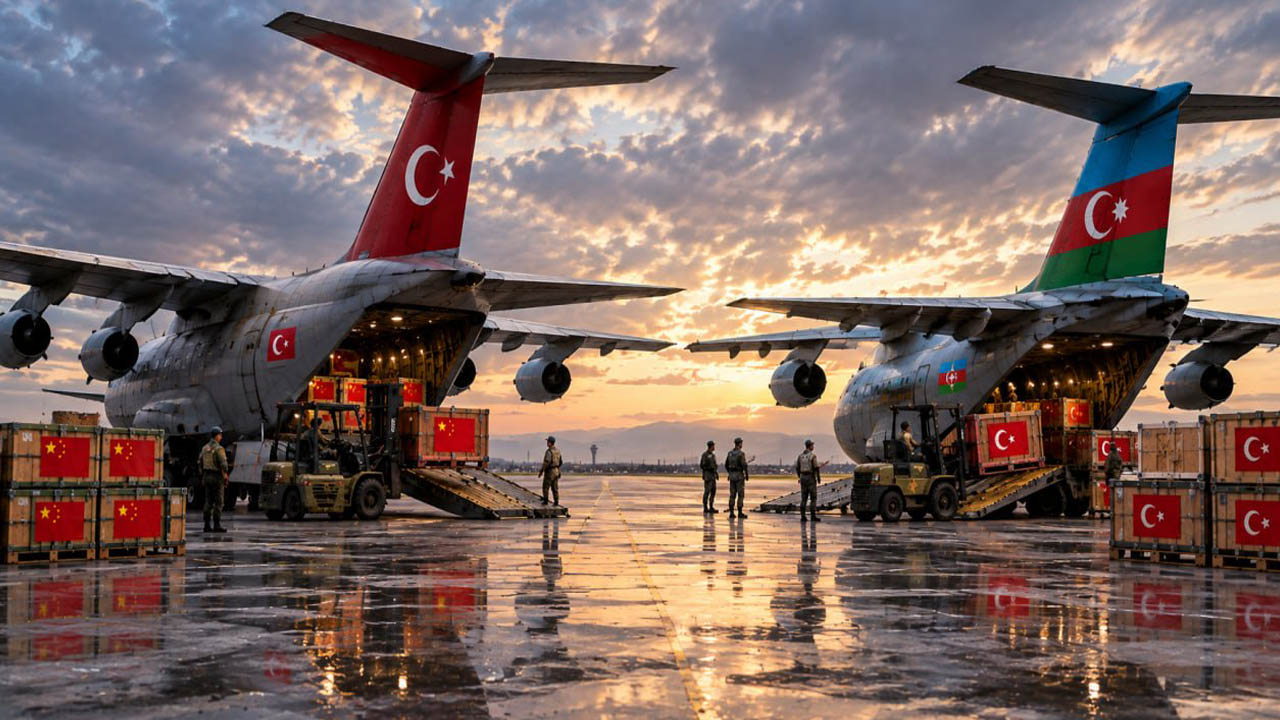
According to the Flightradar24 online flight-tracking service, during August 2026 alone, cargo aircraft operated by the Azerbaijani Silk Way air company made at least 15 flights to China. The airline serves as a key logistics operator for Azerbaijan’s Ministry of Defense and other security agencies, specializing in the transportation of military equipment and weapons.
Silk Way’s traditional geographical routes for military transportation have been from Turkey and Israel to Azerbaijan. In the Turkish sector, the company’s aircraft operated between several airfields, while in Israel the key loading point remained Ovda Air Base, the country’s main hub for import and export operations involving military products.
Considering the recent lull on Silk Way’s traditional routes to Israel and Turkey, the frequent flights to China suggest a possible reorientation of Azerbaijan’s military procurement toward Chinese markets. The military nature of these flights is indirectly confirmed by the fact that during the same period at least one round trip to China was made by the government aircraft of the Azerbaijani Ministry of Defense, which is used for foreign visits of the defense leadership and the General Staff.
The key destination and loading point for Silk Way planes has become Urumqi – the administrative center of the Xinjiang Uyghur Autonomous Region, where, due to Beijing’s strict measures against “Uyghur separatism”, a regime of heightened security and direct military administration has been established. According to available information, this heavily guarded territory serves as China’s most suitable platform for implementing arms contracts that are not intended for broad public disclosure.
Moreover, the region is maximally closed to the activities of foreign intelligence services, making comprehensive control over military cargo dispatched from there practically impossible.
The information presented makes it highly likely that these shipments have a military purpose. Nevertheless, the Azerbaijani media space is completely silent about these developments. The absence of relevant information in international open sources further suggests that Baku and Beijing seek to keep both the high intensity of Silk Way flights and, in particular, the specific list of military cargo being transported confidential.
2. Procurement profile
According to public sources, the previous range and scale of military supplies from China to Azerbaijan remained fairly limited. Baku’s main acquisition from Beijing to date has been the
HQ-9BE long-range surface-to-air missile system, publicly displayed at Azerbaijan’s military parade in November 2025. These systems are designed to engage aerial targets, cruise and ballistic missiles at distances of up to 250 km, with an interception ceiling of up to 50 km and its missile speed exceeding Mach 4. Baku stated that the acquisition of HQ-9BE was intended to complete the development of a layered air-defense system by integrating Chinese SAMs with the Russian S-300, Buk-MB, and Tor-M2KM systems already in service, as well as Israeli Barak MX systems.
In addition to HQ-9BE battalions, the cooperation included the transfer of non-lethal products and specialized equipment, in particular modern equipment for “humanitarian demining”. Open sources also mention the acquisition of Chinese-designed JF-17C Thunder (Block III) multirole fighter aircraft. However, this deal is legally and substantively associated with agreements with Pakistan, where the aircraft are manufactured, while Beijing’s role was limited to formally approving the contract.
In general, the Azerbaijani defense ministry’s substantive interest in Chinese weapons emerged as early as 2019. At that time, delegations from the Ministry of Defense and the General Staff explored options for procuring air-defense systems, radar stations, electronic-warfare and communications equipment, anti-tank missile systems, and MANPADS. Nevertheless, with the exception of the HQ-9BE SAMs, no information on the implementation of the other planned projects has entered the public domain.
3. Geopolitical reasons for Baku’s reorientation
Theoretically, Baku’s renewed interest in Chinese weapons, which may have resulted in cargo shipments from Urumqi, appears quite logical. Due to the rapidly developing events in the Middle East and Ukraine, Azerbaijan has likely encountered difficulties importing certain weapons from European countries and Israel. The European defense-industrial complex is currently focused on supporting Kyiv and preparing NATO for a possible confrontation with the Russian Federation. Tel Aviv, for its part, is effectively conducting military operations on three fronts simultaneously (Palestinian, Lebanese, and Iranian), which, given the substantial depletion of its arsenals over the past two years, requires constant replenishment. Allied Turkey is likewise unable to fully meet Azerbaijan’s defense needs, particularly in the advanced-technology segment. Under these circumstances, Baku is compelled to turn to offers from China.
At the same time, another significant factor plays an important role: the escalation of the Turkish-Israeli confrontation, which could directly affect Baku’s defense procurement. It is highly likely that, under the current circumstances, Ankara has urged Azerbaijan to minimize imports of Israeli weapons or, at a minimum, replace categories for which alternative suppliers exist. Amid the deepening political and diplomatic crisis between Turkey and Israel, which specialists believe could lead to a direct military confrontation, issues of military-technical cooperation (MTC) are becoming particularly acute. It cannot be ruled out that, in order to strengthen its strategic alliance with Ankara, Baku has been compelled to deliberately reduce defense cooperation with Tel Aviv.
In any event, within the framework of its foreign-policy philosophy and taking into account the regional situation, Azerbaijan needs to maintain the pace of technological modernization of its armed forces and systematically replenish its arsenals. In particular, instability around Iran risks spontaneously triggering destabilization in the Caspian basin. Moreover, the possibility of a direct military conflict between Tehran and Baku cannot be ruled out due to the accumulated set of renewed regional contradictions. At the same time, Azerbaijan’s relations with the Russian Federation remain complicated, despite demonstrative steps by both sides to seek areas of common ground. Finally, a final peace agreement with Yerevan has still not been signed, while Baku continues its rhetoric of threats and practice of military-political pressure on the Republic of Armenia. Amid these complex global and regional geopolitical shifts, Azerbaijan, which is increasing the level of its own militarization, is compelled to shift the vector of its partnerships toward Beijing. China may be regarded as an equivalent replacement for its previous partners, capable of meeting a substantial portion of the republic’s defense needs.
Taken together, these factors form a plausible hypothesis that the secret shipments from China are intended directly for the Azerbaijani military.
4. The “Turkish” hypothesis
Although the secret supplies from China may be intended for the Azerbaijani Armed Forces, there is a high probability that Baku is merely a transit hub in a large-scale defense deal serving a third country. Turkey may be the principal recipient of these weapons, as the task of rapidly strengthening its defense capabilities – particularly in the air-defense segment – is currently especially acute. Despite the achievements of its domestic defense industry, Ankara continues to face a significant shortage of high-tech weapons critical to maintaining strategic superiority in the region. Key gaps exist in the areas of the latest manned aircraft, advanced air-defense systems, as well as electronic-warfare systems and communications-jamming capabilities. This deficit is directly linked to the decision to purchase S-400 “Triumph” surface-to-air missile systems from Russia under the agreement of September 12, 2017. This step led to Turkey’s exclusion from the F-35 5th-generation fighter program and blocked access to U.S. weapons systems as a result of sanctions imposed by the United States in December 2020 under the CAATSA.
5. Turkey’s sanctions deadlock
Subsequently, Ankara repeatedly sought the removal of the restrictions and came close to success. However, Washington, under the influence of Israel and the Jewish lobby, has so far maintained the sanctions regime. As a result, Turkey has found itself at an impasse: the United States repeatedly assures it that the restrictions will soon be lifted, without taking concrete steps, while simultaneously warning it against purchasing alternative systems from RF or PRC. Meanwhile, Ankara’s regional rivals – above all Israel and Greece – are rapidly strengthening their arsenals with advanced defense technologies.
Recep Tayyip Erdoğan’s statement of October 15, 2021, that the level of import substitution in the Turkish defense industry had reached 80% indirectly highlighted the existence of a deep systemic crisis. Outside these figures remain key components that the national industry is still unable to produce independently: 5th-generation fighters (development of the Turkish KAAN remains far from complete and depends on supplies of U.S. components) and the latest air-defense systems. Experts emphasize that these remaining 20% contain the critical elements of military superiority and strategic deterrence in modern warfare.
6. The Syrian factor
The growing lag of Ankara in the field of advanced military technologies is shifting the regional balance of power to its disadvantage. Turkey is losing air superiority due to its morally outdated fighter fleet and the lack of resources to create an autonomous layered air defense system. The deployed long-range complexes are integrated into NATO’s structure, which limits Ankara’s freedom of action in the Middle East.
The protection of Syrian and Northern Cypriot airspace has been placed outside NATO’s collective system for countering aerial threats. At the same time, Ankara has assumed obligations to ensure the security of the skies over Damascus, where a regime loyal to it under Ahmed al-Sharaa (Abu Muhammad al-Julani) has been established.
The absence of legal grounds for employing NATO resources to defend subordinate entities forces Turkey to seek alternative solutions to provide cover for allied structures and its own troop contingents stationed in these regions.
According to Israeli sources, Turkey’s effort to build a layered air-defense system in Syria faces serious difficulties due to its limited indigenous military-technological capabilities and strong opposition from the United States. Ankara’s attempt to coordinate with Washington the transfer of Russian S-400 “Triumph” systems to the al-Sharaa government – systems that are a key point of disagreement in bilateral relations – ended in failure. Through this arrangement, the Turkish side sought to accomplish two strategic objectives simultaneously: formally transfer surface-to-air missile systems to Damascus while effectively retaining control over them to ensure operational dominance in Syrian airspace and remove the key pretext for U.S. sanctions under CAATSA. However, the U.S. position proved uncompromising: the White House blocked the plan, making clear that its implementation would permanently close Turkey’s path back into the F-35 fighter program and to the full restoration of technological and military partnership.
Despite this, since the beginning of 2025 Ankara has sought to equip Syria’s air-defense system with short- and medium-range Hisar systems available to it and produced by its domestic defense industry. However, even the deployment of these systems, which are limited in the range at which they can track and engage targets, was perceived by Israel as a violation of the status quo in Syrian airspace.
In March and April 2025, the Israeli Air Force struck the Syrian air bases of Palmyra and T-4 in response to reports that Ankara intended to deploy fighter aircraft, radar stations, UAVs, and Hisar SAMs there. Later, on the night of September 9, 2025, Israeli aircraft struck a facility in Homs Province, destroying containers delivered from Turkey containing equipment for radar stations and Hisar systems. A similar escalation occurred in August 2026, when the Israel Defense Forces carried out a massive raid on the infrastructure and warehouses of the Abu al-Duhur air base. The Israeli command described the operation as a response to Damascus’s violation of status quo agreements and its granting Turkish forces permission to deploy air-defense assets. Despite Israeli opposition, Turkey continues to take steps to deploy its SAMs and radars in Syria. However, even if these plans are implemented, Turkish-Syrian forces will be unable to establish strategic control over Syrian airspace: their capabilities do not allow them to effectively track and intercept hypersonic and ballistic missiles, as well as stealth aircraft.
Taking into account Ankara’s shortage of modern high‑tech means for detecting, alerting, and destroying aerial targets, as well as the political obstacles in military‑technical cooperation with the United States, a likely scenario is the delivery of military cargo from China to Azerbaijan in Turkey’s direct interests. With a high degree of probability, this refers to strategic long‑range HQ‑9BE air defense systems (or their export modification FD‑200B), which have already been adopted by the Azerbaijani Armed Forces and successfully tested during exercises.
The acquisition of these systems enables Ankara to close a critical gap in establishing a multi‑layered, echeloned air defense system on Syrian territory – a necessity for strengthening its strategic foothold, effectively deterring Israel as its main regional rival, and systematically projecting influence across the Middle East.
7. New Baku–Ankara contracts
The hypothesis of Baku’s intermediary role in Turkish-Chinese interaction is further supported by reports of expanded military-technical cooperation between Azerbaijan and Turkey. In early September, following the ADEX exhibition in Baku, the two sides signed a package of contracts worth more than $500 million. According to Haluk Gergün, head of Turkey’s Presidency of Defense Industries, these agreements cover a wide range of weapons, including Hürkuş light attack aircraft, ALP-100 radars, Mizrak loitering munitions, Antidot electronic-warfare systems, and Barbaros shore-based anti-ship missile systems. In addition, construction of a Turkish ammunition plant in Azerbaijan is planned.
It cannot be ruled out that these agreements serve as a legal and regulatory cover for the “legalization” of Chinese supplies whose ultimate recipient is Ankara. Most likely, an informal exchange scheme is being implemented: Baku purchases weapons from Beijing ostensibly for its own needs and subsequently redirects them to Turkey in exchange for Turkish military products on preferential terms. Such a mutually beneficial arrangement could theoretically allow Ankara to avoid objections from the United States and NATO partners regarding unregulated direct cooperation with Beijing.
Because of its alliance commitments within NATO, its difficult dialogue with Washington, and the negative consequences following its acquisition of Russian S-400 “Triumph” SAMs, Ankara currently avoids direct and public contracts with Beijing in the field of military-technical cooperation. This restriction also applies to weapons intended for use outside Turkish borders (in particular, in Syria, Northern Cyprus, or Somalia), where Turkey’s military activity is closely monitored by the United States and Israel. Therefore, the Turkish side resorts to multilayered intermediary schemes through Azerbaijan for the covert import of Chinese defense systems.
This conclusion is a hypothesis based on a comparison of the available facts and an analysis of open sources. At the same time, the resulting logical model appears reasonably well-founded and convincing.
[1] The original (in Rus.) was posted on our website on 08.10.2026.