
Publication
Syria: From Russian presence to a new security vacuum

ARVAK Center comment, August 21, 2026[1]
1. Geopolitical re-emergence of the Syrian track
The Syrian question has resurfaced at the core of the international powers’ intricate geopolitical maneuvering across the Middle East. Following a period since mid-2025 where regional focus shifted largely toward developments in Lebanon, the Persian Gulf, and Iran, Syria temporarily faded from primary media and analytical scrutiny. However, a sequence of critical developments tied to escalating regional rivalries in August 2026 abruptly brought the Syrian file back to the forefront of global concern.
On August 9, 2026, details emerged that Moscow and Damascus had concluded 18 months of diplomacy by settling on terms for Russia’s military assets at Khmeimim and Tartus. Two days later, on August 11, 2026, a Syrian court issued an in absentia death sentence against ousted former President Bashar al-Assad – currently residing in Russia – for war crimes and atrocities committed over the 14-year civil war that cost nearly 500,000 lives. By August 13, 2026, Tehran signaled via intermediaries to transitional President Ahmed al-Sharaa that any military moves against Hezbollah or intervention in Lebanon would spark an all-out confrontation on Syrian territory. The IRGC specified it was prepared to strike more than 100 targets throughout Syria, including the presidential compound in Damascus, while issuing parallel warnings to Saudi Arabia, Turkey, and the UAE. However, Damascus was identified as the primary focus of Iranian intimidation, with Tehran cautioning that any missteps would bring catastrophic consequences for Syria and its post-Assad government.
2. The American strategy of “coercion” and Tehran’s reaction
Unfolding in rapid succession within less than a week, these interconnected developments signal a resurgence of intense diplomatic and military pressure from Washington on Damascus. The United States is actively urging the Syrian leadership to take an assertive stance in the unfolding regional conflict. While Syrian officials had previously dodged these demands – pointing to a volatile domestic security situation, unresolved integration of the Kurdish autonomy in Rojava, lingering threats of an Assadist resurgence, and uncertainties surrounding Russia’s military deployment – that calculus has now changed. The transitional administration under Ahmed al-Sharaa has been signaled that these primary impediments are being resolved on terms favorable to Damascus, in exchange for an unambiguous display of alignment with U.S. strategic objectives. It was this strategic realignment that directly provoked Tehran to issue explicit threats and warnings to the Syrian government.
Analysts note that Washington was instrumental in pressing Rojava’s Kurdish leadership to submit to the sovereignty of Damascus, thereby dismantling the self-proclaimed autonomous region. In line with its timetable for pulling troops out of northeastern Syria, the U.S. had largely finalized its withdrawal by April 16, 2026, handing over its last installation, base “Kasrak”, to the “New Syrian Army”. Some independent American observers suggest that initial setbacks encountered among SDF units led Washington to “reassess the logic of maintaining a military presence in the area”. Rather than leaving unconditionally, however, the United States chose to strategically “monetize” its planned departure to Damascus, extracting pledges from Ahmed al-Sharaa to preserve alignment with U.S. priorities and support its anti-Iran coalition efforts.
3. A new configuration of interests: The roles of Turkey and Israel
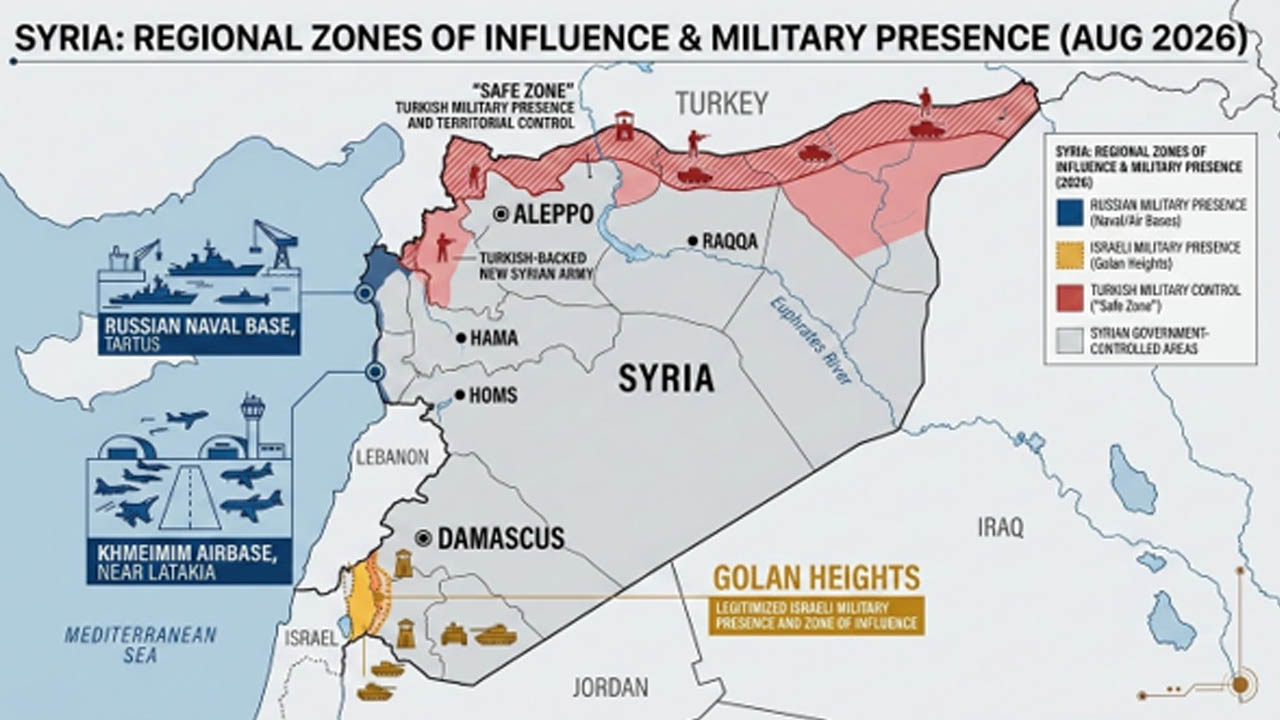
Concurrently, Turkey advanced its own ambitions in Syria by encouraging the transitional president to accede to American demands. Ankara stressed that resolving the Kurdish issue was merely one step toward re-establishing a unified state. To align fully with Washington’s regional framework, Turkish diplomats argued that Damascus also had to settle the status of the Russian military presence and broader bilateral ties – particularly given Moscow’s protection of Assad – while addressing Tel Aviv’s aggressive posture. Israel had declared the Golan Heights an integral part of its territory and expanded its “security zone” toward the outskirts of Damascus following the collapse of the former Syrian government. By leveraging these complex variables, the Syrian leadership secured crucial strategic flexibility: it effectively neutralized the Rojava issue and reclaimed key oil assets while retaining viable grounds to stall its full integration into U.S.-led regional plans.
Early discussions regarding the potential participation of the reorganized Syrian army in military operations targeting Lebanese Hezbollah trace back to a confidential U.S.-Syrian meeting conducted in 2025. The initiative gained public prominence at the G7 summit on June 16, 2026, when U.S. President Donald Trump urged Syrian leaders to “finish off Hezbollah,” asserting that the group was ill-prepared to confront Syrian forces. In response, Ahmed al-Sharaa firmly rejected the proposal, stating that “Syria does not intend to be drawn into someone else’s conflict” and warning that such involvement would jeopardize internal stability amid pressing domestic challenges.
Similar arguments had reportedly been raised by Damascus as early as 2025. During that period, Washington sought to persuade Syrian leadership to support the U.S.-Israeli coalition directly against the Lebanese Shiite organization. In return, the United States offered to remove Assad-era sanctions, restore Syrian access to oil fields in the Euphrates basin, and withdraw support for Kurdish forces. However, Syrian officials adroitly sidestepped these overtures, pointing to ongoing domestic turbulence and unresolved, delicate talks with Moscow. Damascus emphasized that initiating military action against Hezbollah without formal agreements on the status of Russian installations would be a precarious gamble. Consequently, once the status of the Tartus and Khmeimim bases was determined, Washington predictably renewed its pressure regarding operations against Hezbollah. Anticipating this renewed push from the United States, Tehran responded proactively by delivering direct warnings to the Syrian government.
4. Erosion of Russian-Turkish relations as a catalyst for the deal
These developments prompt a natural question: what led Damascus to cease its strategic maneuvering after previously delaying talks by citing threats from Shiite factions and ambiguity regarding Russian military sites? What drove Syria’s leadership to accept a disadvantageous accord with Moscow that cleared the path for direct confrontation with Hezbollah? The primary catalyst appears to be escalating Russian-Turkish friction in the Black Sea theater, sparked by Moscow’s refusal to back Ankara’s push to halt attacks on commercial shipping modeled on the 2022–2023 Black Sea Grain Initiative. Relations strained further on August 15, 2025, when Russia explicitly denounced Turkish military hardware transfers to Ukraine alongside other hostile measures from Ankara “camouflaged by peacekeeping rhetoric”.
Pinpointing the exact initiator of this heightened friction between Ankara and Moscow remains complex. Nevertheless, this escalation is almost certainly tied to the recent Russian-Syrian accords. This connection is underscored by Turkey’s considerable leverage over the transitional leadership in Damascus, as well as the essential reliance of Moscow’s Tartus-based Mediterranean Squadron on Turkish Strait logistics.
Spurred by growing friction with Turkey, the Kremlin sought to fast-track its year-and-a-half-long negotiations with Damascus to secure a concrete outcome in a formal deal. Although the final compromise falls short of Moscow’s initial objectives, it offers a pragmatic path under current conditions to avert a complete loss of regional leverage, sustain a residual military foothold in the Middle East, and cushion the political fallout from the unraveling of the Moscow-backed forces in Syria and the heavy investment in its “Middle Eastern interests” since 2015.
It is particularly revealing that Russian rhetoric toward Ankara sharpened only after finalizing the agreement with Damascus. This shift suggests that Moscow believed it had secured a strategic foothold in Syria, enabling it to take a firmer stance or at least project confidence during intricate negotiations with its Turkish counterparts.
5. Transformation of the Russian military footprint: From bases to training centers
It remains uncertain what actual benefits Russia will gain from its agreement with the SAR transitional authority as it attempts to preserve a modest degree of political and military leverage in Syria. Russian officials have refrained from publicly disclosing the specific provisions of the deal. The initial account of the agreement came on August 9, 2026, via the Syrian state news agency SANA, which remains the primary source for unverified details regarding the accord. Reports indicate that under the memorandum of understanding, both sides are required to convert the Russian facilities at Tartus and Khmeimim into “joint training centers” over a period of 3 months, with the civilian infrastructure at both locations placed under Damascus’s administration. As part of this transition, control of one of the two piers at the Tartus naval installation – previously operated by the Russian Navy – is being handed over to Syrian authorities.
Notably, the deal concerning Tartus was established well ahead of the broader final agreement. Reuters, citing knowledgeable sources in July 2026, revealed that Moscow and Damascus had already arranged to transfer a pier at the naval base to Syrian jurisdiction for “commercial use”. President Ahmed al-Sharaa had directly pressed for this term in January during his talks in Moscow with Vladimir Putin, signaling that the ongoing negotiations in the following months centered primarily on determining the future role of the Khmeimim airbase.
Following the fall of Bashar al-Assad’s government and the takeover of Damascus by HTS forces in December 2024, the newly established Syrian leadership immediately moved to review its military framework with Moscow. The government in Damascus canceled the port modernization contract at Tartus with Russia’s “Stroytransgaz” – intending instead to partner with Emirati firm DW Shipping – and notified Moscow of its plan to shut down Khmeimim airbase. In response to these developments, the Russian Aerospace Forces halted operations from Khmeimim by spring 2025, and the Russian Ministry of Defense signaled an upcoming total evacuation of forces and assets.
By October 2025, however, Damascus permitted a partial resumption of activities at the airbase. Ahead of operations in Rojava, Syrian authorities further consented to shifting a portion of Russian military hardware from the Al-Qamishli airfield to Khmeimim. Relocation efforts commenced in January 2026, coinciding with Ahmed al-Sharaa’s official visit to Moscow, during which he reassured V. Putin that Syria would abide by its earlier commitments.
Yet, between the site’s reactivation in the fall of 2025 and August 2026, the nature of the Russian military footprint was radically transformed. Moscow drastically trimmed both force numbers and heavy weaponry, pulling its entire strike aviation package back to sovereign Russian territory. Khmeimim was scaled down to house only minimal security personnel, communication nodes, airspace surveillance assets, and short-to-medium-range air defenses. Consequently, the airfield’s operational focus pivoted primarily to supporting Russian Military Transport Aviation, converting Khmeimim into a central staging ground for moving military materiel into Africa.
By way of comparison, Western think-tank data indicates that the Russian contingent reached up to 10,000 personnel during the height of Moscow’s military deployment in Syria. The air wing stationed at Khmeimim deployed Su-24, Su-25, Su-34, and Su-35 combat jets, alongside Mi-24 and Mi-35 attack helicopters and military transport aircraft. Comprehensive air defenses shielded the facility, relying on sophisticated S-300, S-400, and Pantsir complexes.
However, driven by the demands of the conflict in Ukraine, Moscow had already undertaken substantial troop reductions by late 2024. Assessments by the Centre for Eastern Studies (OSW) estimated the remaining force at roughly 4,000 troops, with approximately 3,000 stationed across Khmeimim and secondary airfields or outposts in Syria. Following the downfall of the Assad government, Russian forces swiftly gathered remaining personnel and hardware at the Khmeimim and Tartus hubs before executing an expedited withdrawal via maritime and aerial routes. Intelligence figures cited by The Wall Street Journal revealed that by June 2026, Moscow’s presence had dwindled to merely a few hundred personnel, with key armaments fully evacuated – most notably from Khmeimim airbase.
When combined with earlier operational and combat constraints, the memorandum’s terms completely deprive Khmeimim of its strategic value. Rather than its air fleet, the base’s primary role in maintaining the regional balance of power rested on its advanced monitoring and surveillance systems, which covered both Syrian airspace and surrounding territories. Russian sources indicate that the transfer of S-300 and S-400 systems to Russia and Libya had already severely diminished the contingent’s capacity for airspace oversight. Once the memorandum is fully executed, Khmeimim will no longer be capable of fulfilling even this core monitoring function, ultimately restricting Russia to “only minimal logistical options that exclude large-scale military control over airspace”.
6. “Security vacuum” and risks of a major regional war
Following the implementation of the Russian-Syrian MoU, this element emerges as the primary catalyst reshaping the strategic equilibrium across the region. As a result, Syrian airspace is set to remain exposed and largely undefended, with no realistic prospects for filling the resulting security void in the near future.
Because Damascus lacks indigenous medium- and long-range air defense capabilities, it cannot independently regulate or protect its sovereign airspace. Efforts by Ankara to build an integrated, Turkish-led layered air defense architecture in coordination with Syrian authorities have been consistently derailed by preemptive Israeli military strikes. This dynamic was highlighted in mid-August 2026 when the Israeli Air Force targeted Syrian airbases where Turkey, reportedly alongside local security forces, was attempting to station radar installations and set up aviation detachments. Concurrently, Tehran strongly resists any third-party oversight of Syrian airspace to safeguard its transit routes through Iraqi and Syrian air corridors, which are vital for launching strikes against Israel.
This shift has created a deeply complex and unpredictable environment, leaving analysts uncertain about the broader geopolitical fallout of Moscow’s marginalization in Syria. While key regional and global powers often viewed the Russian military posture as destabilizing, it also functioned as a crucial deterrent. Following the collapse of the Assad regime, this presence was vital in constraining direct confrontation between Turkey and Israel, as well as mitigating renewed sectarian conflict between Damascus-aligned Sunnis and the pro-Assad Alawite population.
By reducing Russia’s footprint to a largely symbolic role, the new memorandum risks unraveling this precarious equilibrium. Key dangers now include potential Turkish-Israeli skirmishes over Syrian airspace, Iranian missile strikes targeting Syrian installations, and a U.S.-backed strategy pushing the “New Syrian Army” into Lebanon – a maneuver seemingly designed to ignite a direct clash between Ankara and Tehran.
Continuous direct and indirect interference by external actors has severely obstructed Syria’s path to stability. Paradoxically, Moscow’s presence – despite being culturally and historically alien to Syrian society and deeply opposed to the direction of the new government – served as the vital anchor maintaining the country’s fragile balance.
At first glance, Russia appears to emerge as the defeated actor in this Syrian theater: its military role has been reduced to a purely symbolic partnership stripped of meaningful leverage over Damascus, while it must grant refuge to an “ousted dictator” facing a domestic death sentence simply to sustain its reputation as a “reliable ally.” Nevertheless, a complete Russian withdrawal risks igniting a new wave of regional hostilities. The fallout from such an escalation could ultimately prove far more catastrophic – not only for Syria itself, but also for the foreign powers that hastened the demise of Russia’s 11-year Middle East strategy.
[1] The original (in Rus.) was posted on our website on 21.08.2026.