
Publication
The Istanbul Canal in domestic and geopolitical dimensions

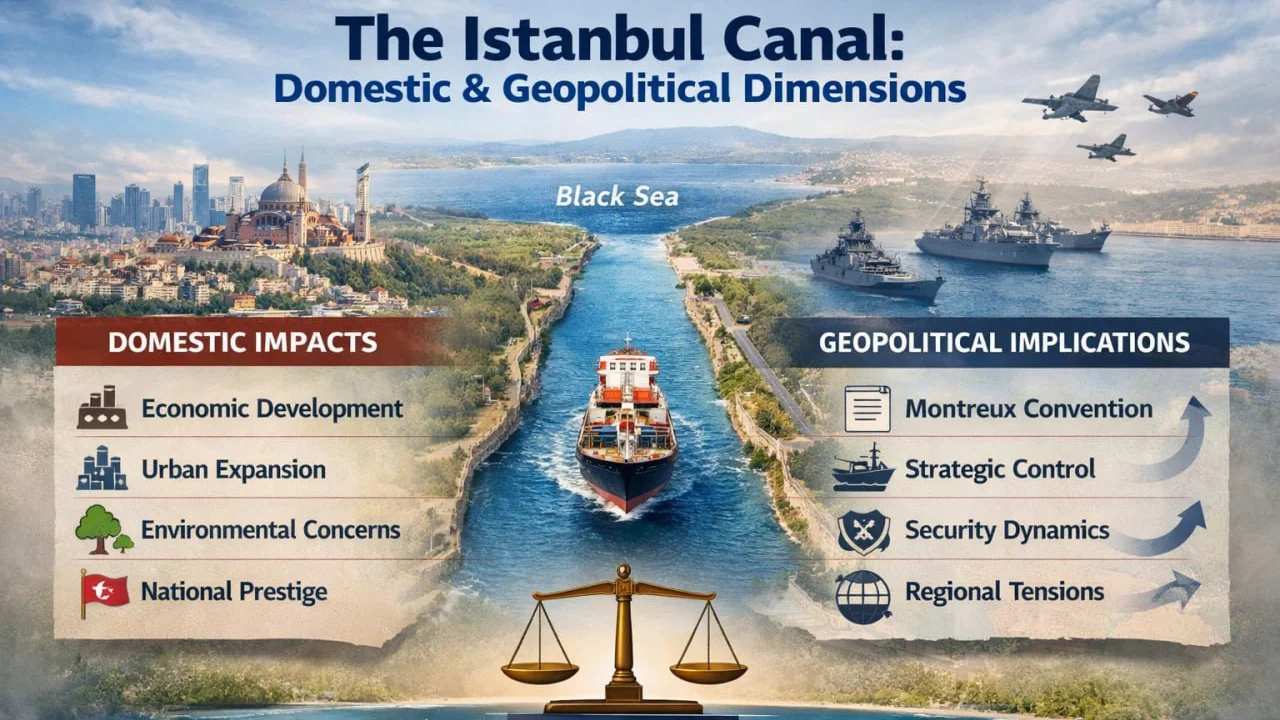
The Istanbul Canal in domestic and geopolitical dimensions[1].
Arestakes S. Simavoryan[2]
Introduction
Heightened tensions surrounding the Strait of Hormuz, exacerbated by the Israel–USA alliance’s military operations against the IRI, have sparked a renewed global interest in alternative maritime corridors. Within this context, European nations have increasingly focused on the Istanbul Canal, the ambitious initiative often referred to as Erdoğan’s “crazy project”. As Turkey approaches its 2028 presidential elections, the discourse surrounding this new waterway has intensified across the nation’s media, political landscape, and civil society.
In our previous analytical publication from 2019, it was observed that the Istanbul Canal initiative transcends simple infrastructural boundaries, representing instead a sophisticated, multi-dimensional program with profound implications for legal frameworks, economic structures, and environmental stability, as well as for future geopolitical configurations. Our analysis suggests that this artificial waterway serves as a strategic alternative to the natural Bosphorus Strait, functioning as a potent diplomatic instrument through which Ankara seeks to enhance its regional influence within the Black Sea and fortify its standing in the global maritime legal order[3].
To this day, the project remains a focal point of intense domestic political debate in Turkey and a subject of scrutiny for global analytical bodies. This continued interest is underpinned by the fact that despite Erdoğan’s 2019 pledge for a 2027 completion, the sluggish pace of development makes an operational canal by next year highly improbable. Consequently, this article examines the recent friction between the government and opposition, the prevailing public sentiment, and the project’s strategic role within the contemporary geopolitical landscape.
The Istanbul Canal project: from historical roots to modern conceptualization
While Ottoman rulers had contemplated an artificial channel linking the Black Sea and the Sea of Marmara as far back as the 16th century, technical limitations at the time prevented those early projects from coming to fruition. However, the concept persisted on the national agenda, frequently resurfacing whenever the Bosphorus Strait faced excessive congestion or heightened strategic risks.
At the dawn of the 21st century, the project was revitalized as R. T. Erdoğan focused on consolidating his authority. The government in Ankara introduced a strategy centered on expensive megaprojects to drive economic expansion and bolster political standing. With the formal unveiling of the Istanbul Canal’s scope in 2011, it was clear the initiative was designed as more than a transit node; it was envisioned as a significant geopolitical instrument capable of altering the strategic equilibrium within the Black Sea. Expert analysis largely centered on the concern that such a waterway would provide a mechanism to circumvent the naval and commercial constraints of the Montreux Convention, acting as a “symbol of the power and independence of modern Turkey”.
Security, economic factors and internal political logic
Official justifications for the new canal center on the unprecedented expansion of maritime trade, which has transformed Bosphorus into a globally congested shipping corridor. The resulting surge in tanker and container traffic presents substantial security and environmental hazards, allowing the government to frame the project as a humanitarian and urban development necessity. However, this rationale masks underlying domestic political motives: the revitalization of the construction industry, the cultivation of economic elites loyal to the Erdoğan administration, and the broadening of the government’s support base. By granting preferred business groups exclusive access to these resources, the authorities ensure a cycle of reciprocal political backing. This dynamic establishes a system where economic activity is subservient to political objectives, ultimately serving as a mechanism for the political survival of the current leadership and its associated bureaucracy.
Despite official endorsements, the initiative has encountered fierce resistance from its inception. Experts and environmental advocates have repeatedly labeled the project a high-stakes venture, pointing to the likelihood of ecological disruption, the exhaustion of freshwater reserves, and increased seismic risks. The administration’s unwavering commitment to the plan since 2011 – persisting despite extensive independent studies and broad public disapproval – indicates that the drive behind the project is rooted more in ideological and geopolitical goals than in rigorous economic or technical evaluation.
Despite the government’s promotional narrative, the project faced intense opposition from its inception. Experts and environmental advocacy groups categorized the official initiative as a high-stakes endeavor, citing primary concerns that endure today: the potential for regional ecological imbalance, the depletion of freshwater reserves, and an elevated seismic risk. Notwithstanding these scientifically supported independent studies and the persistent critical discourse since 2011, the administration’s political resolve has remained firm. This suggests that the project’s momentum is derived less from rigorous economic or technical analysis and more from domestic political, geopolitical, and ideological motives.
From its inception, this ambitious government project faced rigorous criticism from the Republican People’s Party (CHP), the primary opposition, which identified significant financial, environmental, legal, and seismic risks. This political friction intensified following E. Imamoğlu’s 2019 election as Mayor of Istanbul, as he launched legal challenges and public awareness initiatives against the waterway. The dispute reached a peak during the most recent local and presidential-parliamentary elections.
At the 2019 “Local Self-Government Bodies” summit in Istanbul, CHP Chairman K. Kılıçdaroğlu noted that while the project faced widespread rejection, a single individual – alluding to R. T. Erdoğan – continued to insist on its execution. During the same event, then-Mayor Imamoğlu condemned the canal as both a “criminal project” and “treason against Istanbul“. Subsequently, the CHP petitioned the Constitutional Court to invalidate the legislation authorizing the project under the “Build–Operate–Transfer” framework on grounds of unconstitutionality[4].
While the court was initially expected to deliver its verdict in late December 2019, the decision was deferred to the following year. In the interim, the Istanbul Municipality convened a workshop on January 11, 2020, titled “Istanbul Canal,” where 40 experts delivered findings across eight specialized sessions. This event, attended by key political figures including CHP Chairman K. Kılıçdaroğlu, “Good Party” Leader M. Akşener, and Mayor E. İmamoğlu, addressed diverse concerns ranging from economic and legal frameworks to environmental impacts, urban planning, and seismic risks. The conference served a dual strategic purpose: broadly highlighting the project’s potential negative repercussions for Turkey while simultaneously seeking to sway the impending Constitutional Court ruling.
The potential for the Istanbul Canal project to trigger seismic activity remains a primary point of contention. During a specialized session on seismicity and disaster risk management, Professor Dr. Naci Gorur clarified that while the canal’s construction is unlikely to provoke an earthquake, any significant seismic event would pose a grave threat to the completed structure. He specifically highlighted that the southern sections of the canal are built upon highly unstable geological formations, characterized by weak, soft, clayey, and decaying soils.
Ayfer Bartu Candan, an Associate Professor of Sociology at Boğaziçi University, highlighted that the Istanbul Canal project fundamentally entails the expropriation of land. She explained: “Spanning across 6 districts, the Istanbul Canal project primarily occupies forest and agricultural zones, which will detrimentally impact local employment. The project’s effects are unevenly distributed; given the vast area, residents possess diverse educational backgrounds, professions, and socioeconomic statuses. In the southern regions near Küçükçekmece, the workforce is largely concentrated in organized industrial sectors. Conversely, the northern areas are home to low-income farmers who rely on agriculture, consuming approximately 80% of their own produce. Implementing the Istanbul Canal necessitates the seizure of these territories, effectively stripping these farmers of their primary means of subsistence and livelihood”[5].
Essentially, the “Istanbul Canal” initiative entails a mandatory urbanization of rural lands, leading to a shift in land ownership from independent communities and small-scale farmers to major development interests. Deprived of their traditional means of subsistence, these groups will likely be pushed into a congested urban job market where their existing expertise may find little utility, ultimately fostering social marginalization. This strategy threatens to exacerbate class stratification, as R. T. Erdoğan appears prepared to compromise the welfare of the most defenseless social segments to realize his broader geopolitical and economic goals.
Overall, professors representing various scientific and professional fields at the conference also claimed that “400,000 trees will be cut”, “the Marmara Sea will be destroyed”, “the real value of the project will be twice as high as stated”, and so on. Furthermore, the listed negative consequences are only a small part of the scenarios that the city will face if the “Istanbul Canal” project is implemented. It is noteworthy that a 1595-page environmental impact assessment report had been prepared for the project at the order of the authorities by professional groups of several universities, which, according to the scientists participating in the “Istanbul Canal” workshop, is devoid of scientific accuracy[6].
Roughly one month after the workshop, on February 12, 2020, the court deliberated on the opposition’s legal petition. This challenge contended that the Istanbul Canal project was unconstitutional because of its detrimental environmental effects. However, the court ultimately dismissed the lawsuit, ruling that the construction model – specifically the “Build–Operate–Transfer” approach – did not breach constitutional tenets[7].
The progress of the Canal project demonstrates a tendency for local scientific discourse to be influenced by political agendas, which has intensified divisions within the academic sector and created opposing professional camps. This friction between the government and the opposition has evolved beyond standard political debate, engaging various external groups and social strata in a struggle to advance their own interests. These conflicting expert assessments are often utilized by both political sides to justify their respective positions. Additionally, local government bodies, particularly the Istanbul Municipality, have become key actors in this landscape; prior to the detention of Mayor E. Imamoğlu, the municipality actively contested the central government’s authority on several issues, further straining the relationship between national and local leaders.
Various economic stakeholders, including major construction firms, financial institutions, and investors, are deeply engaged in the Canal project, viewing it as a prime chance for financial gain and increased leverage. This involvement prompted a significant warning from K. Kılıçdaroğlu, then-leader of the CHP, on June 30, 2021. He cautioned international investors and entrepreneurs that: “No payment will be made from the treasury to those organizations that will finance the Istanbul Canal project, which contradicts the interests of my nation and global climate policy”[8]. In response to this, the government promised foreign investors “zero bureaucracy” and declared that the door to the Canal project is open to all investors.
Executed through a technically intricate and grand vision, the project demands vast financial resources. Beyond the excavation of the waterway itself, the plan encompasses an array of infrastructures, including maritime ports, high-end transit networks such as bridges and high-speed rail for both surface and sub-aquatic travel, as well as extensive residential, commercial, and social complexes. These include luxury hotels, business, educational, and healthcare hubs, alongside leisure and wellness facilities.
Financial projections for the venture have shown notable inconsistency, suggesting a lack of precise fiscal planning. Early estimates placed the cost between $15 and $20 billion, but official figures later rose to $25 billion. Given the prevailing economic challenges facing Turkey, both political opposition groups and economic analysts express skepticism, suggesting that significant funding hurdles may ultimately obstruct the project’s completion.
The project’s momentum slowed in 2020 amid the global pandemic; however, it was revitalized on the government’s agenda by 2021, largely influenced by the nearing 2023 national elections. During this interval, the administration in Ankara introduced legislative amendments providing state guarantees to the contractors of the Istanbul Canal. R. T. Erdoğan subsequently confirmed a summer 2021 start date for construction. Characterizing the project as a “new respiratory tract for the region”, he noted that a phased tender process would commence shortly. Furthermore, he detailed plans for an urban development housing 500,000 residents to be established along the 45 km waterway.
Substantial international capital is essential for the project’s execution, with Qatar and the People’s Republic of China frequently identified as primary potential contributors in both formal and informal discussions. Erdoğan underscored this expectation in 2021, openly calling for Beijing’s involvement in developing six bridges planned for the waterway.
According to some sources, the project will be mainly financed by the Chinese ICBC Turkey and British HSBC banks, and China is ready to invest a total of $30 million in the Istanbul Canal, which will be the part of its “One Belt, One Road” initiative[9]. Some researchers believe that it is a potential “debt trap”, and if Ankara fails to meet its financing obligations, the strategic route connecting the Black and Aegean Seas could remain under China’s control[10].
While some analysts dismiss the People’s Republic of China’s purported “debt trap” strategy as unsubstantiated, Turkish critics of Beijing’s involvement highlight troubling precedents in Sri Lanka and Kenya. In those instances, major infrastructure passed into Chinese control following the default on loans. Typically, these arrangements involve China providing the necessary capital while simultaneously managing construction using its own materials and workforce. A. Davutoğlu, the former Prime Minister and Foreign Minister who currently heads the opposition “Future” party, has voiced strong objections to proposed land allocations for China near the Istanbul Canal. He cautioned that such concessions “will eliminate both national sovereignty and economic viability”[11].
The Istanbul Canal initiative has also attracted significant interest from Qatar’s high-income economy. Notably, on November 8, 2018, Sheikh Tamim bin Hamad Al Thani’s mother established Triple M Real Estate Tourism Trade Inc. in Istanbul’s Basaksehir district with an initial capital of 100,000 Turkish liras. The company, which includes the spouses of prominent Qatari officials as shareholders, purchased 44,702 m² of agricultural land situated along the Canal’s projected path just 6 weeks after its inception. Current projections indicate this area will be transformed into a hub for commerce and tourism, featuring a variety of developments such as hotels, corporate offices, retail markets, banking facilities, and financial institutions[12].
Regarding the financing of the Canal and Qatari capital, certain perspectives suggest that the opposition has strategically leveraged anti-Arab sentiments found within the secular political sphere. As I. Sezer, editor-in-chief of the Türkiye Today news source puts it: “According to the main opposition camp, the project is for Qatar, not for Turkey, because Qatari businessmen have bought large plots of land in the construction zone of the project. Here again a cultural war begins between those who consider Qatar’s investments to be normal foreign investment, and those who perceive them as a serious problem because of cultural shock and the perception composed of “backward people” from Arab countries who have a “malicious agenda and money at hand”[13].
Developments around the Canal in 2023–2026
The divergent perspectives on the Istanbul Canal held by the primary political factions involved in the 2023 presidential and parliamentary elections emerged as a central theme during their campaigns, alongside other significant economic, social, and diplomatic concerns. Throughout the pre-election cycle, the opposition coalition positioned itself against Erdoğan’s initiative, pledging to halt several large-scale infrastructure ventures if elected; notably, they integrated the formal cancellation of the “Istanbul Canal” project into their official electoral platform[14].
During the pre-election period, the opposition on the one hand promised the internal audience to cancel the project, and on the other hand, passed clear signals to foreign investors related to the political risk of the project. It was obvious that both sides were trying to mobilize voters around the Canal issue as well, but after the earthquake that occurred in southern and central Turkey on February 6, 2023, the public’s attention naturally focused on seismic preparedness and the effectiveness of its management by the state.
Under these circumstances, the initiative – previously touted by the administration as a landmark economic and strategic triumph – faced intense scrutiny from political opponents and the general populace for being an inefficient allocation of capital. Opposing factions argued that directing billions toward a new waterway was a misplacement of priorities, advocating instead for the reinforcement of existing urban structures against seismic activity, particularly within the vulnerable Istanbul region. This argument gained significant traction during the pre-earthquake election cycle; the coalition headed by K. Kılıçdaroğlu officially denounced the canal as a “wrong priority”, emphasizing the urgent need for reconstruction and preventative measures in earthquake-stricken provinces.
In the immediate aftermath of the earthquake, R. T. Erdoğan’s political camp deliberately refrained from utilizing the Canal project for promotional purposes, prioritizing regional restoration and social welfare initiatives instead. However, this shift did not signal the project’s removal from Ankara’s long-term agenda. Notably, the disaster – which claimed over 50,000 lives – significantly elevated the importance of scientific discourse, leading the public to take expert warnings regarding the Canal’s seismic implications more seriously. It is important to highlight that even prior to these events, approximately 60% of survey participants across Turkey had already expressed opposition to the construction, primarily citing concerns over seismic risks[15].
The Istanbul Canal remained a recurring theme for various political entities supporting Erdoğan’s alliance following their 2023 parliamentary victory, a focus largely driven by the 2024 local elections. During this period, the project resurfaced as a central point of debate and scrutiny between two key figures: M. Kurum of the AKP, a former Minister of Environment and Urban Development vying for the Istanbul mayoralty, and E. Imamoğlu of the CHP.
In contrast to Kurum – who refrained from taking a definitive stance during the campaign out of concern for voter sensitivities in Istanbul, stating, “What is not on the agenda of the people of Istanbul will not be on our agenda[16]” – E. İmamoğlu challenged R. T. Erdoğan and his opponent to permanently abandon the Canal, describing it as an “ecologically hostile project”.
Back in 2023–2024, 20 lawsuits had been presented by the Istanbul Municipality, professional organizations, and environmental associations against the “Istanbul Canal” project. More than 10 lawsuits to cancel the zoning plans of the project have been presented by the chambers of the “Union of Chambers of Turkish Engineers and Architects”[17].
R. T. Erdoğan’s situation became more complicated when, as a result of the local elections, E. Imamoğlu occupied the seat of the Mayor of Istanbul and based on his official position, questioned not only the necessity of the project but also its legality. The number of legal and administrative discussions also increased which slowed down the adoption of decisions related to the project. In a significant legal development, Istanbul’s 5th Administrative Court issued a ruling to nullify several initiatives associated with the Canal. The court cited concerns that these ventures could potentially degrade the local environment, compromise essential infrastructure, and jeopardize regional water supplies[18].
A year after occupying the position of Mayor of Istanbul, on March 19, 2025, E. Imamoğlu was arrested by the Turkish police on charges of corruption and ties with the PKK. One month after his arrest, E. Imamoğlu made a post on social networks, noting: “They have started the construction of 24,000 houses around the Sazlidere dam”, and qualified the “Istanbul Canal” project as a “project of profit and plunder”[19].
As of 2026, the “Istanbul Canal” project lacks substantial advancement; following the 2021 bridge groundbreaking, no physical excavation of the waterway has commenced. The initiative appears to be hindered by a combination of domestic and international funding challenges alongside ongoing legal conflicts. Furthermore, a climate of global economic instability and Turkey’s sharp political divisions has led to increased investor caution. This hesitancy is further compounded by recent litigation involving Kuwaiti construction firms that had acquired land along the proposed route[20].
In summary, the conflicts surrounding the Istanbul Canal’s investment strategy are shaped by a convergence of clashing economic agendas, intense academic debate that has split the nation’s scientific community, and multifaceted public opposition.
Geopolitical significance of the Canal and the Montreux Convention
On the eve of the Second World War, in 1936, the convening of a conference on the issue of the Black Sea straits was initiated by the Turkish government, which was interested in changing the convention on the Black Sea straits adopted at the 1922-23 Lausanne Conference in the context of the deteriorating military-political situation in the Mediterranean as a result of the 1935-36 Italo-Ethiopian War.
The decisions of the Lausanne Conference provided for the demilitarization of the Black Sea straits, and free passage was allowed through the Bosphorus and Dardanelles Straits not only for commercial but also for military ships of any country in the world (with minor restrictions). Relying on that point of the Lausanne Treaty, the Turkish side proposed to hold an international conference to review the status of the Black Sea straits. As a result, from June 22 to July 21, 1936, the countries participating in the conference dedicated to the regime of the Black Sea straits held in the Swiss city of Montreux – Bulgaria, Great Britain, France, the Kingdom of Greece, Romania, the USSR, Turkey, the Kingdom of Yugoslavia, and Japan – after long discussions signed the Montreux Convention.
The Convention consists of 29 articles, 16 of which relate to military vessels, and 6 to civilian ships. Articles 2-7 of the Convention regulate the passage and navigation of commercial ships through the Straits. Commercial ships of all countries maintain the freedom of passage through the Straits in both peaceful and wartime, according to the rules established by the Convention. Articles 8-22 regulate the passage and navigation of warships through the Straits. A special status was established for the Black Sea littoral states: they can pass submarines through the Straits, as well as large ships without tonnage restrictions, under certain conditions (Articles 11, 12). The procedure and terms for informing the Turkish government about warships passing through the Straits were also established (Article 13). Warships of non-Black Sea countries can stay in the Black Sea for no more than 21 days (Articles 14, 18). In the event of Turkey’s participation in a war or the immediate threat of war, the passage of warships through the Bosphorus and Dardanelles straits will depend on the exclusive discretion of the Turkish government (Articles 20, 21). During war, in which Turkey does not participate, the Straits will remain closed for the passage of warships of any belligerent power (Article 19)[21]. The convention was concluded for a term of 20 years, but separate articles could be reviewed every five years. In 1938, Italy also joined the convention, and Cyprus did it in 1969.
In 1946, the USSR proposed Turkey a new regime for the Black Sea straits, providing for free passage to military ships of Black Sea states in peaceful and wartime, prohibiting the passage of military vessels of non-Black Sea states except for specially defined cases, and establishing joint protection of the Straits by the two countries. The Turkish government rejected that proposal. It reacted similarly to the proposal to change the Convention, taking into account the 1982 UN Convention on the Law of the Sea which entered into force[22].
Discussions around the Montreux Convention gained new momentum from the very moment when the “Istanbul Canal” project appeared on Turkey’s state agenda. Ankara has repeatedly stated that the project has commercial and transport-logistics significance. Nevertheless, since 2011, various hypotheses and parallels related to the convention and the new canal have been put forward from legal-political and political science perspectives in discussions at various levels[23].
As of this moment, the Istanbul Canal is theoretically an alternative waterway to which the Convention does not apply. If it is considered an “artificial waterway”, then most likely Ankara will take steps to establish its own rules of the game, including the application of fees and political control over the entry and exit of military ships. The main question from expert circles is whether Ankara is trying to de facto bypass the Montreux restrictions with this project.
It is clear that from a legal point of view, the problem is not so unequivocal, as the Convention refers to natural straits, and its applicability to an artificial canal remains highly debatable. In our opinion, even in the presence of a new canal, the conventional obligations cannot be canceled, as the Convention regulates not only the certain waterways but also the regime of the entire Strait system. Another group of authors claims that “The feasibility of the Canal project is valid only after making certain changes in the application of the Montreux Convention. However, this could lead to such a result in which the signatories would question the legality of the Convention in today’s conditions”[24].
The project has triggered significant domestic political controversy. A group of retired high-ranking diplomats and military officers, notably the signatories of the “Letter of 103 Admirals,” cautioned that any disruption or dissolution of the Montreux regime resulting from the Canal’s development could jeopardize Turkey’s strategic equilibrium[25]. This position directly challenges the perspective of R. T. Erdoğan’s administration, which promotes the Canal as a mechanism for strengthening national sovereignty. This ideological clash led to the arrest of all 103 admirals, with several receiving prison sentences.
Back in 2011, Erdoğan declared that the Canal in no way opposes the Montreux Convention, nor can it have any connection with it, as the disposal of the Canal is exclusively Turkey’s sovereign right[26], and the former head of the Turkish MFA, M. Cavusoğlu, for his part, had hinted that Turkey will regulate the passage of ships through the Istanbul Canal in wartime and peaceful times by national legislation[27].
In summary, the legal standing of the proposed waterway continues to be ambiguous. Academic discourse on the subject frequently remains speculative, while media coverage is often dominated by conclusions rooted in “conspiracy theories”. Nevertheless, the persistent debates concerning the Montreux Convention in relation to the Istanbul Canal underscore expert warnings that this megaproject could evolve into a strategic legal and political instrument for Ankara. By leveraging this new corridor, Turkey may seek to significantly bolster its regional influence and geopolitical standing within the Black Sea zone in the years ahead.
From this point of view, it is important to emphasize the question of what developments we can witness at the regional level, even hypothetically, in the presence of the Canal. The primary problem will directly relate to NATO–Russia relations. Imagine that if the restrictions arising from the articles of the Montreux Convention do not apply to the Canal, then theoretically the member states of the North Atlantic Alliance can freely enter the Black Sea with their surface and underwater warships. Such a situation will sharply change the balance of power and exacerbate the regional security environment. Consequently, neither the elimination of the Montreux Convention nor the operation of the Canal, from both military-political and economic perspectives, stems from the interests of the RF. In addition, it must be taken into account that in Russia’s strategic thinking, the Black Sea is a connecting link between the Caucasus, the Balkans, the Mediterranean, and the Middle East. Consequently, any diplomatic or legal move to modify the Straits’ status or assert Ankara’s absolute authority over the artificial waterway – potentially facilitating the entry of non-regional naval assets into the Black Sea – will meet with unequivocal opposition from the Russian Federation.
Of course, those opposing this thesis may note that Ankara, being a member of NATO, currently conducts a balanced policy with Russia. However, the duration of this situation is difficult to predict. Even in this case, the Istanbul Canal, without mandatory operation too, is a “silent threat” for the Russian Federation from a strategic point of view.
Summary conclusions
- The Istanbul Canal may at first glance seem merely an alternative route of logistics significance, but, as we have seen, it is interwoven with many threads of internal political and internal social resistance, economic, environmental, geopolitical, and other issues. At the intra-state level, the project has truly turned into a political and economic tool for R. T. Erdoğan, and it simultaneously serves for the reproduction of authorities and the redistribution of financial and economic resources. It is by no means necessary for the Canal to be a “completed project” in order to fulfill its political function. It is continually postponed, redesigned (most recently on November 28, 2024), and debated. Thus, the megaproject is used by the authorities as a tool of “speculative governance” – managing through promises and visions of the future, something we have witnessed over the past 15 years.
- The uncertainty formed around the project, especially in the context of the Montreux Convention, will affect the security architecture of the Black Sea region. For that reason, the construction of the Canal is viewed as an initiative containing high geopolitical risk. Moreover, those risks equally apply to Turkey and all those countries that are included in the regional power interactions. Perhaps this uncertain situation will strengthen Turkey’s bargaining positions in the short-term perspective (this is in the case if the Turkish side officially sets itself the task of reviewing the Montreux Convention or comes forward with an international legal initiative containing political elements related to the Istanbul Canal), while in the long-term, it will increase the probability of tension and miscalculations in the region.
- It is also important to correctly evaluate the economic significance of the project, as Ankara’s ambitions are also conditioned by the expectation of profit. For example, one of the most profitable waterways in the world, the Suez Canal, is one of the main sources of Egypt’s income. Thus, the data show that it has provided about $40 billion in revenue in 2019–2024. According to the forecasts of the International Monetary Fund, along with the weakening of tension in the Red Sea, its annual revenue could reach almost $12 billion by 2030[28].
The high-income indicators are what stimulate global interest in the construction of artificial waterways. According to the UN Convention on the Law of the Sea, ships enjoy the “right of transit” in natural straits, such as the Bosphorus and the Strait of Hormuz, and coastal states are prohibited from charging fees, except in certain cases. Nevertheless, as artificial waterways, the Suez and Panama Canals give their owners the right to charge fees within the limits of the law. Turkey is going to build the Istanbul Canal precisely to bypass legal restrictions and create a navigation route with its own pricing. According to preliminary calculations of the Turkish side, an annual revenue of about $5 billion is expected from the Istanbul Canal. The central question is how Ankara intends to persuade ships from countries that currently navigate the Bosphorus free of charge to instead use the new, toll‑based artificial Istanbul Canal.
Sources and Literature
- Simavoryan, A. (2020). The Istanbul Canal or New Bosphorus.
Orbeli Center, June, 18.
https://papers.ssrn.com/sol3/papers.cfm?abstract_id=3905727 - Kılıçdaroğlu’ndan Erdoğan’a: İlk Seçimde Gideceksin, Kanal İstanbul’u Yapamazsın․
Bianet, 11.2019,
https://bianet.org/haber/kilicdaroglu-ndan-erdogan-a-ilk-secimde-gideceksin-kanal-istanbul-u-yapamazsin-217371 - Fırat Fıstık․ İstanbul, Kanal İstanbul’u tartıştı․
Gazete Kadıköy, 11․01․2020,
https://www.gazetekadikoy.com.tr/gundem/istanbul-kanal-istanbulu-tartisti - Serkan Ocak․ 7 soruda Kanal İstanbul․
Deutsche Welle Türkçe, 10.01.2020,
https://www.dw.com/tr/7-soruda-kanal-i%CC%87stanbul/a-51960216 - Kanal İstanbul Projesi’nin Yap-İşlet-Devret Modeli Kapsamına Alınmasının Anayasa’ya Aykırı Olmadığı․ 12.02.2020,
https://www.anayasa.gov.tr/tr/haberler/norm-denetimi-basin-duyurulari/kanal-istanbul-projesi-nin-yap-islet-devret-modeli-kapsamina-alinmasinin-anayasa-ya-aykiri-olmadigi/ - CHP lideri Kemal Kılıçdaroğlu’ndan yabancı yatırımcılara 4 dilde Kanal İstanbul uyarısı․
Euronews, 30․06․2021,
https://tr.euronews.com/2021/06/30/chp-lideri-kemal-k-l-cdaroglu-ndan-yabanc-yat-r-mc-lara-4-dilde-kanal-istanbul-uyar-s - Erdoğan’s delirious canal project: Istanbul is on sale.
Duvarenglish, 09.04.2021,
https://www.duvarenglish.com/erdogans-delirious-canal-project-istanbul-is-on-sale-article-57015# - Джунейт Гюрер․ Турецко-китайские отношения։ Экономические потребности и глобальные стремления․
Per Concordiam, 17.11.2022,
https://perconcordiam.com/ru/турецко-китайские-отношения/ - China looms large in Turkey’s controversial waterway project․
Al-Monitor, 14․04․2021,
https://www.al-monitor.com/originals/2021/04/china-looms-large-turkeys-controversial-waterway-project - Katar Emiri’nin annesine Kanal İstanbul piyangosu vurdu․
Karadeniz Gazete, 07.2020,
https://karadenizgazete.com.tr/gundem/katar-emiri-nin-annesine-kanal-istanbul-piyangosu-vurdu/281762 - Ilker Sezer․ Istanbul Canal explained: From ‘Betrayal to Istanbul’ to ‘anti-Arab sentiment’․
Türkiye Today, 03․05․2025,
https://www.turkiyetoday.com/op-ed/istanbul-canal-explained-from-betrayal-to-istanbul-to-anti-arab-sentiment-152363?utm - Ortak Politikalar Mutabakat Metni. (2023). https://chp.org.tr/yayin/ortak-politikalar-mutabakat-metni/Open
- Kanal İstanbul Projesi’ni Destekliyor Musunuz?
Türkiye Raporu, 25․06․2021,
https://turkiyeraporu.com/arastirma/kanal-istanbul-projesini-destekliyor-musunuz-2-5128/ - Kanal İstanbul rantı: AKP’li Sultangazi Belediyesi proje güzergâhına yakın taşınmazlarını satışa koydu․
Cumhuriyet, 03.2024,
https://www.cumhuriyet.com.tr/turkiye/kanal-istanbul-ranti-akpli-sultangazi-belediyesi-proje-guzergahina-2184628 - İBB Başkan adayı Murat Kurum’un Kanal İstanbul ile imtihanı․
Bianet,02.2025,
https://bianet.org/haber/ibb-baskan-adayi-murat-kurumun-kanal-istanbul-ile-imtihani-290477 - Kanal İstanbul Projesi’ne yargı freni․
Bianet,12.2024,
https://bianet.org/haber/kanal-istanbul-projesine-yargi-freni-303047 - Kanal İstanbul’da rant mı yağıyor? 40 bin konut gerçeği şok etti․
Yeniçağ, 22․03․2026,
https://www.yenicaggazetesi.com/kanal-istanbulda-rant-mi-yagiyor-40-bin-konut-gercegi-sok-etti-1011246h.htm - Kanal İstanbul, Kuveytlilere kabus oldu!
Yeniçağ, 22․05․2025,
https://www.yenicaggazetesi.com/kanal-istanbul-kuveytlilere-kabus-oldu-917615h.htm - Конвенция о режиме Проливов. Монтрё. 20 июля 1936 года //
Сборник, действующих договоров, соглашений и конвенций, заключенных с иностранными государствами, выпуск IX. Изд. НКИД, 1938, стр. 100-103.
https://docs.historyrussia.org/ru/nodes/136148-konventsiya-o-rezhime-prolivov-montryo-20-iyulya-1936-goda#mode/flipbook/page/1/zoom/3 - Монтрё конференция 1936.
Большая российская энциклопедия 2004–2017,
https://old.bigenc.ru/world_history/text/2228897 - Eldem, T. (2021). Canal Istanbul: Turkey’s controversial megaproject. Its likely impacts on the Montreux Convention and regional stability (No. 43/2021).
Stiftung Wissenschaft und Politik (SWP), German Institute for International and Security Affairs. - Tütüncü, A. N. (2017). Montreux Convention and Canal Istanbul.
Milletlerarası Hukuk ve Milletlerarası Özel Hukuk Bülteni, 37(1), 113-123. - Özçelik, C., Benli, K. (2021). Canal Istanbul and Political Dispute on Turkish Straits.
Dicle Üniversitesi Mühendislik Fakültesi Mühendislik Dergisi, 12(5), 849-863. - Pirim, C. Z. (2023). Uluslararası hukukçu bakış açısından kanal Istanbul projesi.
Galatasaray Üniversitesi Hukuk Fakültesi Dergisi (1). - Akgün, M., Tiryaki, S. (2020). Istanbul Kanalının Siyasi Fizibilitesi.
South African Journal of Obstetrics & Gynaecology․ - 103 amiral ‘Montrö bildirisi’ yayımladı, AK Parti hükümeti tepki gösterdi․
Euronews, 04․04․2021,
https://tr.euronews.com/2021/04/04/103-amiral-montro-bildirisi-yay-mlad-ak-parti-hukumeti-tepki-gosterdi - Kanalistanbul’dan 5 milyar dolar gelir beklentisi!
Emlakkulisi, 05.2011,
https://emlakkulisi.com/kanalistanbuldan-5-milyar-dolar-gelir-beklentisi/73548 - Nazlı Yüzbaşıoğlu․ Dışişleri Bakanı Çavuşoğlu: Emekli büyükelçilerin Kanal İstanbul açıklaması siyasi bir deklarasyondur․
Anadolu Ajansı, 02.2020,
https://www.aa.com.tr/tr/politika/disisleri-bakani-cavusoglu-emekli-buyukelcilerin-kanal-istanbul-aciklamasi-siyasi-bir-deklarasyondur/1721885 - Akay, S. (2026). The politics of megaprojects in Istanbul through a critical analysis of the Kanal Istanbul project.
Land Use Policy, 166,
https://doi.org/10.1016/j.landusepol.2026.108022 - Egypt’s Suez Canal revenues reach $2bn in 5 months, up 17.5% YoY․
Arab news, 09․12․2025,
https://www.arabnews.com/node/2625560/business-economy - Simavoryan, A. (2023). Presidential Elections in Turkey-2023.
ARVAK | Armenian Analytical Center paper, https://arvak.am/en/28022023_arestakes_simavoryan_presidential_elections_in_turkey_2023_eng/
[1] The original of the article (in Rus.) was published on our web-page on May 7, 2026.
[2] Orientalist, Turkologist. From 2008 to 2019, he worked at the “Noravank” Scientific-Educational Foundation under the Government of Armenia as Head of the Armenology Center. From 2014 to 2021, he was a researcher at the “Center for Regional Studies” of the Public Administration Academy of Armenia. Between 2019 and 2021, he served as Senior Expert in the “Analytical Service” Department of the “Center for Public Relations and Information” SNCO of the Office of the Prime Minister of Armenia. In 2021–2022, he was Chief Archivist of the “Research and International Relations Department” of the National Archives of Armenia SNCO. He is the author of more than 100 scholarly-analytical articles and 12 collective monographs.
[3] Simavoryan, A. (2020). The Istanbul Canal or New Bosphorus. Publisher: Orbeli Center, June, 18. https://papers.ssrn.com/sol3/papers.cfm?abstract_id=3905727 (download date: 01.05.2026).
[4] Kılıçdaroğlu’ndan Erdoğan’a: İlk Seçimde Gideceksin, Kanal İstanbul’u Yapamazsın․ Bianet, 19.11.2019, https://bianet.org/haber/kilicdaroglu-ndan-erdogan-a-ilk-secimde-gideceksin-kanal-istanbul-u-yapamazsin-217371 (download date: 01.05.2026).
[5] Fırat Fıstık․ İstanbul, Kanal İstanbul’u tartıştı․ Gazete Kadıköy. 11․01․2020․ https://www.gazetekadikoy.com.tr/gundem/istanbul-kanal-istanbulu-tartisti (download date: 01.05.2026).
[6] Serkan Ocak․ 7 soruda Kanal İstanbul․ Deutsche Welle Türkçe, 10.01.2020, https://www.dw.com/tr/7-soruda-kanal-i%CC%87stanbul/a-51960216 (download date: 01.05.2026).
[7] Kanal İstanbul Projesi’nin Yap-İşlet-Devret Modeli Kapsamına Alınmasının Anayasa’ya Aykırı Olmadığı․ Türkiye Cumhuriyeti Anayasa Mahkemesi․ 12.02.2020, https://www.anayasa.gov.tr/tr/haberler/norm-denetimi-basin-duyurulari/kanal-istanbul-projesi-nin-yap-islet-devret-modeli-kapsamina-alinmasinin-anayasa-ya-aykiri-olmadigi/ (download date: 01.05.2026).
[8] CHP lideri Kemal Kılıçdaroğlu’ndan yabancı yatırımcılara 4 dilde Kanal İstanbul uyarısı․ Euronews, 30․06․2021, https://tr.euronews.com/2021/06/30/chp-lideri-kemal-k-l-cdaroglu-ndan-yabanc-yat-r-mc-lara-4-dilde-kanal-istanbul-uyar-s (download date: 01.05.2026).
[9] Erdoğan’s delirious canal project: Istanbul is on sale. Duvarenglish, 09.04.2021, https://www.duvarenglish.com/erdogans-delirious-canal-project-istanbul-is-on-sale-article-57015# (download date: 01.05.2026).
[10] Джунейт Гюрер․ Турецко-китайские отношения։ Экономические потребности и глобальные стремления․ Per Concordiam, 17.11.2022, https://perconcordiam.com/ru/турецко-китайские-отношения/ (download date: 01.05.2026).
[11] China looms large in Turkey’s controversial waterway project․ Al-Monitor, 14․04․2021,
https://www.al-monitor.com/originals/2021/04/china-looms-large-turkeys-controversial-waterway-project (download date: 01.05.2026).
[12] Katar Emiri’nin annesine Kanal İstanbul piyangosu vurdu․ Karadeniz Gazete, 13.07.2020, https://karadenizgazete.com.tr/gundem/katar-emiri-nin-annesine-kanal-istanbul-piyangosu-vurdu/281762 (download date: 01.05.2026).
[13] Ilker Sezer․ Istanbul Canal explained: From ‘Betrayal to Istanbul’ to ‘anti-Arab sentiment’․ Türkiye Today, 03․05․2025, https://www.turkiyetoday.com/op-ed/istanbul-canal-explained-from-betrayal-to-istanbul-to-anti-arab-sentiment-152363?utm (download date: 01.05.2026).
[14] Ortak Politikalar Mutabakat Metni. (2023), https://chp.org.tr/yayin/ortak-politikalar-mutabakat-metni/Open (download date: 05.05.2026).
[15] Kanal İstanbul Projesi’ni Destekliyor Musunuz? Türkiye Raporu, 25․06․2021, https://turkiyeraporu.com/arastirma/kanal-istanbul-projesini-destekliyor-musunuz-2-5128/ (download date: 05.05.2026).
[16] Kanal İstanbul rantı: AKP’li Sultangazi Belediyesi proje güzergâhına yakın taşınmazlarını satışa koydu․ Cumhuriyet, 12.03.2024, https://www.cumhuriyet.com.tr/turkiye/kanal-istanbul-ranti-akpli-sultangazi-belediyesi-proje-guzergahina-2184628 (download date: 05.05.2026).
[17] İBB Başkan adayı Murat Kurum’un Kanal İstanbul ile imtihanı․ Bianet, 10.02.2025, https://bianet.org/haber/ibb-baskan-adayi-murat-kurumun-kanal-istanbul-ile-imtihani-290477 (download date: 05.05.2026).
[18] Kanal İstanbul Projesi’ne yargı freni․ Bianet, 25.12.2024, https://bianet.org/haber/kanal-istanbul-projesine-yargi-freni-303047 (download date: 05.05.2026)․
[19] Kanal İstanbul’da rant mı yağıyor? 40 bin konut gerçeği şok etti․ Yeniçağ, 22․03․2026, https://www.yenicaggazetesi. com/kanal-istanbulda-rant-mi-yagiyor-40-bin-konut-gercegi-sok-etti-1011246h.htm (բեռնման օրը՝ 05.05.2026).
[20] Kanal İstanbul, Kuveytlilere kabus oldu! Yeniçağ, 22․05․2025, https://www.yenicaggazetesi.com/kanal-istanbul-kuveytlilere-kabus-oldu-917615h.htm (բեռնման օրը՝ 05.05.2026).
[21] Конвенция о режиме Проливов. Монтрё. 20 июля 1936 года // Сборник, действующих договоров, соглашений и конвенций, заключенных с иностранными государствами, выпуск IX. Изд. НКИД, 1938, стр. 100-103. https://docs.historyrussia.org/ru/nodes/136148-konventsiya-o-rezhime-prolivov-montryo-20-iyulya-1936-goda#mode/flip book/page/1/zoom/3 (բեռնման օրը՝ 05.05.2026).
[22] Монтрё конференция 1936. Большая российская энциклопедия, 2004–2017, https://old.bigenc.ru/ world_history/text/2228897 (բեռնման օրը՝ 05.05.2026).
[23] Տես, Eldem, T. (2021). Canal Istanbul: Turkey’s controversial megaproject; its likely impacts on the Montreux Convention and regional stability. Tütüncü, A. N. (2017). Montreux Convention and Canal Istanbul. Milletlerarası Hukuk ve Milletlerarası Özel Hukuk Bülteni, 37(1), 113-123. Özçelik, C., Benli, K. (2021). Canal Istanbul and Political Dispute on Turkish Straits. Dicle Üniversitesi Mühendislik Fakültesi Mühendislik Dergisi, 12(5), 849-863. Pirim, C. Z. (2023). Uluslararası hukukçu bakış açısından kanal Istanbul projesi. Galatasaray Üniversitesi Hukuk Fakültesi Dergisi, (1).
[24] Akgün, M., Tiryaki, S. (2020). Istanbul Kanalının Siyasi Fizibilitesi. South African Journal of Obstetrics & Gynaecology․
[25] 103 amiral ‘Montrö bildirisi’ yayımladı, AK Parti hükümeti tepki gösterdi․ Euronews, 04․04․2021, https://tr.euronews.com/2021/04/04/103-amiral-montro-bildirisi-yay-mlad-ak-parti-hukumeti-tepki-gosterdi (բեռնման օրը՝ 05.05.2026).
[26] Kanalistanbul’dan 5 milyar dolar gelir beklentisi! Emlakkulisi, 18.05.2011, https://emlakkulisi.com/kanalistanbuldan-5-milyar-dolar-gelir-beklentisi/73548 (բեռնման օրը՝ 05.05.2026).
[27] Nazlı Yüzbaşıoğlu․ Dışişleri Bakanı Çavuşoğlu: Emekli büyükelçilerin Kanal İstanbul açıklaması siyasi bir deklarasyondur․ Anadolu Ajansı, 02.02.2020, https://www.aa.com.tr/tr/politika/disisleri-bakani-cavusoglu-emekli-buyukelcilerin-kanal-istanbul-aciklamasi-siyasi-bir-deklarasyondur/1721885 (բեռնման օրը՝ 05.05.2026)
[28] Egypt’s Suez Canal revenues reach $2bn in 5 months, up 17.5% YoY․ Arab news, 09․12․2025, https://www.arabnews.com/node/2625560/business-economy (բեռնման օրը՝ 05.05.2026).