
Publication
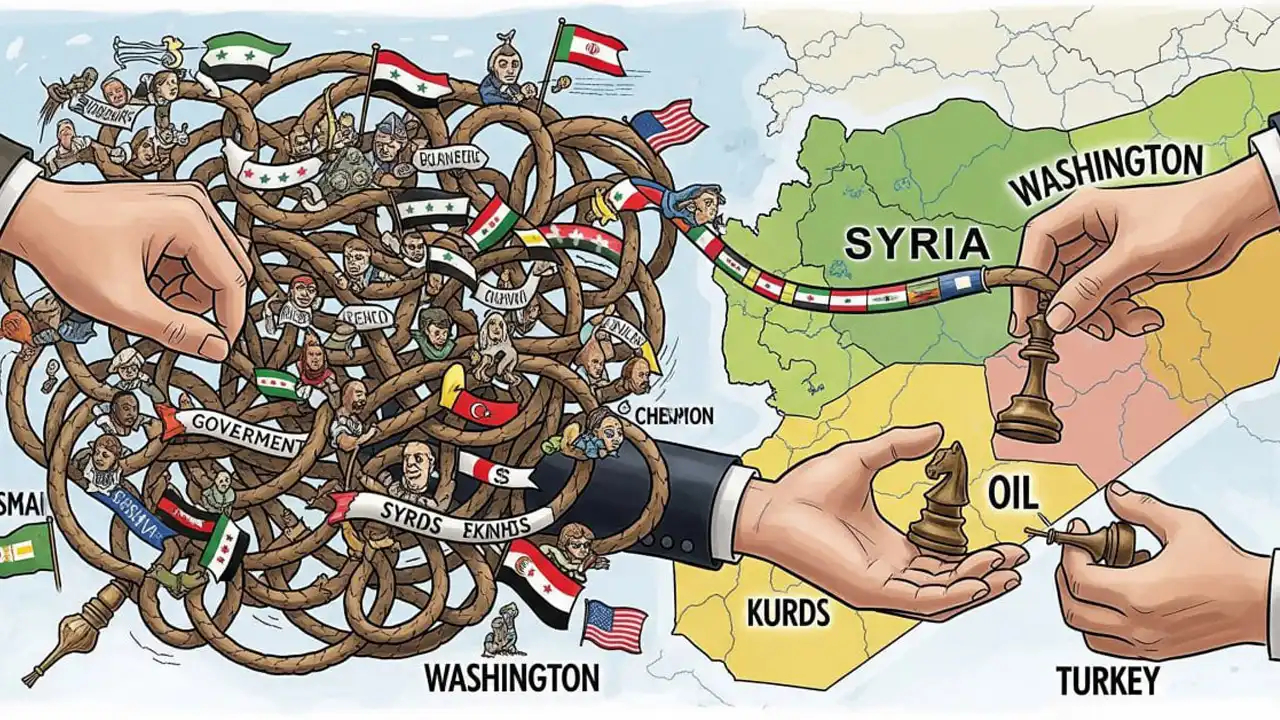
The Syrian knot and Washington’s strategic exchange

ARVAK Center comment, January 23, 2026[1]
Escalation in Aleppo and the offensive on Rojava positions
A new round of armed confrontation in Syria has coincided with a critical rise in tension surrounding the Islamic Republic of Iran (IRI) and the final stage of the institutionalization of the “Peace Council” for the Gaza Strip. This dynamics indicates a complex interdependence of regional processes.
On January 6, 2026, fighting broke out in Aleppo between the Syrian government army and Kurdish formations within the Syrian Democratic Forces (SDF). The interim government of Syria, led by Ahmed al-Sharaa, accused the Kurdish leadership of violating agreements that mandated the SDF’s integration into the SAR Armed Forces by the end of 2025. Official Damascus also accused the Kurds of artillery shelling of civilians in the Kurdish-controlled Ashrafieh and Sheikh Maqsoud districts of Aleppo.
Meanwhile, verified data suggests that Kurdish units loyal to the Rojava administration lacked rational motives for escalation in Aleppo, given their effective encirclement by government forces. It is highly probable that Damascus initiated the hostilities, launching a military operation to eliminate the Kurdish presence under the pretext of violating the terms of the March–April 2025 peace agreement.
Expansion of government forces in the Eastern direction
After establishing control over Kurdish enclaves in Aleppo, the Syrian government army shifted its operational focus to the east and southeast – toward the administrative centers of Rojava. By the end of January 17, government forces occupied several areas west of the Euphrates and approached the outskirts of Raqqa, a key defensive hub for the SDF. Consequently, Damascus seized strategic assets, including the large Rasafa and Safyan oil fields, Tabqa airport, and the Euphrates Dam (Tabqa Dam).
Parallel to the military operation, interim President Ahmed al-Sharaa signed a decree on January 16, 2026, concerning the protection of Kurdish rights. According to the document, all Syrian Kurds deprived of political rights in 1962 are to have their Syrian citizenship restored; the Kurdish language is granted official status in the Syrian Arab Republic and is to be taught in schools within Kurdish-populated areas; and Kurdish holidays, specifically Nowruz – widely celebrated among Iranian-speaking peoples – acquire state status. Notably, the decree includes a vow by al-Sharaa to uphold obligations to ensure Kurdish security and all their civil and political rights.
This decree appears to be an instrument of information-psychological warfare aimed at fragmenting Kurdish society and stimulating the loyalty of moderate factions toward the Damascus authorities. Furthermore, the interim government seeks to legitimize the current campaign before the international community, positioning it not as ethnic cleansing, but as an operation to restore state sovereignty and eliminate separatist structures hiding behind the rhetoric of fighting for the freedom of Syria’s oppressed Kurdish population.
According to expert assessments, al-Sharaa’s initiatives define the limit of compromise the interim government in Damascus is willing to offer. This position effectively excludes the preservation of Kurdish autonomy: civil and political rights for Kurds are to be realized solely within a unitary political system and a single legal framework common to all ethno-confessional groups. Damascus views any rejection of these terms as grounds for further military escalation to completely dismantle Rojava’s administrative and security institutions.
Deactivation of the Kurdish factor within the U.S.-Turkish consensus
The expert community agrees that the intensification of Damascus’s actions was made possible by back-channel agreements between Washington and Ankara. The terms of this deal imply a minimization of Kurdish political subjectivity and the transfer of the Right bank of the Euphrates, along with strategic water and oil infrastructure, to the control of Damascus.
This thesis is confirmed by the passive resistance of the SDF, which abandoned several strategic areas without a full-scale defense. A representative example was the statement by SDF leader Mazloum Abdi on January 17, 2026, noting that it was he who ordered subordinate units to leave Aleppo and redeploy to the Left bank of the Euphrates – a zone considered better protected and safer. It is evident that Abdi is operating under a deficit of external support from the U.S. Washington’s official position has been limited to declarative calls for Damascus to avoid bloodshed and resolve the Rojava issue through inclusive dialogue.
Specifically, U.S. Central Command (CENTCOM) head Admiral Brad Cooper called on Damascus to cease all offensive actions in areas between Aleppo and Tabqa. Additionally, the U.S. House Foreign Affairs Committee issued a condemning statement regarding the escalation. However, the matter has not progressed beyond these appeals. Meanwhile, real steps taken by Washington indicate pressure on the Rojava leadership to force concessions.
Diplomatic pressure and the disarmament scenario
At the height of the escalation in Syria, a meeting took place in Erbil between the U.S. Ambassador to Turkey and President Donald Trump’s special representative for Syria, Tom Barrack, and the political leader of Iraqi Kurds, KDP Chairman Masoud Barzani. The commander of the SDF and de facto leader of Rojava, Mazloum Abdi, participated in this meeting via video link. While details remain confidential, it is highly likely that Barrack relayed the Trump administration’s demand to abandon “maximalist demands” and agree to Rojava’s integration into Syria. European political centers have shown a similar interest in Syrian unification more openly. For instance, French media reported that President Emmanuel Macron, in a phone call with Iraqi Kurdish regional leader Nechirvan Barzani, emphasized the need for the “SDF to return to negotiations in accordance with the March 10 agreement”.
Thus, unprecedented pressure is being exerted on Rojava’s military-political leadership. Should they refuse to dissolve the autonomy, Damascus, with the silent consent of external players, will likely continue the forceful absorption of the region.
Dynamics of January 18-19: from capitulation to renewed fighting
On the evening of January 18, 2026, Syrian and Turkish media circulated reports that Mazloum Abdi had signed a ceasefire agreement with Damascus, transferring all strategic Rojava sites – including prisons holding ISIS militants – to Syrian government forces. Turkish sources interpreted this as a total capitulation of the SDF and a strategic victory for Recep Tayyip Erdoğan.
However, simultaneously with reports of the de facto liquidation of autonomy, information leaked into Middle Eastern media that the Barzani clan leaders in Erbil were deploying three large “Peshmerga” units into Rojava. Reports also emerged that a mass mobilization was declared within Rojava itself to protect the autonomy from a Syrian army invasion. By the morning of January 19, 2026, it became clear that the agreement to cease resistance was violated before it even took effect: fighting continued throughout the night near the cities of Raqqa and Deir ez-Zor and the Tishrin Dam on the Euphrates. Despite this, the general trend indicates a reluctance on the part of the U.S. to intervene to save Rojava’s autonomy.
Geopolitical exchange: Syria in exchange for Iran
Washington’s withdrawal of support for Syrian Kurds is part of a larger strategy. On January 16, 2026, the U.S. published information on the structure and composition of the “Peace Council” for Gaza, which, quite unexpectedly for many observers, included Turkey alongside Egypt and Qatar. According to Israeli sources, D. Trump’s decision to include Ankara (represented by Foreign Minister Hakan Fidan) caused sharp dissatisfaction in Tel Aviv; however, the White House stood its ground despite a demarche from the Israeli government led by B. Netanyahu.
This development allowed Turkish politicians to claim that Ankara achieved a major diplomatic victory, while Israel suffered a “strategic defeat in the realm of symbols and procedures”. This narrative is not without merit, as the Netanyahu government had repeatedly and categorically rejected any Turkish participation in stabilizing or rebuilding Gaza. Tel Aviv emphasized Ankara’s destructive role in the Palestinian question, citing the pan-Ottomanist rhetoric of Turkish leadership regarding the need to “return Jerusalem to the bosom of Turkey” and hinting at data regarding covert military-political support for Hamas by Turkish intelligence and military structures.
The high political price paid by Washington in its relations with Israel suggests the receipt of counter-concessions of exceptional importance from Turkey. The most likely subject of exchange is Ankara’s loyalty to U.S. plans to overthrow the theocratic regime in Iran and radically transform Iranian statehood.
Until recently, Ankara not only officially condemned the destructive actions of the U.S. and its allies against Iran but also, according to open sources, provided intelligence support to Iranian authorities to prevent the transfer of Kurdish formations from Iraq to Iran to aid the “Party of Free Life of Kurdistan” (PJAK) in its struggle against Tehran. It is also probable that Turkish interaction with Iran was not limited to this component and threatened to derail global U.S. plans regarding Iran. Without the loyal position of Turkey and its satellite, Azerbaijan, the U.S. anti-Iranian strategy would be difficult to implement, which explains Washington’s readiness to strike a deal with Ankara, sacrificing the interests of Syrian Kurds for the formation of a monolithic anti-Iranian front.
Conclusion and forecast
Recent actions by the United States concerning the Syrian conflict have prompted international commentators to assert that the Trump administration has “abandoned the Kurds”. The aspirations of Syrian Kurds for the independence of Rojava – a goal for which they actively collaborated with the U.S.-led coalition against ISIS and the “Assad regime” – have not been realized. Furthermore, the trajectory of events suggests that while “ceding” Rojava’s interests in Syria, the U.S. is concurrently developing a similar coalition initiative involving Kurds on the Iranian front. In this new endeavor, PJAK structures will also be offered the prospect of statehood in return for a full-scale and overt conflict against the Shiite “oppressors” in Tehran.
The current events in Syria confirm the thesis of a revision of U.S. treaty obligations toward the Syrian Kurds. Donald Trump has effectively disavowed the Rojava independence project, which previously served as a tool for engaging this segment of Syrian society in the fight against ISIS and Bashar al-Assad’s regime.
Current events in Syria substantiate the proposition of a revision of U.S. treaty obligations concerning the Syrian Kurds. Donald Trump has effectively repudiated the Rojava independence initiative, which had previously functioned as a mechanism for enlisting this segment of Syrian society in the opposition against ISIS and the regime of Bashar al-Assad.
Simultaneously, the situational forecast does not preclude an attempt by the U.S. to execute a comparable scenario in Iran. The establishment of a new coalition incorporating Iranian Kurds (PJAK) is fully anticipated, with promises of prospective statehood potentially offered in return for their participation in hostilities against the central government in Tehran. Should this occur, the Kurdish factor will persist as a disposable asset within Washington’s overarching Middle East strategy.
[1] The original (in Rus.) was posted on our website on 20.01.2025.