
Publication
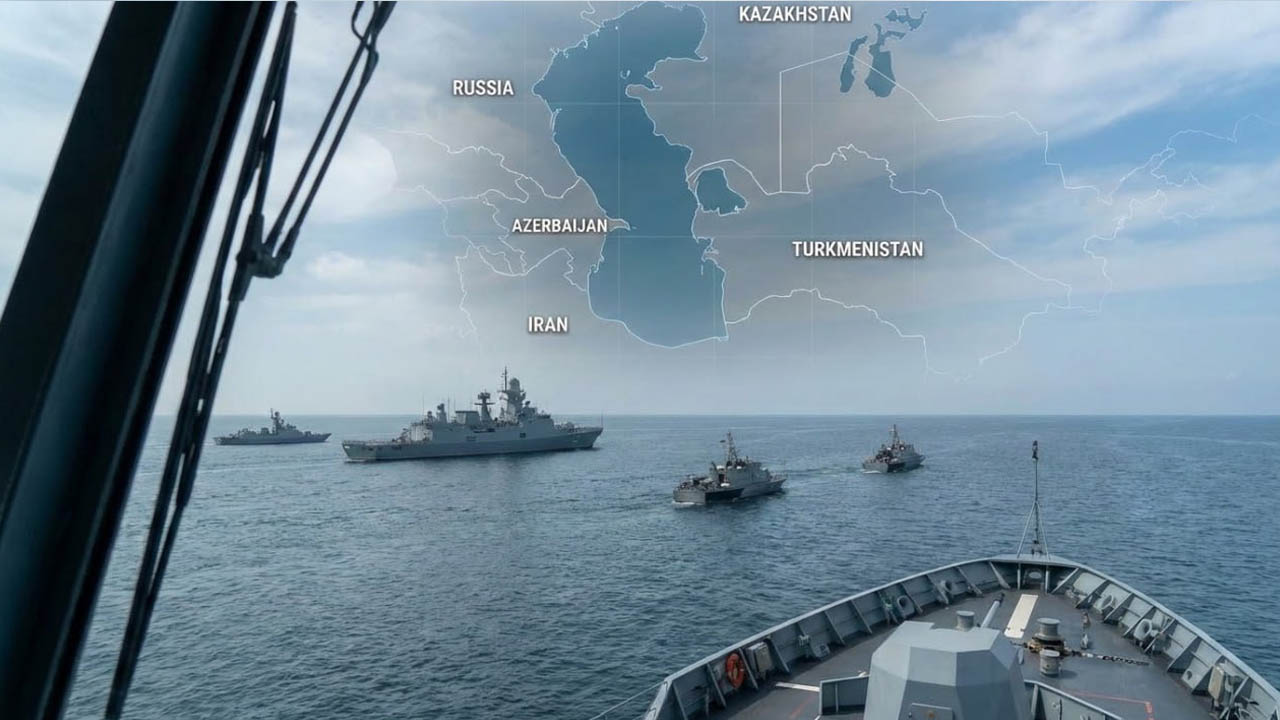
The Caspian Sea as a potential arena for military operations

ARVAK Center comment, April 3, 2026[1]
1. Massive attack on Bandar Anzali: precedent and consequences
On March 18-19, 2026, for the first time in the history of its military confrontation with Iran, Israel carried out a massive attack on the Islamic Republic of Iran (IRI) naval grouping in the Caspian Sea. According to the IDF General Staff, strikes were delivered against the headquarters of Iran’s Northern Naval Command in the Bandar Anzali area and against warships moored in the port. As a result of the attack, one corvette, 4 missile boats, auxiliary vessels, a shipyard, and a command center were disabled or sustained confirmed damage.
The Israeli General Staff justified the raid on Bandar Anzali by claiming that the attacked vessels allegedly posed a threat to Israeli aircraft in Iranian skies and “possessed anti-submarine capabilities”. At the same time, reports appeared in the information sphere suggesting that, in reality, the strike was carried out based on intelligence regarding a certain secret military cargo, including high-tech electronic equipment, that had arrived at the port of Bandar Anzali from the Russian Federation.
The scale and repercussions of the air attack are assessed differently by the Israeli and Iranian sides; however, irrespective of the objectivity of the data presented by either party, the very occurrence of a strike against a crucial military and civilian port of the Islamic Republic of Iran on the Caspian Sea signifies the expansion of the Iranian escalation beyond the conventional confines of the Middle East. Expert analyses suggest that subsequent to the Israeli attack on Bandar Anzali, the Caspian region is undergoing a transformation into an additional theater of military operations, thereby conferring upon all Caspian littoral states the designation of frontline states.
2. Destabilization of the Caspian legal regime and Moscow’s reaction
Immediately following the Israeli raid, the Caspian littoral countries issued standard statements expressing concern over the escalation in the Caspian waters and the threat to the security of logistical routes and commercial shipping in this landlocked body of water. Relatively severe, compared to the reactions of Baku, Astana, and Ashgabat (excluding the condemnation from Tehran itself), was the statement from Moscow, which condemned the “reckless and irresponsible actions of the aggressors [which] pose the risk of drawing the Caspian states into military conflict”.
Moscow’s pronounced reaction appears justifiable, given that the “Convention on the Legal Status of the Caspian Sea”, formally signed on August 12, 2018, following nearly two decades of intensive negotiations, fundamentally precludes the deployment of third-party military forces within the Caspian waters. Furthermore, it assigns the responsibility for maintaining security in this sea to all five signatory states. Concurrently, Moscow tacitly proceeded from the assumption that its own Caspian Flotilla and the Iranian Navy, possessing the highest level of combat readiness in the region, would serve as the principal deterrent against external actors attempting to destabilize the balance of power in the Caspian basin. The Israeli strike targeting Iranian warships and port infrastructure has already been interpreted as an effort to dismantle this pre-existing balance and has established a perilous precedent, potentially drawing certain Caspian littoral states into the Iranian conflict. This specific scenario presents a significant threat to Moscow, jeopardizing not only the security of Russian interests in the Caspian waters but also the stability of its Caucasian and Central Asian borders.
3. Analysis of military motives and the geopolitical logic of provocation
Experts from Russia and Iran assert that the rationale presented by the IDF for the bombardment of the Iranian Navy in the Caspian Sea lacks a logical foundation. The offensive capabilities of Iranian vessels in the Caspian Sea were not utilized to repel strikes against the territorial integrity of the Islamic Republic of Iran (IRI) and, even theoretically, were incapable of preventing attacks by the U.S.-Israeli coalition against Iran’s ocean fleet in the southern part of the country. The operational deployment of the IRI Navy’s Caspian contingent was strictly confined to the waters of that sea – specifically, Iranian territorial waters and coastal areas in the north. Consequently, the Israeli strike appears to have been primarily intended not for the neutralization of Tehran’s military assets in the region, but rather to instigate a significant escalation in the Caspian, potentially drawing regional states into the anti-Iranian campaign. In this context, Russian experts specifically cite Azerbaijan and, to a lesser extent, Kazakhstan.
The validity of these claims is rather compelling. Iran has consistently declared that its forces would immediately target the critical infrastructure of any neighboring state providing support, in any capacity, to the actions of the U.S.-Israeli alignment against Tehran. These pronouncements were substantiated by substantial Iranian missile and drone attacks, not only against U.S. bases situated in Saudi Arabia, Bahrain, the UAE, and Qatar, but also against strategic industrial and raw material export facilities belonging to these nations. Given this context, it is plausible that the Israeli attack on Bandar Anzali, which resulted in damage to both IRI naval military installations and civilian port infrastructure, was executed primarily to provoke retaliatory actions directed toward Azerbaijan.
4. The Azerbaijani vector and the threat to energy exports
Several Middle Eastern sources assert the high probability that Israeli F-15I Ra’am (“Thunder”) fighter-bombers, responsible for the missile launch targeting Bandar Anzali, traversed the airspace of Syria and Iraq to reach northern Iran. However, the possibility cannot be discounted that reconnaissance and target acquisition for the strike were conducted from the territory of Azerbaijan, given the established long-term presence of Israeli military personnel there. It is plausible that Tel Aviv deliberately factored in this circumstance, anticipating a strong reaction from Tehran based on the same retaliatory logic Iran employs against the Arab Gulf states.
This primarily pertains to Azerbaijan’s offshore oil and gas assets (specifically the “Shah Deniz” and “Azeri–Chirag–Gunashli” platforms), the Sangachal terminal, and the hydrocarbon export pipelines. It was presumed that these strategically vital facilities, which constitute the foundation of Azerbaijan’s economy, would immediately become targets for the Iranian military and the IRGC should Tehran determine that Baku, through any form of assistance to Israel, had breached Iran’s designated “red lines”. A hypothetical analysis of such a scenario suggests that Azerbaijan would be drawn into the conflict, a contrast to the Persian Gulf Arab monarchies, which currently endeavor to avoid direct military confrontation with the Islamic Republic.
5. Tel Aviv’s risks and diversification of oil imports
Even assuming the attack on the Caspian was intended to diminish the Iranian naval grouping’s firepower or impede the shipment of critical high-tech Russian weaponry, Tel Aviv must have recognized that, amidst general tension and unpredictable dynamics, Iranian security forces might undertake radical actions against Azerbaijan. Relations between Tehran and Baku are already at a critically exacerbated stage, notwithstanding both parties’ declared mutual desire not to breach the fragile threshold of military confrontation. Consequently, Tel Aviv must have considered the high probability of an Iran–Azerbaijan clash and likely proceeded with all potential consequences and development scenarios duly contemplated.
Experts tend towards the perspective that the attack by Tel Aviv on Bandar Anzali was executed deliberately to elicit retaliatory measures from Iran against Azerbaijan. The sole ambiguity for these experts lies in the actual preparedness of the U.S. and Israel to jeopardize their strategic interests in the South Caucasus and the Caspian within this complex situation. This pertains to Washington’s cultivated plans to secure control over the strategic routes of the “Middle Corridor”, encompassing Trans-Caspian logistics, Azerbaijani-Georgian thoroughfares, and the TRIPP. For its part, Tel Aviv maintains an interest in the stability of the region’s oil sector and the uninterrupted functioning of the Baku–Tbilisi–Ceyhan pipeline, which supplies Israel with the majority of its oil imports (estimated variously between 30% and 60%).
Considering this, an alternative hypothesis warrants deliberation: that Tel Aviv, viewing Azerbaijan’s involvement in a conflict against Iran as an existentially vital objective, pre-emptively resolved the issue of replacing Caspian oil imports and conducted the operation in Bandar Anzali autonomously, without notifying the U.S. command or the White House. While this hypothesis may not appear entirely persuasive due to several objective factors, it cannot be dismissed, particularly in light of the established narrative within certain expert circles that the entire anti-Iranian military campaign constituted an “adventure” into which Israel “enticed” Donald Trump.
6. Reorganization of energy flows
The feasibility of an alternative to Azerbaijani-Kazakhstani oil, which is transported via pipeline from Absheron to the Turkish port of Ceyhan and subsequently by tanker to the Haifa refinery, is a theoretical possibility. Data concerning Israel’s oil imports are classified, and publicly available information, according to analyses, does not accurately reflect the actual situation. Even in the context of escalation in the Persian Gulf and the Gulf of Aden, which facilitate international access to Middle Eastern energy resources, Israel could theoretically mitigate the situation by relying, for instance, on supplies from the United States, Nigeria, or even Russia. Furthermore, it is evident that irrespective of recent developments in the Caspian region, Israel has already secured options for diversifying its suppliers. Given the critical deterioration of relations with Turkey, this step should be regarded as a strategic imperative, a necessity seemingly acknowledged in Tel Aviv.
Summary
In summation, the substantial strike on the Iranian port of Bandar Anzali should be interpreted within the same framework as the incidents of March 4, 2026, in Nakhijevan (specifically, the Unmanned Aerial Vehicle attack on the Nakhijevan airport) and the persistent, incoming intelligence reports concerning the detection of unidentified UAV flights over the Azerbaijani capital. This evidence suggests that specific actors are consistently intensifying the level of friction in Azerbaijan–Iran relations. These efforts are likely to continue until the conflict involving Iran is halted through the mutual accord of all opposing parties.
[1] The original (in Rus.) was posted on our website on 28.03.2026.