
Publication
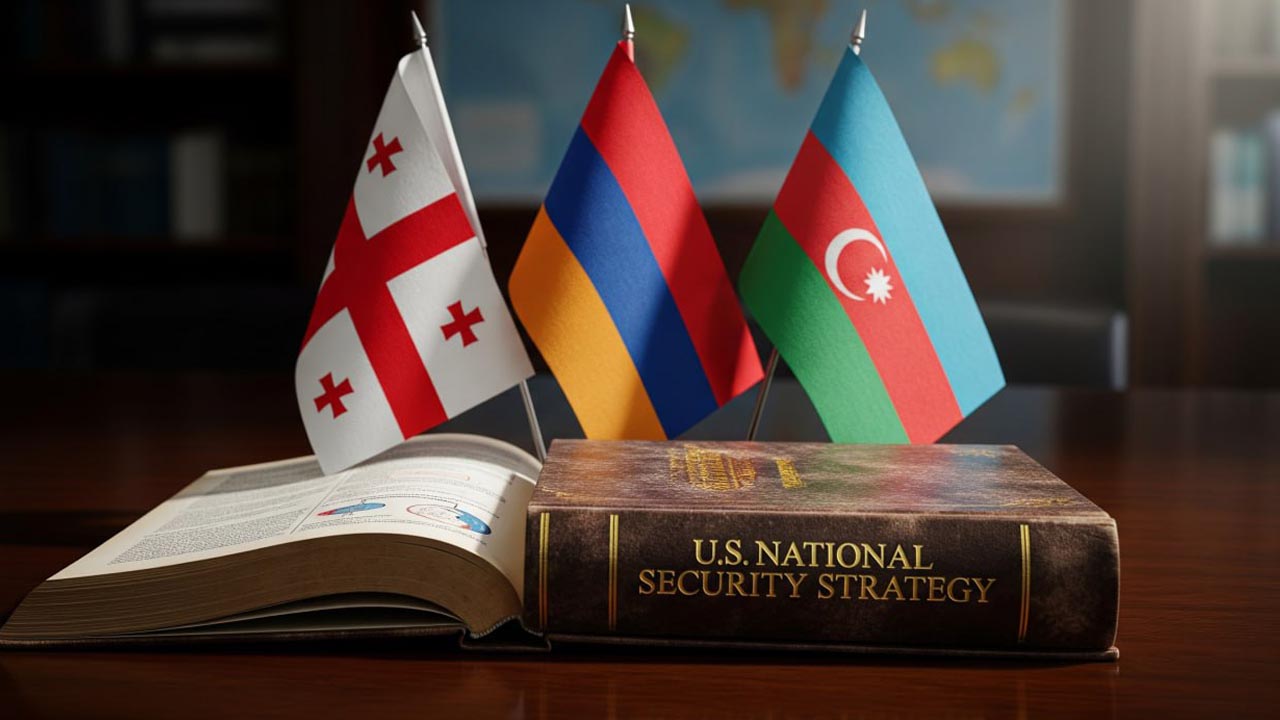
New U.S. National Security Strategy and the South Caucasus

ARVAK Center comment, 22.12.2025 [1]
Conceptual departure from global hegemony and revision of foreign policy doctrines
U.S. president Donald Trump’s administration has prepared and published a “New National Security Strategy”. The 33-page document presented on December 4, 2025, according to the majority of the experts, is of a paradigmatic nature. It clearly outlines the current administration’s concept of departing from the foreign policy doctrine that has dominated Washington since the second half of the 20th century. The authors of the document effectively recognize the limited nature of the U.S. resources for maintaining a unipolar model of the world order, noting a miscalculation of their own capabilities in the post-Cold War period. According to the provisions of the Strategy, the pursuit of total global domination and intervention in all peripheral conflicts lead to a dissipation of resources and a lack of sustained positive results. The published document correlates to a certain extent with the “Monroe Doctrine”; however, it does not imply a full withdrawal of the U.S. from former zones of global presence. Instead, the Western Hemisphere is viewed as a special and inviolable space of Washington’s unconditional hegemony, which must not be challenged by any other world center of power – neither in the military-political nor in the economic dimension.
De-ideologization of foreign policy and the principle of regional delegation
The “New Strategy” postulates the need for a more cautious U.S. attitude toward the state sovereignty and internal political structure of the world’s countries. The Strategy implicitly signals a departure from the doctrine of liberal interventionism and the policy of regime change, renouncing the forced exportation of American values and the mandatory imposition of Western democratic models. For the Strategy’s architects, the internal socio-political composition of ‘problematic states’ is secondary to their potential for alignment; the primary objective is their cultivation as reliable partners and allies, irrespective of their specific governance structures or mental-civilizational leanings.
Another fundamental innovation of the Strategy is the intent to substantially delegate responsibility to strong regional allies. By entrusting partners with the rights and duties to maintain order within their respective ‘zones of responsibility’, Washington seeks to establish a decentralized security architecture. This approach is specifically designed to prevent the emergence of ‘dominant adversaries’ while reducing the direct operational burden on the United States. Washington intends to redistribute part of its influence at the regional level in favor of allied states, provided that a balance of power is maintained that excludes threats to regional and global U.S. interests.
In general, these theses do not indicate a U.S. refusal of the status of a leading world power that dictates the rules of the game. It is about optimizing resources for the effective management of geopolitical processes through the use of new tools of influence in those regions where the U.S., by definition, cannot renounce its strategic interests. The transfer of part of the functions to regional “operators” (“junior allies”) is viewed as a forced measure necessitated by the growth of their ambitions and the need to minimize Washington’s costs for their rigid containment. This factor is also significant; however, specialists pay insufficient attention to it, viewing the U.S. “New Strategy” exclusively in the context of the confrontation with key competing powers on the world stage. Meanwhile, the containment of allies striving for greater independence within the field of its strictest control requires no less effort and resources from Washington, and under the current conditions, granting them greater – though largely conditional – geopolitical independence is a forced measure.
Crisis of Euro-Atlantic solidarity and strategic reorientation toward China
Despite its innovative nature, the Strategy does not change the fundamental goal of the United States. It received the status of “revolutionary” largely due to a radical revision of the Trump administration’s approaches to the European and Russian directions of foreign policy. In this regard, the document, according to assessments by several authoritative Western media outlets, truly “shocked” both the international community and the American public. The “New Strategy” documentarily records Donald Trump’s theses on the systemic degradation of Europe as a historical-political, civilizational, and economic center of power. As statistical confirmation of the Old World’s declining role in global politics, the reduction of continental Europe’s share in world GDP from 25% in 1990 to 14% in 2025 is cited. However, the most threatening issues appear to be the value decay of European civilization and the inability of the EU to maintain its own cumbersome construction in balance. The “New Strategy” no longer considers the dominant role of the U.S. in ensuring EU security to be expedient, allows for the stagnation of the NATO expansion process, and seeks to enable Europe to “stand on its own feet and operate as a group of aligned sovereign nations” by preventing adversarial powers from gaining domineering influence on the continent.
The document almost directly indicates that the EU will not pass the “historical exam” if it continues the policy of moving away from national identity and suppressing the sovereignty of both the member states of the integration project and countries located in the zone of Brussels’ geostrategic ambitions. Particularly significant is the provision recommending that the EU cease to perceive Russia as an “existential threat”, thereby indirectly confirming the recognition of Moscow’s right to define and defend its interests in zones of traditional historical presence.
Rehabilitation of the RF as a tool for containing the PRC
Official circles in the RF reacted to the Strategy with restraint; at the same time, the exclusion of Russia from the list of existential threats caused a positive resonance in certain political circles and the country’s expert community. In the context of the Ukrainian crisis and the activation of the U.S. peace initiatives, the document’s theses confirm Washington’s desire to establish a long-term balance of interests in Eastern Europe that excludes the prospect of a direct military clash between Russia and the collective West. Thus, D. Trump’s administration distances itself from radical circles of the European elites who insist on continuing the military confrontation and the forced admission of Ukraine into NATO in violation of the provisions of the Organization’s Charter, which is fraught with the escalation of the conflict into a larger-scale war with Russia.
Expert circles are inclined to believe that D. Trump and his team are significantly weakening the pressure on Russia, forcing Brussels to engage in a constructive dialogue with the RF, and are shifting their strategic attention to the Indo-Pacific region to contain the “Chinese threat”. This is the essence of the Strategy: the rehabilitation of Russia as a secondary threat for the sake of concentrating efforts on military-economic opposition to the PRC. The mention of Taiwan and the Taiwan Strait as a zone of U.S. priority interests indicates the intention to stop the process of strengthening the PRC’s geopolitical and geoeconomic positions as a global pole of power, which has lasted for three decades.
Thus, the document reflects D. Trump’s repeatedly voiced idea of the need to stop the process of “pushing” the RF out of the orbit of Western civilization, to which it belongs historically, politically, and mentally, and not to provoke it into an alliance with the PRC, which could result in the loss of U.S. dominant positions in the world.
The South Caucasus in the system of regional “operator-powers”
The “rehabilitation” of Russia and the new concept of U.S. reliance on regional allies, with the delegation of part of its responsibility to them, suggests that changes will not bypass the South Caucasus. Although this region does not figure in the Strategy as an isolated case, it is considered in the context of the large-scale Middle Eastern vector of the American policy. This strategic direction here is characterized by the prioritization of Israel’s security interests, as well as the search for new formats of regional management. Iran continues to be recognized as a “destabilizing force” in the Middle East; at the same time, the region itself is recognized as having lost its former strategic importance for the U.S. in light of the new policy of diversifying energy resources. The U.S., according to the provisions of the “New Strategy”, will increase the development and export of “own” energy resources, which will automatically reduce the importance of Middle Eastern fossil reserves for the Western and world economy as a whole. In view of this, the Middle East will likely turn into one of those geopolitical zones where the U.S. will strive to minimize its activity, transferring part of its functional role to regional allies.
The document does not explicitly indicate potential contenders for such roles; however, it can be assumed that this refers primarily to Israel, Turkey, and possibly Saudi Arabia, which will be tasked with responsibility for order in the region and maintaining balance. Possessing significant experience of partnership as traditional allies of the United States, these regional actors are simultaneously burdened with a complex of accumulated mutual contradictions. Such antagonism creates conditions for intense competition, which allows Washington to build a multi-level system of checks and balances necessary for maintaining the status of supreme arbiter in the region.
Hypothetically, a similar system should appear in the South Caucasus, where Washington, on the one hand, will provide Ankara with the opportunity for more independent actions in the context of Turkey’s regional interests, and on the other – in accordance with the new Strategy –will not challenge Russia’s historical right to defend its own interests in the region. Furthermore, for objective reasons, the Iran factor will also remain in the South Caucasus, while Israeli influence is likely to only increase (primarily in Azerbaijan), which in combination will also provide the U.S. with the opportunity for arbitration of the competitive struggle of regional powers loyal (fully or partially) to Washington.
In the long term, such a configuration of forces in the South Caucasus is capable of increasing the effectiveness of the realization of American interests in the region and providing results that significantly exceed current indicators. Primarily, the agenda of strategic rapprochement between Russia and Iran, which became a forced measure for both countries in the conditions of increasing Western pressure and geoeconomic isolation, will be torpedoed.
At the same time, despite the demonstrative recognition of Russia’s right to maintain a large-scale multi-level presence in the South Caucasus, its real capabilities in the region will be significantly limited by the systematic strengthening of Turkey’s military-political influence. In turn, Ankara will face significant resistance in its attempts to dismantle Moscow’s traditional positions in the South Caucasus. This configuration of forces minimizes the risks of Turkey’s excessive autonomy, limiting its ambitions for conducting an independent geopolitical game not coordinated with Washington.
The intensification of Russian-Turkish rivalry under the aegis of American arbitration will lead to the displacement from the region of secondary actors – the European Union (in Armenia) and China (in Georgia and Azerbaijan). This will create critical obstacles for the full realization of the “One Belt, One Road” transcontinental project, which is viewed by Washington as the most serious challenge to U.S. global leadership. Given the potential of this initiative for forming an informal geopolitical alliance of Eurasian states, accumulating about 40% of the world’s GDP, Washington seeks to prevent such a consolidation of its competitors’ interests. In this regard, the U.S. is likely ready to delegate to Turkey and Russia the right to rigid competition and the division of spheres of influence in the South Caucasus, which will allow for the destabilization of Beijing’s plans for creating a key logistics hub in this subregion.
Conclusion: a permanent goal in new geopolitical realities
In the opinion of the international expert community, the provisions of the “New US National Security Strategy” should not be perceived as a dogmatic road map for Washington’s foreign policy. The history of recent decades demonstrates that various administrations have regularly initiated a revision of foreign policy priorities, adapting them to the dynamics of global processes and internal political transformations. Nevertheless, despite the variability of the methods used, the strategic goal remains unchanged – the preservation of U.S. global dominance. In this sense, the document prepared by D. Trump’s team does not change the fundamental “super-task” but offers a revolutionary approach to revising the categories of “allies” and “adversaries”. The Strategy’s innovation resides in the attempt by a segment of the American elite to synchronize national ambitions with the actual distribution of power within contemporary global processes.
[1] The original (in Rus.) was posted on our website on 20.12.2025.