
Publication
NATO crisis and Turkey’s geopolitical anxiety

ARVAK Center comment, 28.01.2026 [1]
-
NATO crisis and Turkey’s geopolitical anxiety
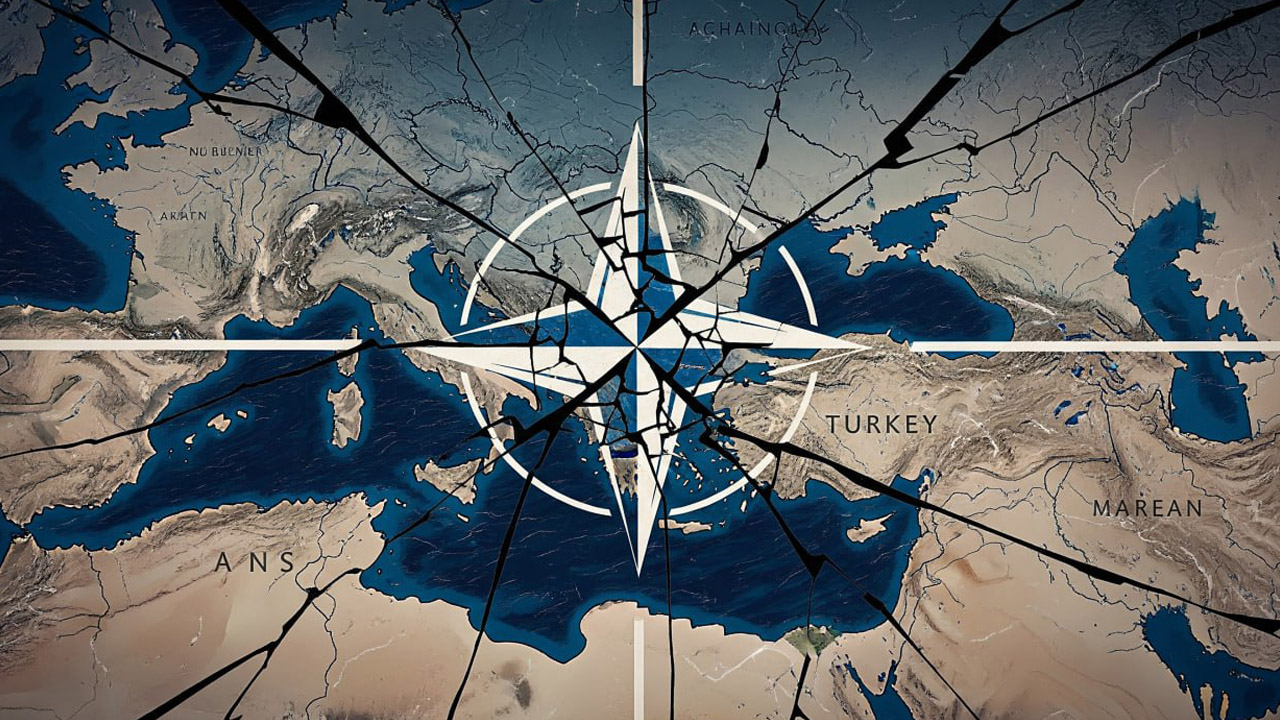
Turkish mass media are broadcasting the growing alarm of the country’s military-political establishment regarding the future of NATO. The North Atlantic Alliance, in which Turkey has held a key position due to its geopolitical location and military potential, is undergoing an unprecedented crisis that could lead to the dissolution of this military-political union.
-
Origins of the systemic crisis: from “gendarme” to stagnation
The intra-systemic problems of NATO are rooted in the 1990s, when, following the collapse of the USSR, the North Atlantic Alliance shifted from an institution for deterring the “global communist threat” into a “gendarme” of a unipolar world. The expansion of NATO to the East, unmotivated by real security challenges to the U.S. or its European allies, provoked post-Soviet Russia to change its integration vector with the Western world and remobilize its deterrent potential, emphasizing critical nuclear defense components.
The direct approach of the Alliance to Russian borders revived the existential threat of nuclear escalation, which inevitably caused friction among certain members. Simultaneously, the first signs of internal imbalance appeared: some countries (primarily those admitted post-USSR) pursued a policy of active militarization, while many “veteran states” faced a stagnation of their military-industrial complexes (MIC) and army building due to the loss of priority in defense funding.
Furthermore, the NATO system was “upended” by perpetual large-scale military operations by its most influential members, who bypassed consensus regarding the use of the organization’s defense potential outside its strategic zones. This resulted in interventionist wars in the former Yugoslavia, Iraq, Afghanistan, and Libya, significantly deepening the crisis of mutual understanding within the bloc.
-
Devaluation of meaning and U.S. pragmatism
The devaluation of the ideological foundations of this military-political union – following the exit of the Warsaw Pact as the primary antagonistic force – led to a disorientation of NATO’s priorities and a loss of its raison d’être, at least in its previous formats. Projecting the ghost of a communist threat onto an exhausted and objectively weakened Russia failed, calling into question the primary purpose of the Alliance and the solidarity of its members on the global security agenda.
As a result, NATO was formally preserved and even expanded to manage its members, intimidate non-compliant international actors, provide a vast market for the MIC, and accumulate colossal financial resources that primarily serve the economic interests of the bloc’s leader – the United States.
-
Turkey in the Alliance: historical experience and the “nuclear umbrella”
Throughout its membership in NATO (since 1952), Turkey has directly experienced both significant positive results of military-political integration and the negative aspects of being in the Alliance. It was the world’s bipolarity (the NATO–Warsaw Pact antagonism) that drove Turkey into the bloc, which enabled it to form a modern Western-style army, achieve substantial technological growth, and step under the “nuclear umbrella” of the U.S. and other allies.
NATO’s focus on deterring the Soviet threat also facilitated Ankara’s relatively unimpeded projection of power during the Greco-Turkish rivalry in the Mediterranean (e.g., the 1974 invasion of Cyprus), which was not prevented by allies due to the recognition of Turkey’s critical role on the anti-Soviet southern flank. In fact, this action was the first harbinger of crisis potential within NATO, leading to a lingering phase of low-intensity military confrontation between two member states (Greece joined NATO in 1952, simultaneously with Turkey).
-
Post-Soviet transformation and loss of exclusivity
The collapse of the USSR weakened Turkey’s role in NATO’s configuration. Ankara lost its tacit status as the only member directly bordering the primary traditional rival – Russia –ceding this position to former Warsaw Pact and Baltic states. Additionally, the reformatting of the secular Kemalist model pushed Turkey toward a more active and independent policy focused on Asia.
Consequently, while formally maintaining full membership, Turkey gradually lost its exclusive relationship with the bloc’s leader – the United States. This resulted in the loss of access to advanced American military technology (e.g., exclusion from missile defense programs, the cancellation of the F-35 deal). Furthermore, internal NATO tensions encouraged the formation of “silent alliances” with a distinct anti-Turkish orientation (e.g., French-Greek cooperation). In the same vein, a new alliance is currently forming in the Eastern Mediterranean between Cyprus, Greece, and Israel – the latter being a “Major Non-NATO Ally” (MNNA) since 1987, receiving unprecedented U.S. support.
-
Misuse of status and the “Ukrainian factor”
Internal decentralization has sparked an open discourse among members regarding the feasibility of Turkey’s continued presence in NATO. Ankara’s assertiveness in the Eastern Mediterranean and the Balkans, coupled with its neo-Ottoman tendencies, forces opponents within the Alliance to question Turkey’s right to security preferences, specifically the “nuclear umbrella”.
Critics argue that Ankara uses this extraordinary power to pursue its own geopolitical initiative, often contradicting NATO’s collective interests. Many European members consider this a blatant misuse of the Alliance’s image and military potential for Ankara’s independent geopolitical maneuvers. Furthermore, many NATO countries are dissatisfied with Turkey’s passive stance regarding Ukraine and its rapprochement with Moscow. Ankara was specifically blamed for exploiting the NATO principle of consensus; by using its veto power, Turkey blocked the accession of Sweden and Finland, bringing NATO’s systemic crisis into the public eye and stalling Russian “containment” efforts in Northern Europe and the Baltics.
-
The Greenland dilemma and the breakdown of the security system
Despite these internal problems, Turkey’s NATO membership remained its primary pillar for geopolitical initiative. Therefore, the threat of a NATO collapse deeply concerns Ankara, as it faces a disorientation of its defense doctrine and the loss of its “nuclear shield”. While the U.S. might offer a bilateral nuclear protection format, it cannot compensate for the loss of the institutional global security system that Turkey utilized for seven decades.
Ankara recognizes that the White House’s program to “expropriate” Greenland is no longer an eccentric idea but a systemic U.S. need for absolute possession of a strategic landmass in the North Atlantic. In this new system, Europe ceases to be the primary consumer of Washington’s security guarantees, rendering NATO in its current format irrelevant. Donald Trump’s statements regarding the choice between Greenland and NATO demonstrate that the Alliance’s significance to the U.S. elite has been devalued. The dilemma has likely already been decided in favor of Greenland’s annexation.
This prospect threatens to transform the unified security system into fragmented local alliances: Anglo-American, U.S.-Israeli, Franco-German, and Eastern European, which could be either situational or long-term.
-
Risks for Ankara and preparing for the worst
Optimistic views that the European flank can remain intact without the U.S. do not withstand criticism. Moreover, a U.S. exit and the “Greenland crisis” could trigger the collapse of the European Union, which largely overlaps with NATO’s borders and relies on its security guarantees.
For Turkey, this is a high-risk scenario. The collapse of NATO would deprive the country of the ability to effectively control the “Kurdish problem”, deter destabilization in the Arab world, or compete with Israel. Its expansionism in the South Caucasus and Central Asia would be jeopardized. Instead, Ankara would face a critical Greco-Israeli alliance, potentially joined by France. These are existential challenges not only to external security but also to an internal organization based on the ruling elite’s commitment to returning Turkey to its former greatness.
Turkey has been preparing for this “worst-case scenario” by expanding its own MIC (naval shipbuilding, UAVs, and missile systems). It has also established a network of military bases in Syria, Azerbaijan, Libya, Somalia, and Qatar.
-
The Asian vector: searching for a new “nuclear shield”
The most fundamental task for Ankara remains finding an alternative to the “nuclear umbrella”. This explains the formation of the recently announced alliance between Turkey, Saudi Arabia, and Pakistan. This bloc aims to stabilize a region vulnerable to the U.S.–China confrontation and the destabilization of Iran.
Experts note this bloc aims to implement a synergy of Saudi financial capacity, Turkish technological progress, and Pakistan’s “nuclear shield” into a self-sufficient pole of power in Asia. While the participants share geopolitical interests and a common confessional identity (Sunnism), factors such as geographical distance and different political systems complicate the union’s long-term stability. Nevertheless, the intense pace of negotiations suggests a shared fear of losing strategic security in a shifting global order.
-
Conclusion
Ankara is seriously preparing for NATO’s potential collapse. The alliance with Pakistan and Saudi Arabia is currently the only real alternative. While not equal to NATO, it acquires existential importance for a country situated on the “geopolitical tectonic fault lines”.
[1] The original (in Rus.) was posted on our website on 26.01.2026.