
Publication
Israel’s “Biblical borders” as a tool of geopolitical discourse

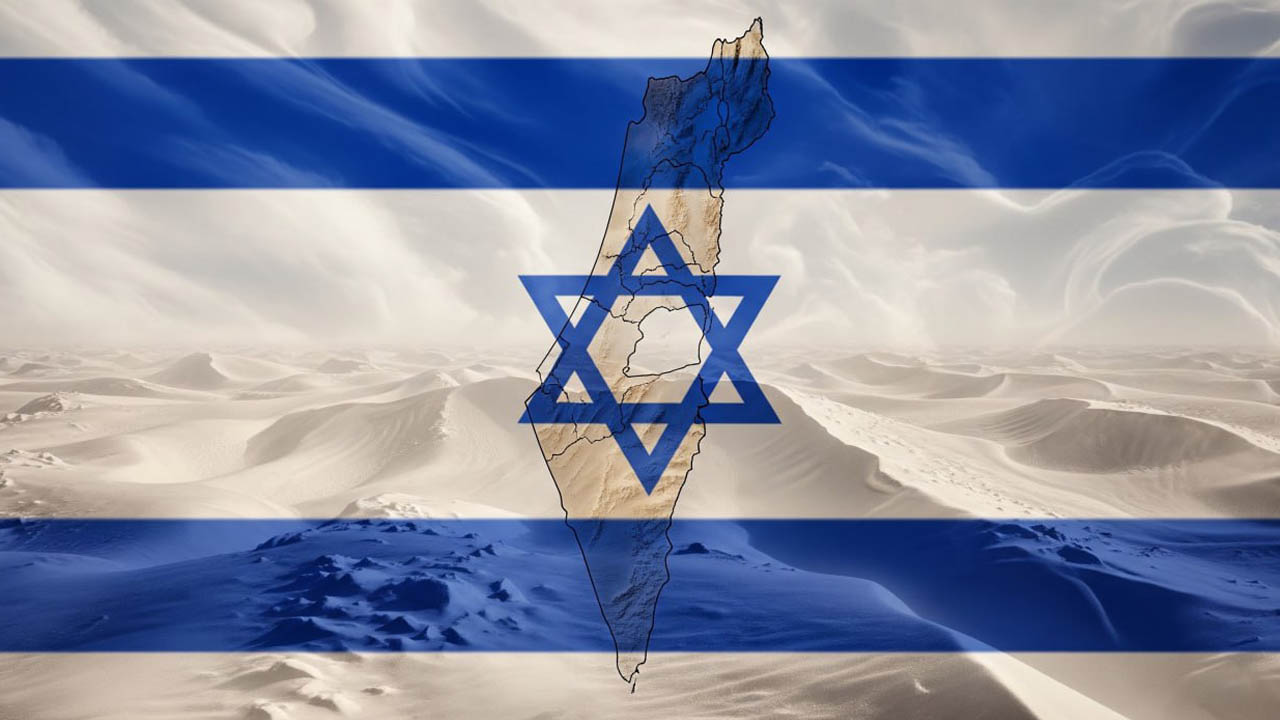
ARVAK Center comment, March 9, 2026[1]
1. Diplomatic resonance and regional reaction
On February 20, 2026, in an interview with well-known Fox News journalist Tucker Carlson, U.S. Ambassador to Israel Mike Huckabee made remarks that were interpreted as an appeal to Israel’s Biblical right to lands “from the Nile to the Euphrates”. Huckabee immediately added that Israel does not seek this and “they are now asking to at least take the land that they now live in, they now occupy, they now own legitimately” to protect their people.
The interview predictably caused an international outcry. A number of Arab and other Muslim states demanded explanations from the U.S. State Department in connection with the ambassador’s statement, which questioned not only the “two-state solution” principle regarding Israel and Palestine but also the sovereignty and territorial integrity of Middle Eastern states neighboring the Jewish state. The content of Huckabee’s interview apparently did not receive approval from Israeli authorities, as Tucker Carlson admitted that immediately after the filming, security personnel at Ben-Gurion Airport seized the entire crew’s passports and detained them for a long period before they could depart Tel Aviv. Nevertheless, Carlson noted that he had encountered difficulties with Israeli authorities even before the interview itself.
2. Theological basis and historical retrospective
Ambassador Huckabee’s remark was, in all likelihood, a direct reference to a key text of the Old Testament – the Book of Genesis (15:18) – which describes the boundaries of the Promised Land that, according to Biblical tradition, God promised to Abraham and his descendants. The mention of this passage is not coincidental: it serves as a tool of geopolitical discourse, directly linking modern territorial claims to ancient religious and historical legitimation.
Furthermore, the ambassador’s words can be interpreted in the context of historical chronicles describing the period of greatest flourishing and power of the United Kingdom of Israel and Judah. This “Golden Age” is traditionally associated with the reign of King Solomon, under whom, according to legend, influence and dominion extended over vast territories. Specifically, Solomon’s borders are described as extending “from the Euphrates to the land of the Philistines and to the border of Egypt”. This formulation, encompassing the space from the great Euphrates River in the north to the strategically important Egyptian border in the south, as well as the lands of the Philistines to the west (the modern coastline), underscores the unprecedented scale of the ancient state.
Mentioning such expansive borders not only highlights historical glory but is actively utilized in the modern political and cultural narrative of Israeli and pro-Israel circles to justify the idea of “Greater Israel”, thereby becoming a permanent (and dangerous) element of discussions regarding Middle East policy and territorial issues. Thus, Ambassador Huckabee’s reference performs a dual function: it appeals to sacred texts while evoking the peak of ancient imperial power.
3. Ideological profile of the ambassador
The U.S. State Department experienced notable discomfort in connection with Mike Huckabee’s statements, attempting to clarify to partners and allies in the Middle East that the ambassador’s words were taken out of context. The problem lies in the fact that since assuming his post as the U.S. Ambassador to Israel (April 9, 2025), a non-career diplomat Huckabee has failed to draw a clear line between his diplomatic authority and public rhetoric, as well as his past career as a Christian minister and TV host.
Huckabee is a Baptist pastor belonging to the “Southern Baptist Convention” and served as president of the Arkansas Baptist State Convention. A conservative Republican, he also served for many years (1997–2007) as Governor of Arkansas and led the National Governors Association (2005–2007). Judging by Huckabee’s career trajectory, his political convictions and views have always been based on religious ideology and the mystical practices of American “Christian Zionists”, to which the “Southern Baptist faction” he represents belongs.
The idea of unconditional support for the State of Israel and accelerating Biblical prophecies regarding the end of the world, stemming from the doctrine of “Christian Zionism”, resonates in many circles of the U.S. political elite. Thanks to two terms of Donald Trump’s presidency, proponents of sacred doctrines from evangelical U.S. churches affiliated with the Republican Party gained access to high-ranking positions in the government apparatus, including structures determining the country’s foreign policy. Mike Huckabee is a typical representative of these circles, whose thinking is largely permeated by spiritual-mystical judgments, far removed from the pragmatism of their opponents. In this instance, however, the U.S. Ambassador deviated not only from the postulates of pragmatism but also from the rules of diplomatic ethics, effectively opening a discussion on one of the most sensitive topics for the Middle East.
Experts note that Ambassador Huckabee should have realized his interview would be interpreted not as the speech of a preacher, but as the position of a diplomat, which fundamentally transforms the scope of his judgments. Despite extensive experience in media communication with his congregation through his own television platform, Mike Huckabee failed to define the boundary between the judgments of a private individual and those of the official head of a diplomatic mission in one of the most complex and contradiction-ridden regions of the world. Moreover, by expert assessment, he failed in the televised discussion with Tucker Carlson, whose propensity for provoking interlocutors with uncomfortable questions should have been known to the ambassador in advance.
4. Strategic implications and Defense doctrine re-evaluation
Events surrounding Iran have certainly overshadowed Huckabee’s statement in the information space. It is assumed that the political-diplomatic resonance caused by the American ambassador’s remark would have been significantly stronger had it not been for the start of active military operations throughout the Middle East. Nevertheless, his words have left a negative imprint on the agenda of relations between the U.S., Israel, and several regional states, which will likely have a certain influence on the current course of hostilities against Iran.
If, in the recent past, the reflections of various Israeli politicians and experts regarding plans for creating a “Great” or “Greater Israel” that leaked to the media could be perceived by regional states as conspiratorial versions or purely provocative narratives of occultist-ultraradicals from the lower echelons of Israeli power or specific Israeli experts, the situation is now qualitatively different. “Greater Israel” – even if presented in the form of references to historical texts – is now being discussed by an official representative of the United States: a country that undoubtedly possesses the most significant geopolitical and military potential for intervention in Middle Eastern affairs and has shown clear signs in recent years of preparing for a radical reorganization of the balance of power in said region.
Neighboring Middle Eastern countries, even those in the friendliest relations with Washington and Tel Aviv, have thus received another cause for alarm. The issue is not that eccentric or occult circles within Israeli and American elites are nostalgic for the historical greatness of the Jewish state or are experimenting with accelerating the Biblical prophecies, but rather the correlation of these seemingly “delusional” narratives with real signs of Israel reassessing its defense doctrine in an era of high-tech warfare. Israel has never had strategic depth, and this problem has now become more acute than ever for the Jewish state. Consequently, the attitude toward the seemingly frivolous and eccentric narratives of the U.S.–Israeli elite also requires revision and re-evaluation by regional actors whose territories are affected by the historical geography “from the Nile to the Euphrates”.
[1] The original (in Rus.) was posted on our website on 05.03.2026.